
The Best Nutrients for Growing Autoflowers
Autoflowering cannabis plants can produce impressive results in a short time, but feeding them correctly is one of the biggest challenges for beginner growers. Unlike photoperiod strains, autoflowers generally require lighter nutrient levels and have less time to recover from feeding mistakes, which can reduce growth and flower development. Understanding how autoflower nutrients work during each stage of growth helps you avoid common problems like nutrient burn, deficiencies, and stunted plants. In this guide, you will learn how to choose the best nutrients for autoflowers, build an effective feeding schedule, and improve plant health from seed to harvest.
Article Insights
- Most autoflowers perform best with lighter feeding levels than photoperiod cannabis strains, especially during early growth.
- A typical autoflower nutrient schedule gradually increases feeding strength from seedling stage through flowering before reducing nutrients before harvest.
- Common autoflower nutrient problems include overfeeding, calcium and magnesium deficiencies, and incorrect pH levels.
- Soil-grown autoflowers often require fewer bottled nutrients during the first 2–3 weeks compared to coco or hydroponic systems.
- Many growers keep autoflower feeding levels between EC 0.8–1.5 depending on growth stage, genetics, and growing conditions.
- Autoflowers can sometimes grow successfully without bottled nutrients when planted in nutrient-rich living soil or super soil mixes.
What nutrients do autoflowers need?
Autoflowers require the same essential nutrients as all cannabis plants, although they generally need lighter feeding levels than photoperiod strains. The main goal is to provide enough nutrition to support rapid growth without overwhelming the plant.
Autoflower nutrients fall into two categories:
- Macronutrients
- Micronutrients
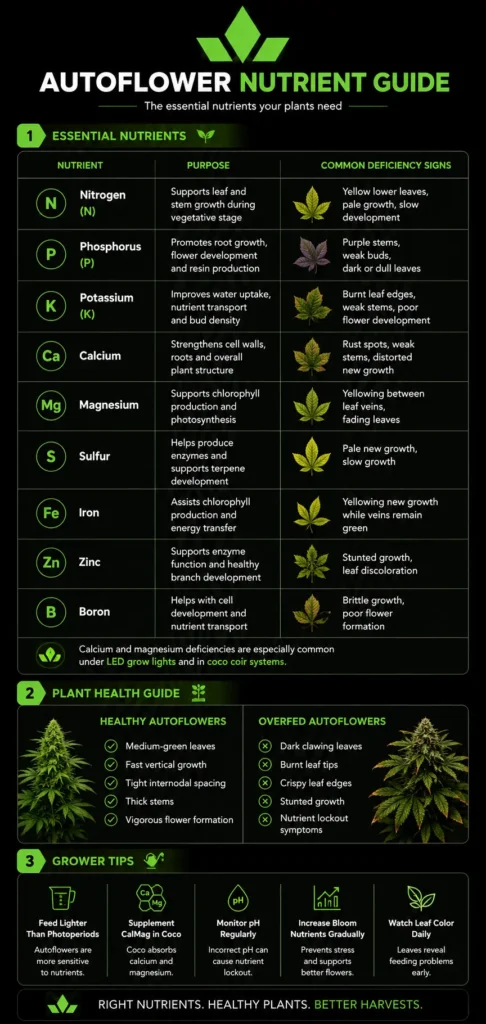
Macronutrients are nitrogen (N), phosphorus (P), and potassium (K), these are called NPK Ratios. These nutrients drive vegetative growth, root development, and flower production.
| Nutrient | Purpose | Common Signs |
| Nitrogen (N) | Supports leaf and stem growth during veg | Yellow lower leaves, slow growth |
| Phosphorus (P) | Helps root growth and flower development | Weak buds, purple stems |
| Potassium (K) | Improves water uptake and bud density | Burnt edges, weak flowers |
| Calcium | Strengthens roots and plant structure | Rust spots, weak stems |
| Magnesium | Supports chlorophyll and photosynthesis | Yellowing between veins |
| Sulfur | Supports enzymes and terpene production | Pale new growth |
| Iron | Assists energy transfer and chlorophyll production | Yellow new leaves |
| Zinc | Supports enzyme activity and branching | Stunted growth |
| Boron | Helps nutrient movement and cell growth | Brittle growth |
In my experience, calcium and magnesium deficiencies are especially common under LED grow lights and in coco coir systems.
| Healthy Autoflowers | Overfed Autoflowers |
| Medium-green leaves | Dark clawing leaves |
| Fast vertical growth | Burnt leaf tips |
| Tight node spacing | Crispy leaf edges |
| Thick stems | Stunted growth |
| Vigorous flower sites | Nutrient lockout symptoms |
When nutrient levels become excessive, the plant often responds with dark clawing leaves and burnt leaf tips.
The Difference Between Autoflower and Photoperiod Nutrient Requirements
Autoflowers need less nutrients because they remain smaller and transition into flowering much faster than photoperiod strains.
Compact indica-dominant autoflowers often require lighter feeding than larger sativa-leaning autos with extended flowering periods.
A photoperiod cannabis plant can recover from stress during a long vegetative stage. Autoflowers do not have this recovery window. Once growth slows during early development, final yield potential drops immediately.
This is why I always feed autos more conservatively.
For example, if a nutrient company recommends:
- EC 1.8 during flowering
- 100% feed strength
I usually begin autoflowers closer to:
- EC 1.1–1.3
- 50–70% strength
Many modern autoflower hybrids can tolerate heavier feeding later in flower, although most still perform better under moderate nutrient levels.
Essential Macronutrients for Autoflowers: Nitrogen, Phosphorus and Potassium
Nitrogen drives vegetative growth. During early growth, autoflowers need enough nitrogen to develop healthy leaves and stems.
Phosphorus supports:
- Root development
- Flower formation
- Resin production
Potassium improves:
- Water uptake
- Nutrient transport
- Flower density
- Stress resistance
During vegetative growth, I prefer nutrient ratios with higher nitrogen. Once flowering begins, I gradually reduce nitrogen and increase phosphorus and potassium.
A balanced feeding transition prevents:
- Stretching
- Nitrogen toxicity
- Weak flower development
Important Micronutrients and Why CalMag Matters for Autoflowers
Calcium and magnesium deficiencies are among the most common autoflower feeding problems.
Calcium strengthens plant tissue and root structure, while magnesium supports chlorophyll production and photosynthesis.
Common magnesium deficiency symptoms include:
- Yellowing between leaf veins
- Rust-coloured spots
- Weak lower growth
I almost always supplement CalMag when growing autoflowers in coco coir. Coco naturally binds calcium and magnesium, which makes deficiencies more likely if supplementation is ignored.
Under high-powered LED lighting, autoflowers also tend to consume more magnesium due to increased photosynthetic activity.
Do Autoflowers Need Less Nutrients Than Photoperiod Strains?
Yes, most autoflowers need less nutrients than photoperiod plants.
Beginner growers often achieve better results with stable, easy-to-grow autoflower strains that tolerate lighter feeding schedules and environmental fluctuations.
In my grow room, I usually keep autoflower feeding levels around:
- Seedlings: EC 0.4–0.6
- Vegetative stage: EC 0.8–1.2
- Flowering stage: EC 1.2–1.5
Photoperiod strains can often tolerate EC levels above 2.0 during aggressive flowering cycles, although many autoflowers become stressed at those strengths.
I have consistently found that lighter feeding produces healthier autos with better terpene profiles and less nutrient burn.
Choosing the Best Nutrients for Autoflowers
Choosing the best autoflower nutrients depends on your growing medium, environment, and cultivation style. Organic soil growers feed very differently from hydroponic growers.
The best nutrient line is not necessarily the most expensive one. Consistency and proper environmental control matter far more than fancy bottles.
Organic vs Synthetic Nutrients for Autoflowers
Organic nutrients release slowly through microbial activity in the soil. These nutrients commonly come from:
- Worm castings
- Compost
- Fish hydrolysate
- Bat guano
- Kelp meal
Organic autoflower grows often produce richer terpene profiles and smoother smoke.
Synthetic nutrients are immediately available to the roots. This allows:
- Faster uptake
- Faster growth
- Greater precision
- More aggressive feeding schedules
I personally prefer organic soil for terpene-rich homegrown cannabis, although synthetic nutrients perform extremely well in coco and hydroponic systems.
The Best Nutrient Types for Soil, Coco and Hydroponic Autoflowers
Each growing medium requires a different feeding approach.
Soil already contains nutrients, so seedlings usually need only water for the first 10–14 days.
Coco coir behaves more like hydroponics and requires frequent feeding from early growth onward. In coco, I feed small amounts daily once roots establish.
Hydroponic systems deliver the fastest growth rates but require careful monitoring of:
- pH
- EC
- Water temperature
- Oxygen levels
For beginners, I usually recommend soil because it gives you more room for error while reducing the chances of nutrient burn.
When to Use Grow Nutrients vs Bloom Nutrients
Grow nutrients support vegetative growth with higher nitrogen content.
Bloom nutrients contain:
- Reduced nitrogen
- Increased phosphorus
- Increased potassium
I typically transition bloom nutrients once I see:
- Early pistils
- Stretching
- Flower site formation
Instead of switching instantly, I gradually blend grow and bloom nutrients together over several feedings. This prevents unnecessary stress during transition.
Common Signs of Nutrient Deficiencies and Nutrient Burn in Autoflowers
Autoflowers communicate feeding problems very quickly through leaf appearance.
Deficiency symptoms commonly include:
- Pale leaves
- Yellow lower foliage
- Rust spots
- Weak stems
- Slowed growth
Nutrient burn usually appears as:
- Burnt leaf tips
- Dark glossy leaves
- Downward clawing
- Crispy edges
I always recommend adjusting nutrients gradually. Overcorrecting deficiencies often creates even bigger problems.
Autoflower Nutrient Schedule From Seed to Harvest
A successful autoflower nutrient schedule changes throughout each stage of growth. Feeding intensity should increase slowly as the root zone expands and flower production accelerates.
Seedling Stage Nutrient Schedule for Autoflowers
Seedlings require extremely light feeding.
During the first 10–14 days, I usually provide:
- pH-balanced water
- Root stimulant
- Light CalMag supplementation
Target feeding levels:
- EC 0.4–0.6
- pH 6.2 in soil
- pH 5.8 in coco
At this stage, overwatering is often more dangerous than underfeeding.
Healthy seedlings should remain compact with vibrant green cotyledons and rapid root expansion.
Vegetative Stage Feeding Schedule for Healthy Growth
Once vigorous leaf growth begins, autoflowers demand more nitrogen and calcium.
My average vegetative feeding range:
- EC 0.8–1.2
- Moderate nitrogen levels
- Regular CalMag supplementation
At this stage I focus heavily on root health because strong roots directly influence final flower size.
Healthy vegetative autoflowers should display:
- Thick branching
- Tight node spacing
- Fast daily growth
- Strong leaf turgor
If leaves become dark and glossy, nutrient levels are usually too high.
Pre-Flower and Flowering Stage Nutrient Requirements
Flowering is when nutrient demand peaks.
During early flower I gradually reduce nitrogen while increasing phosphorus and potassium to support:
- Flower stacking
- Resin production
- Bud density
Typical flowering targets in my grow room:
- EC 1.2–1.5
- pH 6.2–6.5 in soil
- pH 5.8–6.0 in coco
Many growers overuse bloom boosters during this phase. I prefer moderate PK supplementation because excessive phosphorus can create nutrient lockout and harsh smoke.
When and How to Flush Autoflowers Before Harvest
Flushing involves feeding plain pH-balanced water during the final 7–14 days before harvest.
The purpose is to reduce excess mineral buildup in the medium while encouraging the plant to consume stored nutrients.
I normally begin flushing once:
- Pistils darken
- Trichomes become cloudy
- Fan leaves naturally fade
A proper flush often improves:
- Flavour
- Burn quality
- Smoothness
Especially in heavily fed synthetic grows.
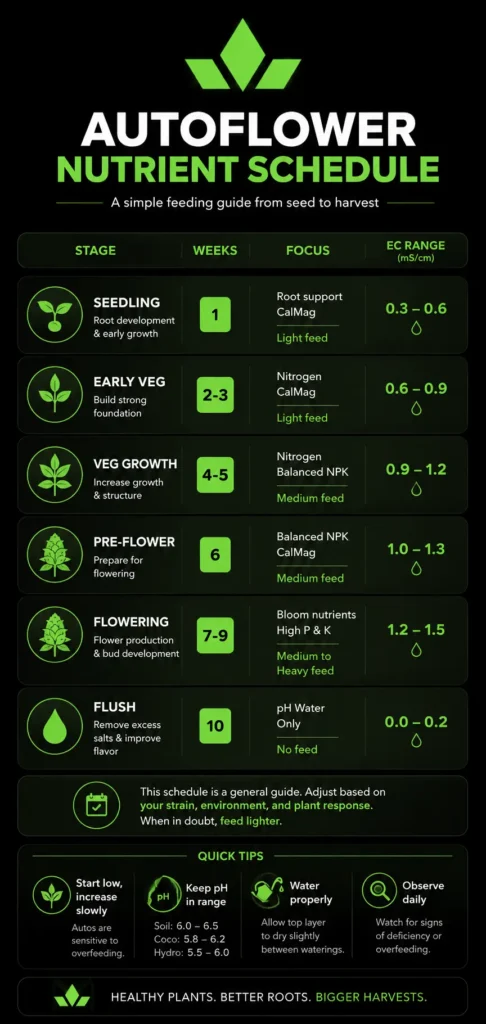
Autoflower Feeding Chart and Weekly Nutrient Recommendations
This is the basic feeding schedule I follow for most autoflower strains:
| Week | EC Range | Feeding Focus |
| 1 | 0.4–0.6 | Root support and seedling care |
| 2–3 | 0.6–0.8 | Early vegetative nutrients |
| 4–5 | 0.8–1.2 | Nitrogen and CalMag support |
| 6–8 | 1.2–1.5 | Bloom nutrients and PK support |
| 9–10 | 0.4–0.8 | Reduced feeding and flushing |
Some large autoflower cultivars tolerate heavier feeding, although I rarely exceed EC 1.5 unless the genetics clearly demand it.
Can You Grow Autoflowers Without Nutrients?
Yes, you can grow autoflowers without bottled nutrients when using nutrient-rich living soil or super soil systems.
This method relies on natural microbial activity to break down organic matter into plant-available nutrition.
Growing Autoflowers in Super Soil or Living Soil
Living soil contains pre-amended organic inputs such as:
- Worm castings
- Compost
- Kelp meal
- Bone meal
- Bat guano
Microbes and fungi convert these amendments into usable nutrients over time.
I enjoy living soil grows because they simplify feeding while producing highly aromatic cannabis flowers with exceptional terpene profiles.
When Autoflowers Can Survive Without Added Nutrients
Autoflowers can complete their lifecycle without bottled nutrients when:
- Soil quality is high
- Containers are large enough
- Water quality remains stable
- Genetics are not excessively nutrient hungry
Smaller autoflower cultivars often thrive in living soil with nothing but water from seed to harvest.
The Pros and Cons of Growing Autoflowers Without Nutrients
Pros:
- Lower maintenance
- Reduced overfeeding risk
- Improved flavor and aroma
- More natural growing process
Cons:
- Less feeding control
- Slower correction of deficiencies
- Potentially lower yields
- Reduced ability to push aggressive growth
For many beginners, living soil is actually easier because it removes much of the guesswork surrounding feeding schedules.
How Nutrient-Free Growing Impacts Yield, Potency and Plant Health
In my experience, living soil autoflowers often produce:
- Richer terpene expression
- Better aroma
- Smoother smoke
- Healthier microbial ecosystems
Synthetic feeding programs usually produce slightly larger yields, although the quality difference with living soil can be impressive.
Common Autoflower Nutrient Mistakes and Expert Growing Tips
Most autoflower feeding issues come from impatience. Cannabis responds better to consistency than aggressive correction.
Overfeeding and Why Autoflowers Are Sensitive to Nutrients
Autoflowers are genetically programmed for rapid flowering. Early stress immediately reduces growth potential.
Overfeeding commonly causes:
- Stunted plants
- Nutrient lockout
- Burnt foliage
- Reduced flower production
I always advise new growers to start at half-strength nutrients and increase gradually only if the plant responds positively.
The Ideal pH Range for Autoflower Nutrient Uptake
Correct pH allows roots to absorb nutrients efficiently.
Recommended ranges:
- Soil: 6.0–6.5
- Coco: 5.8–6.2
- Hydroponics: 5.5–6.0
Incorrect pH can mimic nutrient deficiencies even when nutrients are present.
I check runoff pH weekly because stable root-zone conditions dramatically improve plant health and nutrient uptake.
How to Avoid Nutrient Lockout in Autoflowers
Nutrient lockout usually develops from:
- Incorrect pH
- Excessive salts
- Overfeeding
- Poor watering practices
To prevent lockout:
- Monitor runoff EC
- Avoid excessive nutrient strength
- Maintain stable watering cycles
- Flush periodically if salt buildup develops
Healthy roots are the foundation of productive autoflower cultivation.
Expert Tips for Bigger Yields and Healthier Autoflower Plants
After years of breeding and growing autoflowers, these are the practices that consistently improve results:
- Feed lightly during early growth
- Prioritize root health
- Maintain stable temperatures and humidity
- Use quality genetics
- Avoid transplant stress
- Monitor plants daily
- Keep pH stable
Autoflowers reward consistency far more than aggressive feeding strategies.
Large High Yield autoflower genetics typically respond extremely well to optimised nutrient schedules and stable environmental conditions.
Final Thoughts on Choosing the Best Autoflower Nutrients
The best autoflower nutrients are the ones that match your cultivation style and allow stable, predictable growth.
There is no magic nutrient bottle that guarantees massive yields. Healthy environmental conditions, strong genetics, proper watering, and balanced feeding all work together to produce exceptional cannabis.
Once you learn how autoflowers respond to nutrients at each stage of growth, feeding becomes far more intuitive.
Conclusion
Autoflower cannabis strains thrive when nutrients are managed carefully and consistently. While these plants generally require lighter feeding than photoperiod strains, they still need balanced nutrition to produce dense flowers, heavy resin production, and healthy vigorous growth.
Whether you choose living soil, synthetic nutrients, coco coir, or hydroponics, the key is moderation. Overfeeding causes far more problems in autoflowers than underfeeding.
I have found that maintaining stable pH levels, moderate EC ranges, and healthy roots consistently produces the best results. Once you understand how your plants respond to feeding, you can fine-tune your autoflower nutrient schedule to maximise both yield and flower quality.
With patience, observation, and a balanced approach, autoflowers can become some of the most rewarding cannabis plants you will ever grow.
FAQ
Do autoflowers need less nutrients than photoperiod cannabis strains?
Yes, autoflowers typically require lighter feeding levels because they grow faster and remain smaller than most photoperiod plants. Many growers start autos at 25–50% nutrient strength and gradually increase feeding based on plant response.
What are the best nutrients for autoflowers?
The best autoflower nutrients provide balanced levels of nitrogen, phosphorus, potassium, calcium, and magnesium. The ideal nutrient line often depends on your growing medium, environmental conditions, and whether you prefer organic or synthetic feeding methods.
What is a good autoflower nutrient schedule?
A typical autoflower nutrient schedule starts with low-strength feeding during the seedling stage, increases nutrients gradually during vegetative growth and flowering, and finishes with reduced feeding or flushing before harvest. Feeding strength commonly ranges between EC 0.4–1.5 depending on plant stage and genetics.
Can you grow autoflowers without nutrients?
Yes, autoflowers can grow without bottled nutrients when planted in nutrient-rich living soil or super soil. In these setups, organic matter and microbial activity naturally provide nutrition throughout the grow cycle.
When should I start feeding autoflowers nutrients?
Most soil-grown autoflowers do not need nutrients during the first 10–14 days because quality soil already contains enough nutrition for seedlings. Coco coir and hydroponic grows usually require earlier feeding with low-strength nutrients.
What pH is best for autoflower nutrient uptake?
Most growers maintain:
- Soil pH between 6.0–6.5
- Coco pH between 5.8–6.2
- Hydroponic pH between 5.5–6.0
Stable pH levels help roots absorb nutrients efficiently and reduce the risk of nutrient lockout.
Why are my autoflower leaves turning yellow?
Yellowing leaves can result from several issues including nitrogen deficiency, incorrect pH, overwatering, nutrient lockout, or natural fading late in flowering. Checking pH, runoff EC, and feeding strength usually helps identify the cause.
Is CalMag necessary for autoflowers?
CalMag is commonly used for autoflowers grown in coco coir or under LED lighting because calcium and magnesium deficiencies occur more frequently in these conditions. Many growers supplement CalMag throughout vegetative growth and early flowering.
How often should I feed autoflowers?
Feeding frequency depends on the growing medium. Soil growers may feed every few waterings, while coco and hydroponic growers often feed daily at lower nutrient strengths. Plant size, environmental conditions, and genetics also influence feeding frequency.
Should I flush autoflowers before harvest?
Many growers flush autoflowers during the final 7–14 days before harvest by using plain pH-balanced water. This practice is commonly used to reduce excess nutrient buildup and improve flavor and burn quality, although results can vary depending on the growing method.


