
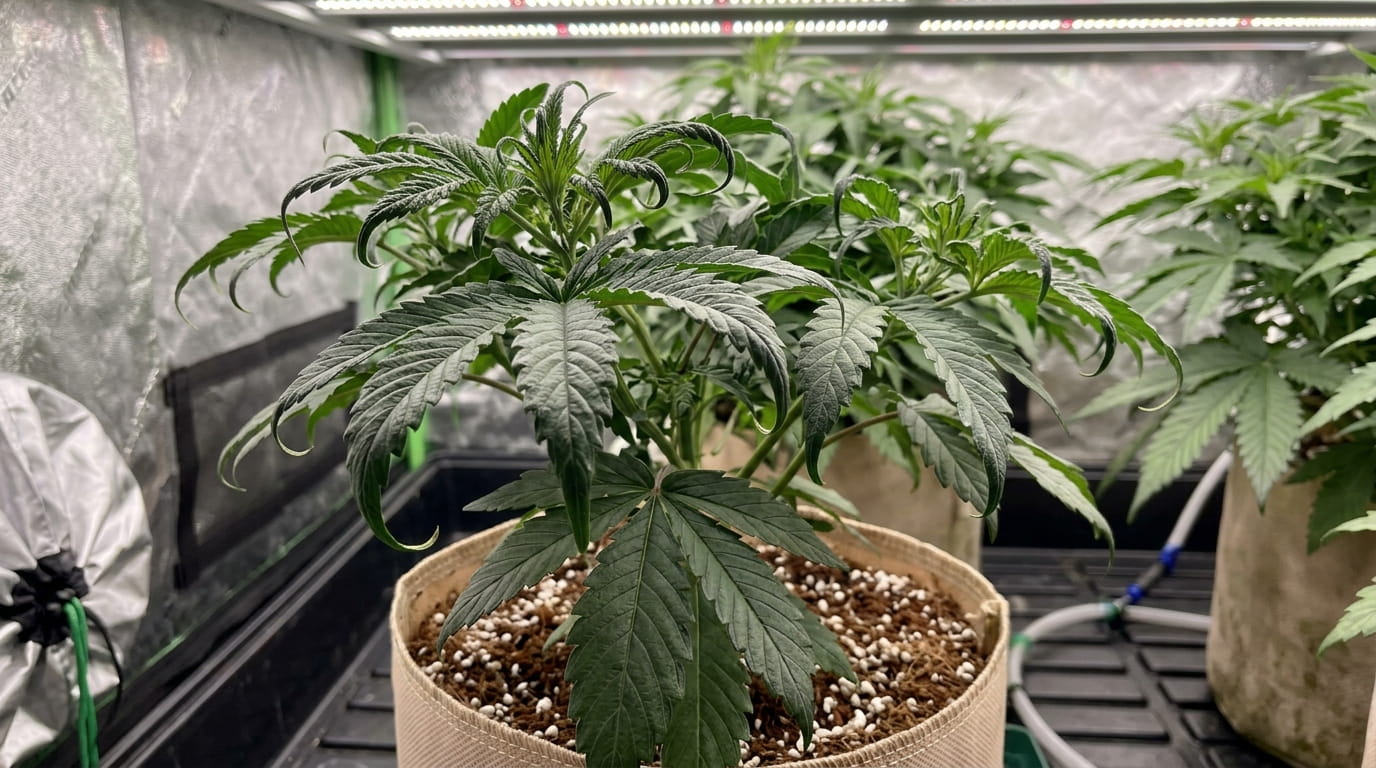
Cannabis Nutrient Toxicity: Symptoms, Chart & How to Fix Nutrient Burn in Cannabis Plants
Cannabis nutrient toxicity is one of the most common problems growers face, especially when feeding schedules become too aggressive or environmental conditions reduce nutrient uptake. Excess nutrients can build up around the roots, causing burnt leaf tips, dark green foliage, clawing leaves, and slowed growth that often gets mistaken for deficiencies or watering issues. In many cases, the problem starts small but worsens quickly if feeding continues unchanged. Understanding how nutrient toxicity develops, how to identify symptoms early, and how to correct nutrient imbalances can help you avoid long-term stress, nutrient lockout, and reduced yields. This guide breaks down the most common toxicity symptoms, causes, and recovery methods growers use to restore healthy cannabis growth.
Article Insights
- Burnt leaf tips, dark green foliage, and clawing leaves are some of the earliest signs of cannabis nutrient toxicity.
- Excess nitrogen is one of the most common causes of nutrient burn during vegetative growth.
- High EC or PPM levels in runoff often indicate salt buildup and overfeeding in the root zone.
- Incorrect pH levels can worsen toxicity symptoms by disrupting normal nutrient uptake.
- Flushing with pH-balanced water is commonly used to remove excess nutrients from soil, coco, and hydro systems.
- Autoflower cannabis strains are generally more sensitive to nutrient toxicity and often require lighter feeding schedules.
What Is Cannabis Nutrient Toxicity and What Causes It?
Cannabis nutrient toxicity is a condition where the plant absorbs excessive nutrients, usually because of overfeeding, salt buildup, or poor root zone management. The excess nutrients disrupt normal biological processes while also damaging root function.
What nutrient toxicity in cannabis means
Nutrient toxicity is essentially overfertilisation. Cannabis plants absorb more nutrients than they can metabolise, causing excess mineral accumulation within plant tissue.
The first symptoms are usually subtle but easy to identify once you know what to look for.
| Early Toxicity Symptoms | What They Mean |
| Burnt leaf tips | Excess nutrient concentration |
| Dark green leaves | Too much nitrogen |
| Leaf clawing | Nutrient overload stress |
| Slow growth | Root zone imbalance |
| Crispy leaf edges | Salt buildup damage |
Most growers encounter nutrient toxicity at least once. It is one of those lessons every cultivator learns eventually, usually after trying to push feeding schedules too aggressively.
Nutrient toxicity is commonly caused by overfeeding, unstable pH levels, and salt buildup around the root zone, especially in grows where nutrient schedules are pushed too aggressively. Many beginner growers choose hardy cannabis genetics and outdoor cannabis seeds because they are often easier to manage under changing environmental conditions and simpler feeding routines. If you are planning your next grow, explore our beginner-friendly cannabis seeds and outdoor strains selected for growers looking for reliable performance from seed to harvest.
The difference between cannabis nutrient toxicity and nutrient burn
Many growers think nutrient toxicity and nutrient burn are identical, but there is a slight difference between the two.
| Nutrient Toxicity | Nutrient Burn |
| Internal nutrient overload | Visible leaf damage |
| Root zone imbalance | Burnt leaf tips and edges |
| Caused by excessive feeding | Symptom of toxicity |
| Can affect plant metabolism | Usually appears on leaves first |
I always explain it this way: toxicity is the condition itself, while nutrient burn is the visible evidence of that condition.
How excess nutrients damage roots and nutrient uptake
Cannabis roots absorb nutrients through osmotic processes. When nutrient concentrations become too high, osmotic pressure increases around the root system. This makes water uptake more difficult.
As a result:
- roots become stressed
- nutrient transport slows
- oxygen availability decreases
- nutrient lockout develops
This also creates the strange situation where your plant may look dehydrated despite being in wet soil.
How salt buildup and incorrect pH levels contribute to toxicity
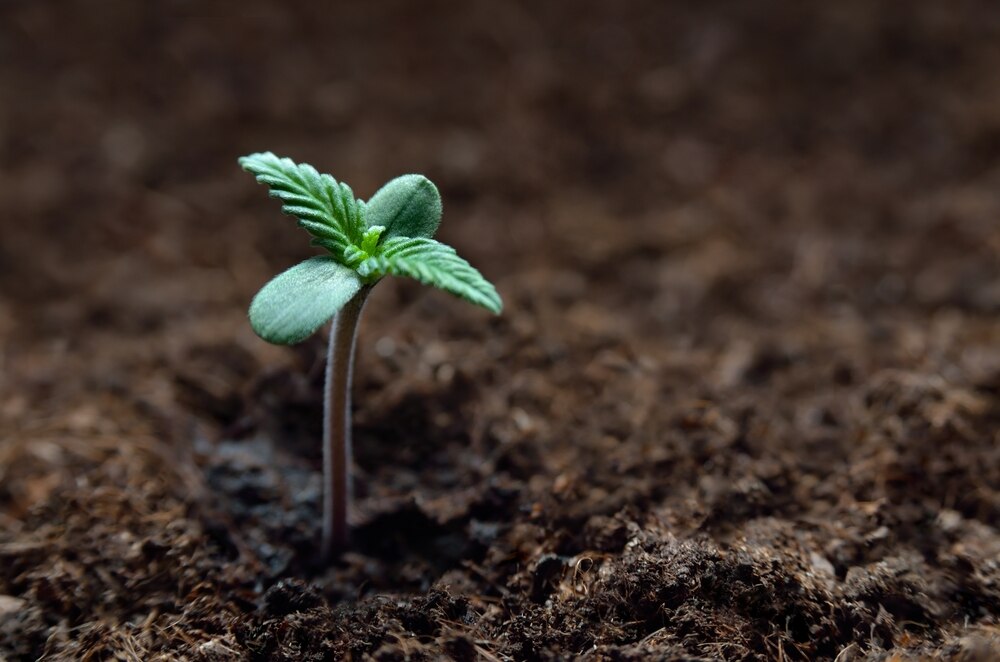
Salt buildup is one of the largest contributors to cannabis nutrient toxicity. Synthetic nutrients leave behind mineral salts after feeding, and those salts accumulate over time.
This is especially common in:
- coco coir grows
- heavily fertilised soil
- hydro systems with poor flushing
- grows with minimal runoff
Incorrect pH compounds the issue further.
| Growing Medium | Ideal Cannabis pH Range |
| Soil | 6.0 – 6.8 |
| Coco Coir | 5.8 – 6.2 |
| Hydroponics | 5.5 – 6.1 |
When pH drifts outside these ranges, certain nutrients become unavailable while others accumulate excessively.
Cannabis Nutrient Toxicity Chart and Common Symptoms
Learning how to diagnose nutrient toxicity visually is one of the most valuable cannabis cultivation skills you can develop.
Cannabis nutrient toxicity chart by nutrient type
Different nutrients create different symptom patterns.
Nitrogen toxicity commonly causes dark green leaves, thick foliage, and downward leaf clawing caused by excessive vegetative nutrients. If your plants are showing pale leaves instead, compare the symptoms with our nitrogen deficiency guide.
Phosphorus toxicity is often linked to burnt leaf edges, micronutrient lockout, and unusual discoloration that commonly develops after overusing bloom boosters. These symptoms can sometimes resemble phosphorus deficiency during flowering.
Potassium toxicity usually appears as yellow or burnt leaf margins alongside calcium and magnesium imbalance symptoms caused by excessive PK additives. If your leaves are fading instead of burning, it may be worth checking our potassium deficiency guide.
Calcium toxicity can cause distorted growth, brittle leaves, and tip burn, especially when Cal-Mag supplements are overused. Similar symptoms can also appear in calcium-deficient cannabis plants under unstable pH conditions.
Magnesium toxicity may lead to curling leaves, dark spotting, and nutrient imbalance issues caused by excessive supplementation. Growers often confuse this with magnesium deficiency because both conditions can affect leaf coloration and overall plant vigor.
Iron toxicity is less common in cannabis plants but can create bronze spotting and unusual discoloration when pH levels drift outside the ideal range. If your plant is yellowing instead, compare the symptoms with our iron deficiency guide or explore our full cannabis nutrient deficiencies hub for a more accurate diagnosis.
| Nutrient | Common Toxicity Symptoms | Common Cause |
| Nitrogen | Dark green leaves, clawing | Excess vegetative nutrients |
| Phosphorus | Burnt edges, micronutrient lockout | Too many bloom boosters |
| Potassium | Yellow leaf margins, calcium issues | Excess PK additives |
| Calcium | Distorted growth, tip burn | Overuse of Cal-Mag |
| Magnesium | Curling leaves, dark spots | Supplement overfeeding |
| Iron | Bronze spotting | Incorrect pH |
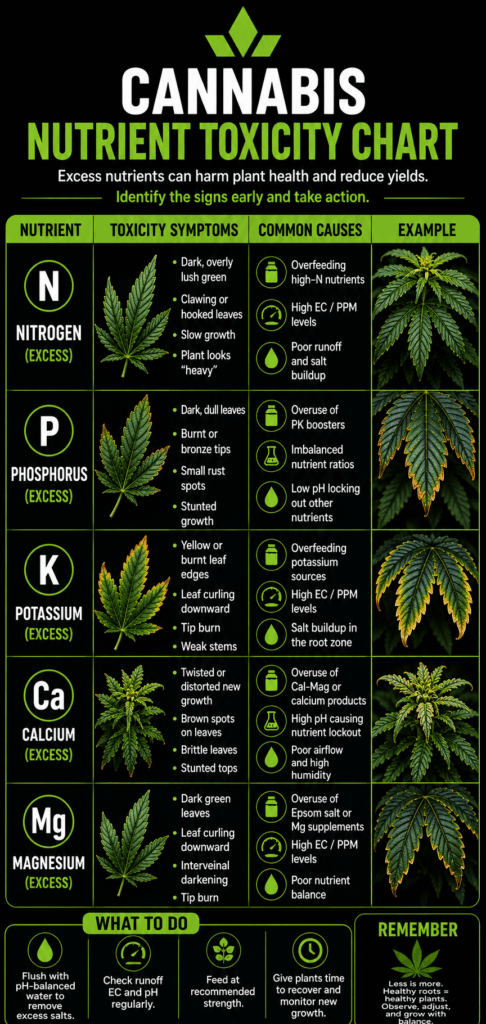
This chart gives you a reliable diagnostic foundation before making feeding adjustments.
Early signs of nutrient burn in cannabis leaves
Nutrient burn usually begins at the leaf tips.
The first warning signs include:
- slight yellowing at the tips
- crispy leaf edges
- unusually glossy foliage
- downward leaf curling
At this stage, your plant is warning you that nutrient levels are becoming excessive. Acting early prevents long-term damage.
How nutrient toxicity symptoms appear across cannabis leaves
Cannabis toxicity symptoms follow recognizable patterns across the leaves.
| Symptom Pattern | Likely Cause |
| Dark green clawing leaves | Nitrogen toxicity |
| Burnt margins | Potassium toxicity |
| Bronze spotting | Phosphorus toxicity |
| Twisted new growth | Calcium excess |
| Curling with dark patches | Magnesium toxicity |
I always look at the entire plant rather than focusing on a single damaged leaf. Toxicity tends to appear evenly across multiple leaves, while deficiencies often appear in isolated areas first.
How toxicity symptoms change during vegetative and flowering stages
Cannabis plants respond differently to nutrient toxicity depending on growth stage.
| Growth Stage | Typical Toxicity Symptoms |
| Seedling | Burnt tips, stalled growth |
| Vegetative | Dark leaves, clawing |
| Flowering | Burnt sugar leaves, poor bud formation |
Flowering-stage toxicity is usually more damaging because the plant has less time to recover before harvest.
Cannabis nutrient toxicity vs nutrient deficiency symptoms
Many beginner growers confuse nutrient toxicity with deficiencies because both can create discoloration and weak growth.
| Toxicity Symptoms | Deficiency Symptoms |
| Dark foliage | Pale foliage |
| Burnt tips | Uniform yellowing |
| Clawing leaves | Thin weak growth |
| Crispy edges | Fading coloration |
One of the biggest cultivation mistakes is adding more nutrients to a plant that is already suffering from toxicity.
Nitrogen, Phosphorus, Potassium, and Micronutrient Toxicity in Cannabis
Each nutrient affects cannabis differently when supplied in excess.
Nitrogen toxicity cannabis symptoms and causes
Nitrogen toxicity is the most common nutrient toxicity issue in cannabis cultivation.
| Nitrogen Toxicity Symptoms | Description |
| Very dark leaves | Excess chlorophyll production |
| Clawing tips | Nitrogen overload |
| Thick waxy leaves | Excessive vegetative growth |
| Slow vertical growth | Metabolic stress |
This problem usually develops during vegetative growth when growers push nutrient levels too aggressively.
I rarely feed cannabis at full manufacturer strength because many nutrient schedules are excessive.
Phosphorus toxicity and nutrient lockout cannabis issues
Phosphorus toxicity often appears during flowering after excessive bloom booster use.
Excess phosphorus interferes with:
- calcium uptake
- zinc absorption
- iron availability
| Phosphorus Toxicity Symptoms | Common Effects |
| Bronze spotting | Micronutrient imbalance |
| Burnt edges | Salt accumulation |
| Weak flower formation | Reduced nutrient uptake |
Bloom boosters are useful, but too much phosphorus creates more problems than benefits.
Potassium toxicity and calcium magnesium imbalances
Potassium plays a major role in flower production, but excessive potassium creates nutrient competition around the root zone.
| Excess Potassium Effects | Result |
| Calcium lockout | Rust spots |
| Magnesium lockout | Leaf curling |
| Weak stems | Structural instability |
Many growers mistakenly add more Cal-Mag supplements without realising excessive potassium is the actual issue.
Calcium, magnesium, and micronutrient toxicity symptoms
Secondary nutrients and trace minerals can also become toxic when overused repeatedly.
| Nutrient | Toxicity Symptoms |
| Calcium | Distorted growth |
| Magnesium | Curling and dark leaves |
| Iron | Bronze discoloration |
| Copper | Twisted leaves |
This usually happens when growers stack too many supplements together.
How bloom boosters and supplements create nutrient toxicity
One of the biggest modern cannabis growing mistakes is overcomplicating feeding schedules.
Growers often combine:
- base nutrients
- bloom boosters
- terpene enhancers
- root stimulants
- Cal-Mag supplements
All of these products contain nutrients. When combined together, EC levels can rise dangerously high.
I always recommend keeping feeding programs simple, especially for beginner growers.
How to Fix Cannabis Nutrient Toxicity
Once nutrient toxicity develops, your goal is to remove excess salts while restoring balance inside the root zone.
Nutrient toxicity is often easier to prevent when growers maintain balanced feeding schedules and avoid pushing plants too aggressively during veg and flower. Stable cannabis genetics can also make nutrient management more forgiving, especially for newer growers still learning how different strains respond to feeding levels and environmental conditions. If you are planning your next grow, explore our collection of beginner-friendly cannabis seeds and outdoor strains selected for reliable growth and easier overall cultivation.
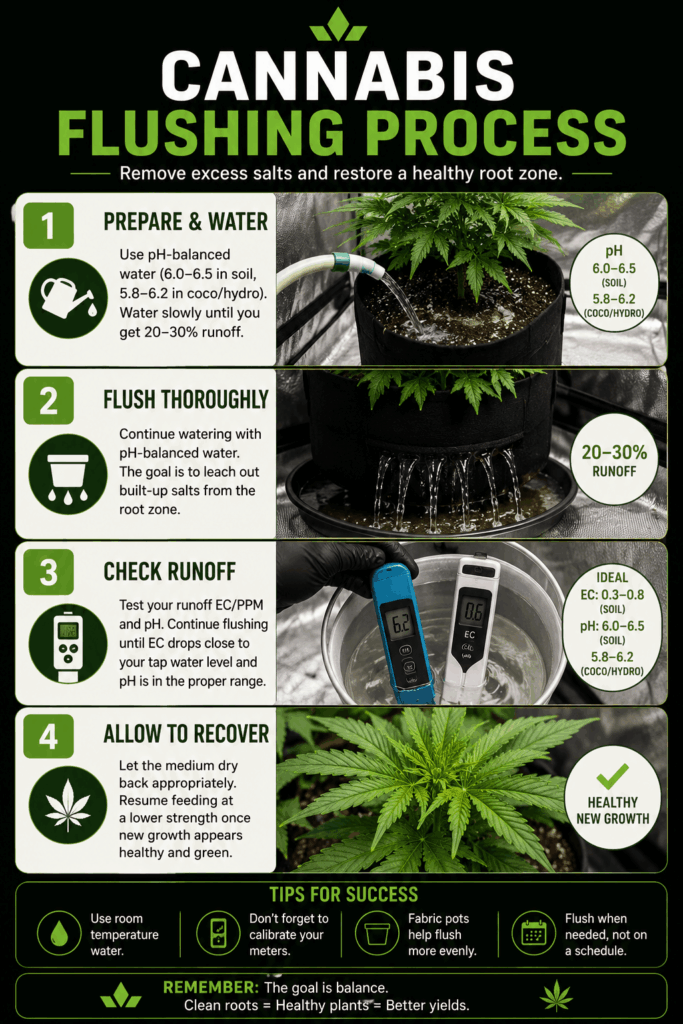
How to flush cannabis plants properly step by step
Flushing is the fastest way to remove accumulated salts from the growing medium.
| Flushing Step | Purpose |
| Use pH-balanced water | Prevent additional stress |
| Saturate medium slowly | Dissolve salt buildup |
| Allow heavy runoff | Remove excess nutrients |
| Measure runoff EC | Monitor salt removal |
In soil, I usually flush with several times the pot volume in water. Coco coir typically flushes faster because drainage is more efficient.
Correct cannabis pH levels for nutrient recovery
After flushing, stabilising pH becomes extremely important.
| Medium | Recovery pH Range |
| Soil | 6.2 – 6.5 |
| Coco | 5.8 – 6.0 |
| Hydro | 5.5 – 5.9 |
Correct pH allows nutrients to become available evenly again while reducing lockout problems.
Using EC and PPM readings to diagnose overfeeding
EC and PPM meters are some of the best cannabis diagnostic tools available.
| Reading Type | What It Measures |
| EC | Electrical conductivity |
| PPM | Dissolved nutrient concentration |
| Runoff EC | Salt buildup in medium |
High runoff EC readings usually indicate overfeeding or poor flushing practices.
How to safely reintroduce nutrients after flushing
After flushing, avoid returning immediately to full nutrient strength.
I usually:
- restart feeding at 25–50%
- monitor new growth carefully
- increase nutrients gradually
This allows the root system to stabilise before nutrient demand increases again.
Signs your cannabis plant is recovering from nutrient toxicity
Healthy recovery signs include:
- upright leaf posture
- lighter green new growth
- improved vigor
- stronger flower formation
Damaged leaves may never fully recover, but healthy new growth indicates the problem has been corrected.
How to Prevent Nutrient Toxicity in Future Grows
Prevention is always easier than recovery. Most nutrient toxicity issues come from aggressive feeding habits and poor root zone management.
Feeding schedule mistakes that lead to nutrient burn
Many commercial nutrient schedules encourage overfeeding.
| Common Feeding Mistake | Result |
| Feeding every watering | Salt buildup |
| Excess bloom boosters | Phosphorus toxicity |
| Too much Cal-Mag | Calcium lockout |
| Ignoring runoff EC | Hidden toxicity |
Your cannabis plants tell you more than the nutrient bottles do.
Why autoflowers are more sensitive to nutrient toxicity
Autoflowers usually have:
- smaller root systems
- shorter lifecycles
- lower nutrient demands
Because of this, they react faster to excessive nutrients.
| Autoflower Toxicity Effects | Impact |
| Stunted growth | Smaller plants |
| Slower flowering | Reduced yields |
| Burnt leaves | Lower vigor |
I always feed autoflowers conservatively compared to photoperiod strains.
Environmental factors that increase toxicity risk
Environmental stress directly affects nutrient uptake efficiency.
| Environmental Issue | Toxicity Risk |
| Weak lighting | Reduced nutrient demand |
| Overwatering | Root oxygen loss |
| Poor airflow | Increased plant stress |
| High root temperatures | Faster nutrient uptake imbalance |
Even perfect feeding schedules fail under poor environmental conditions.
Best practices for balanced cannabis nutrient management
Healthy cannabis cultivation is about consistency and observation.
My general approach is simple:
- monitor runoff regularly
- increase nutrients gradually
- maintain stable pH
- avoid unnecessary additives
- prioritize root health
Cannabis rewards balanced cultivation practices. Once you stop chasing aggressive feeding schedules and start reading your plants properly, nutrient toxicity becomes much easier to avoid.
Conclusion
Cannabis nutrient toxicity is one of the most common cultivation issues growers face, but it is also one of the easiest to prevent once you understand the underlying causes. Most toxicity problems begin with overfeeding, salt buildup, or unstable pH levels. As nutrient concentrations rise inside the root zone, water uptake slows, nutrient lockout develops, and visible leaf damage begins appearing across the plant.
The good news is that cannabis is resilient. If you catch toxicity early, flush the growing medium properly, stabilise pH levels, and return to balanced feeding practices, your plants can recover surprisingly well.
I always remind growers that successful cannabis cultivation is not about forcing growth with heavy nutrients. Great cannabis comes from healthy roots, balanced feeding, stable environmental conditions, and careful observation. Once you learn how your plants communicate through their leaves, growth patterns, and overall vigor, you become a far more effective grower.
Healthy cannabis plants start with stable genetics, balanced environmental conditions, and feeding routines that match the needs of each strain throughout the grow cycle. Many growers choose autoflower cannabis seeds because they are fast-growing, beginner friendly, and well suited to both indoor and outdoor cultivation setups. If you are planning your next grow, explore our range of autoflower cannabis seeds selected for reliable performance, quicker harvest times, and easier overall cultivation.
FAQ
What does nutrient toxicity look like in cannabis plants?
Cannabis nutrient toxicity usually starts with burnt or yellow leaf tips before progressing into dark green foliage, clawing leaves, crispy edges, and slowed growth. In more severe cases, leaves may curl downward while also developing rust spots or discoloration caused by nutrient lockout.
What causes nutrient toxicity in cannabis?
The most common cause of nutrient toxicity is overfeeding. Excess nutrients build up around the root zone and create salt accumulation that disrupts water and nutrient uptake. Incorrect pH levels, poor drainage, overwatering, and excessive supplement use can also contribute to toxicity issues.
Can cannabis plants recover from nutrient toxicity?
Yes, cannabis plants can often recover from nutrient toxicity if the problem is identified early. Most growers correct toxicity by flushing the growing medium with pH-balanced water, reducing nutrient strength, and restoring stable root zone conditions. Severely damaged leaves may not recover, but healthy new growth is usually a positive sign.
How long does it take cannabis to recover after flushing?
Recovery time depends on how severe the toxicity is and what stage the plant is in. Mild nutrient burn may improve within several days, while more severe toxicity can take one to two weeks before healthy new growth appears. Autoflowers often recover more slowly because of their shorter lifecycle.
What is the difference between nutrient toxicity and nutrient deficiency?
Nutrient toxicity is caused by excess nutrients, while nutrient deficiency is caused by a lack of nutrients or poor nutrient availability. Toxicity commonly creates dark green leaves, burnt tips, and clawing, whereas deficiencies usually cause pale leaves, yellowing, and weak growth.
Does pH affect nutrient toxicity in cannabis?
Yes, incorrect pH levels can make nutrient toxicity worse. When pH moves outside the ideal range, some nutrients become unavailable while others accumulate excessively around the roots. This imbalance often causes nutrient lockout alongside toxicity symptoms.
What EC level causes nutrient burn in cannabis?
There is no single EC level that causes nutrient burn because tolerance varies between strains, growth stages, and growing mediums. However, consistently high runoff EC readings often indicate salt buildup and overfeeding. Many growers monitor runoff EC to catch toxicity problems before symptoms become severe.
Are autoflowers more sensitive to nutrient toxicity?
Autoflower cannabis strains are generally more sensitive to nutrient toxicity than photoperiod strains. Their smaller root systems and shorter growth cycle make them less tolerant of aggressive feeding schedules, especially during early vegetative growth.
Can overwatering cause nutrient toxicity symptoms?
Overwatering can contribute to nutrient toxicity symptoms because saturated roots struggle to absorb oxygen properly. This slows nutrient uptake and increases root zone stress, which can worsen salt buildup and nutrient imbalance problems.
How do you prevent nutrient toxicity in cannabis grows?
The best way to prevent nutrient toxicity is to feed conservatively, monitor runoff EC and pH levels regularly, avoid unnecessary supplements, and increase nutrient strength gradually. Maintaining stable environmental conditions and healthy root zones also helps cannabis plants process nutrients more efficiently.