
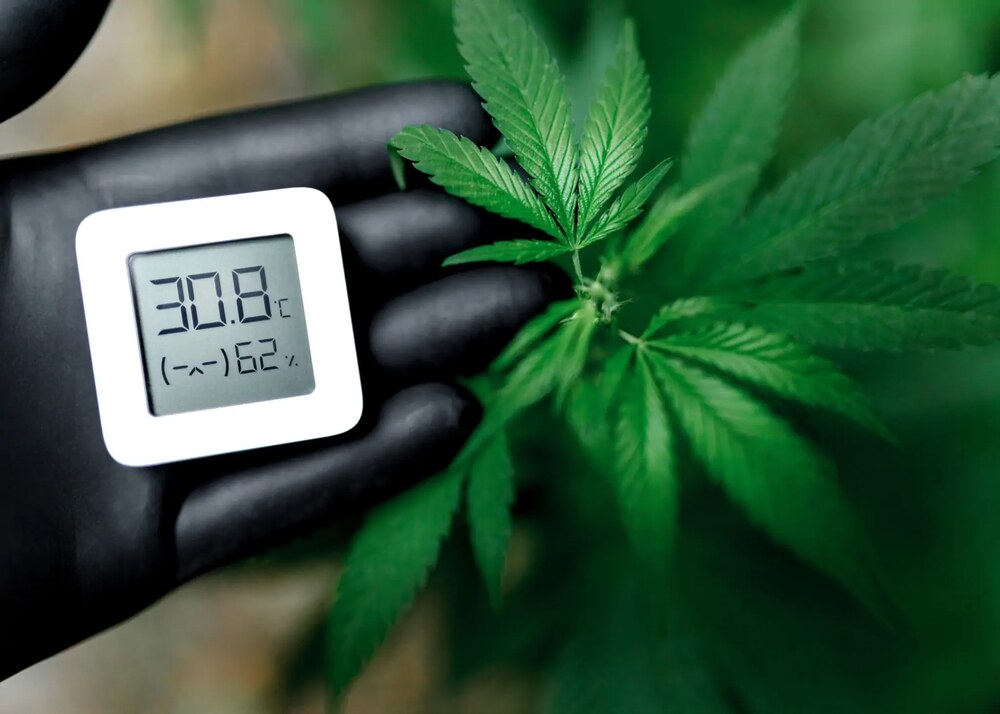
What is VPD, and how does it affect autoflowers?
VPD. Three letters that can make or break your grow, especially if you’re working with autoflowers – which so many of us are these days.
While most new growers obsess over temperature and humidity somewhat separately, Vapour Pressure Deficit gives you a much fuller picture. It tells you how thirsty your air is, how quickly your plants are drying out, and how well they’re able to move water and nutrients from root to leaf.
Is it 100% necessary for all new growers to be measuring and factoring in VPD to their first few autoflower weed grows?
No, but if you’re serious about getting the best results, huge yields, banging flower with the very best trichome coverage, stick around.
What is VPD, and why does it matter in cannabis cultivation?
If you’ve ever set your grow room’s temperature and humidity exactly where the guides say you should, only to watch your plants look a bit sad, and sorry for themselves, VPD is the likely culprit.
Okay, but what is VPD exactly?
Vapour Pressure Deficit is a way of describing how much more moisture the air is able to hold. It measures the gap between what’s already there and the maximum it could possibly carry before becoming fully saturated.
That might sound slightly unnecessary for growing a few weed plants, but it’s just not.
VPD determines how fast moisture is pulled from the leaves. If the air is dry, they lose water rapidly. If it’s humid, they hold on to it. In either extreme, the plant’s ability to move water (and, in turn, nutrients) around the whole plant structure breaks down.
VPD matters because it connects the dots between temperature and humidity. It explains why 60 percent relative humidity can be perfect in one grow and harmful in another.
And for autoflowers, where you don’t have the luxury of extra veg time to bounce back, getting VPD right from day one gives your plants the conditions they need to thrive.
Understanding Vapour Pressure Deficit (VPD)
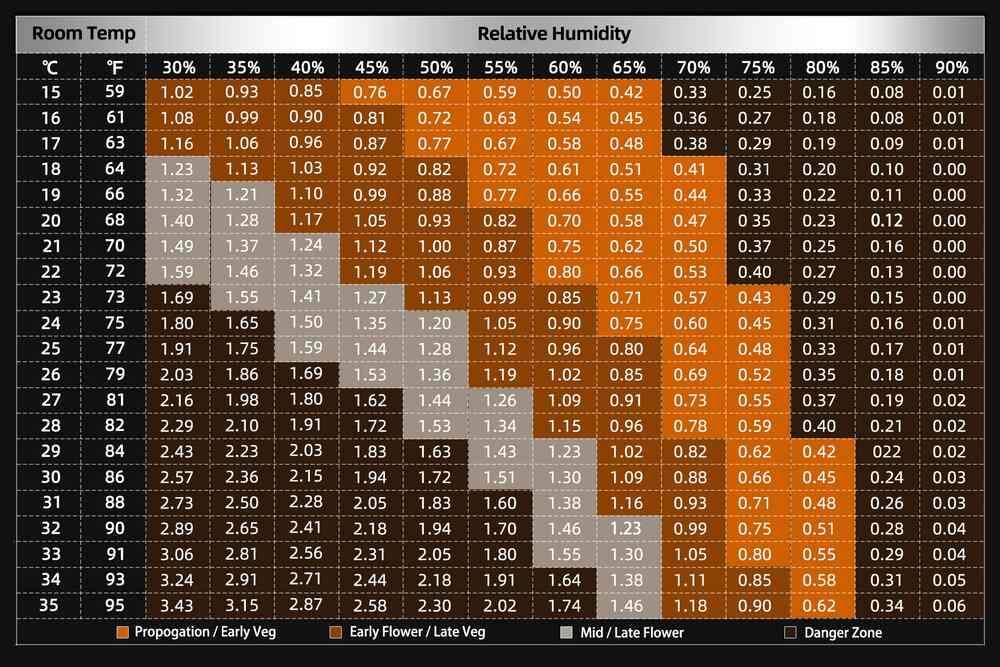
VPD is measured in kilopascals (kPa). It’s not a guess or a gut feeling. It’s a calculated number based on temperature and relative humidity, showing how much moisture the air can still take in.
- A low VPD means the air is getting close to saturation. Your plants won’t transpire as much, and that slows down root nutrient uptake and internal nutrient movement.
- A high VPD means dry air that pulls moisture out quickly. That can lead to dehydration, curling leaves, and stalled growth.
Plants, especially autoflowering marijuana plants, are real Goldilocks. Not too much, not too little. VPD is the tool that helps you find that balance.
How VPD differs from relative humidity
Relative humidity is just a snapshot. It tells you how full the air is, as a percentage, but it ignores temperature. And temperature changes everything.
60% humidity in a 68°F room is very different from 60% humidity at 82°F. In one, your plants may be thriving. In the other, they’ll be very, very thirsty. That’s where VPD comes in.
It tells the whole story, not just the surface reading.
Why is VPD more accurate than RH for grow room control?
When it comes to controlling your environment, VPD is simply more useful than RH alone. Relative humidity tells you how ‘moist’ the air feels. VPD tells you whether your plant is actually losing water too quickly, or not fast enough.
It’s a small shift in thinking, but one that most growers come to far too late, and one that is really quite powerful. Once you start measuring and adjusting with VPD in mind, your entire grow becomes more stable, more responsive, and (this is a big one, especially for the newbies among us) far easier to troubleshoot.
How VPD affects autoflowering cannabis plants
Autoflowers don’t waste time. From the moment they break soil, they’re sprinting pretty bloody rapidly toward the finish line. There are no pauses, no second chances, no recovery windows. That speed is one of the factors that makes autos so appealing, but it also means conditions need to be right from the beginning.
VPD shapes how a plant breathes, drinks, and feeds. When it’s off, even briefly, autoflowers feel it. Growth will slow, thanks to a stutter in the flow of nutrients throughout the plant,which means buds don’t fill out the way they should or could.
Photoperiods can bounce back. Autos can’t. What happens in week two echoes through to harvest time. We all know how much a stable childhood can shape the course of a life. Well, in this situation, the autoflowers are your kiddies, and VPD is the home environment you’re raising them in.
Ideal VPD ranges for autoflowers during each growth stage
Autoflowers develop fast. Their needs change quickly, and your environment needs to adapt with them. VPD isn’t about chasing perfection every minut of the day, but providing the right conditions most of the time.
Each autoflower cannabis growth stage has a range that supports steady development without introducing stress.
Seedling and early vegetative phase
Target VPD: 0.4 to 0.8 kPa
In the first two weeks, seedlings are delicate little ladies. The right balance between warmth and moisture is really important.
Their roots are undeveloped, so most of their hydration comes through the leaves. You want high humidity (starting around 70%, then dropping to 65% in the second week) and moderate temperatures (78 to 82°F) to keep transpiration gentle and steady. If the air is too dry, they’ll wilt. If it’s too wet, they’ll stagnate. A low, steady VPD helps them establish without stress.
Once the third node is up and about, you can slowly start lowering the humidity to around 55% (and keep it around there for the next few weeks), which should bring your VPD into a healthier range for early to mid veg.
Late veg and pre-flower transition
Target VPD: 0.8 to 1.1 kPa
The roots should have now filled the pot out, the leaves are proper solar panels, and everything speeds up.
Drop humidity slightly to 50%, and let temperatures stay between 76 to 84°F. A moderate VPD here helps drive water and nutrients upward without overwhelming the plant. If you overshoot it, the leaves may curl or thin out. If you undershoot, things slow down.
This is the window to support strong branching and healthy pre-flower structure.
Flowering and late-stage VPD needs
Target VPD: 1.1 to 1.5 kPa
Now the plant shifts focus to buds. The structure is built, and it’s all about flower density and oil production.
It’s time to lower the RH again, this time to around 40 to 50%, and temperatures can also come down to the 72 to 80°F range. This helps reduce the risk of mould while encouraging resin output.
Late in flower, some growers edge toward the higher end of the range to tighten structure. Just be careful not to dry things out too far. If VPD climbs too high, trichomes can degrade early (meaning more of your THC will turn into CBN) and buds may lose weight or flavour.
How to measure and adjust VPD in your grow space
VPD isn’t something you guess, it’s something you calculate. Ggetting that number is pretty straightforward once you’ve got the right tools and a basic grasp of how temperature and humidity interact.
Tools for monitoring temperature and humidity
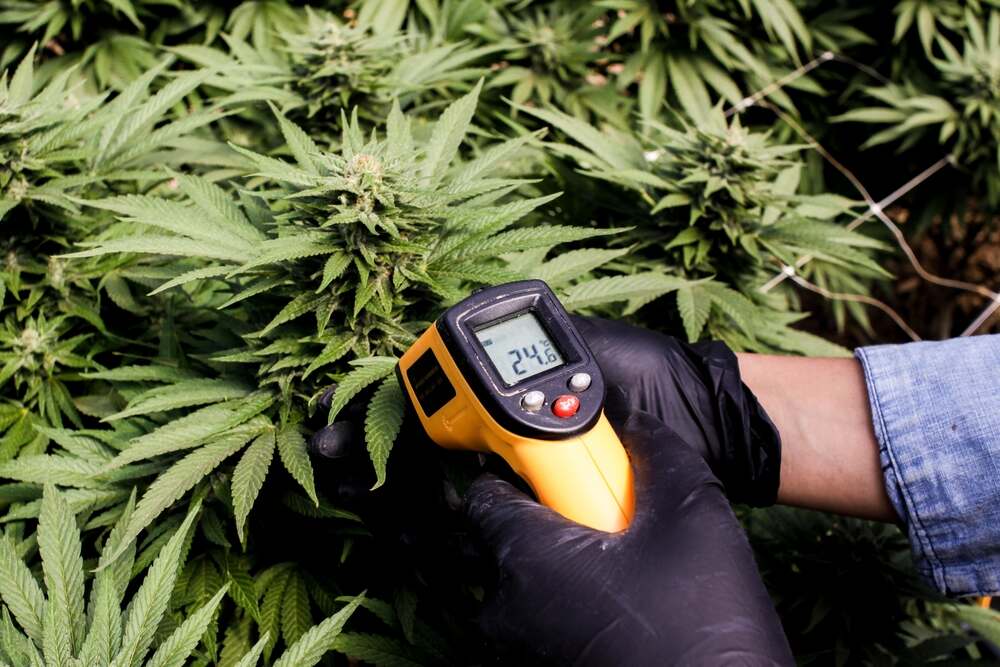
Start with a digital thermometre-hygrometre – every grower should already have one of these (if not, grab one right now). You want one that updates in real time and reads both temperature and relative humidity with decent accuracy. These days, you don’t have to spend much.
For best results, place your sensor at canopy height. Not on the floor. Not taped to the side of the tent. VPD affects the leaves directly, so the data needs to reflect what the plant is experiencing.
If you can afford it, get a unit with data logging or wireless alerts. That helps you catch swings before they cause problems – not 100% necessary at all, but if you’re here, you’re probably a bit of a weed geek, so why not.
Using VPD charts or calculators
There’s no need to calculate VPD manually. Use one of the many online VPD calculators or grow apps. You just plug in your temperature and RH, and you get your VPD reading in kilopascals.
Printable VPD charts are also useful. They usually show ideal zones for seedlings, veg, and flower, colour-coded for clarity. Pinning one near your grow tent (along with other fun weed growing info) is how I have always done it. It’s a good way to track your targets at a glance.
Adjusting temp and RH to hit the VPD sweet spot
Once you’ve got your number, the next step is adjusting your environment. It’s all simple stuff.
If your VPD is too high, just lower the temperature or increase the humidity. If it’s too low, raise the temperature or drop the humidity.
You might need to employ the help of a humidifier, dehumidifier, better intake and exhaust fan, or even tweak light intensity if it’s affecting ambient warmth. A portable AC is one thing that almost all growers should have handy, unless you are constantly needing to work to keep your grow space warm.
Change things slowly. Sudden swings can stress the plant, especially in flower when it’s less flexible.
Sudden shifts can startle a plant more than you’d think, especially during flowering when it is already working flat out. Steady is always better than perfect. A stable environment keeps everything ticking along: water uptake, nutrient flow, bud development, and the general business of growing without interruption.
If you need to tweak temperature or humidity, do it gradually over the course of a day. Twelve to twenty-four hours is plenty. Plants do not require super precision. They need consistency. Nudge things gently and give the plant time to adjust. It knows what to do as long as you are not swinging the room from sauna to arctic every few hours.


