
How to identify and fix nitrogen deficiency in cannabis
Cannabis nitrogen deficiency is one of the most common nutrient problems growers’ encounters, especially during the vegetative stage when plants require high levels of nitrogen for leaf, stem, and canopy development. Yellow lower leaves, pale foliage, and slowed growth are often the first signs that your plants are struggling to absorb or access enough nitrogen. In many cases, the issue is linked to pH imbalance, nutrient lockout, or feeding inconsistencies rather than a complete lack of nutrients in the root zone. Understanding how nitrogen functions in cannabis plants helps you identify symptoms early, correct deficiencies properly, and prevent long-term damage to plant growth and yields.
Article Insights
- Consistent monitoring of pH, runoff EC, watering habits, and plant colour helps prevent most cannabis nutrient deficiencies.
- Cannabis plants typically require the highest nitrogen levels during vegetative growth when leaf and stem production is most active.
- Lower leaves turning yellow is one of the earliest and most observed symptoms of cannabis nitrogen deficiency.
- Incorrect pH levels can cause nutrient lockout, preventing cannabis plants from absorbing nitrogen even when nutrients are present.
- Mild nitrogen deficiencies often begin improving within 3–7 days after correcting pH and feeding conditions.
- Excess nitrogen during flowering may reduce bud development and increase leafy growth.
What Is Cannabis Nitrogen Deficiency and Why Is Nitrogen Important?
Nitrogen is one of the three primary macronutrients cannabis plants require throughout their lifecycle, alongside phosphorus and potassium. You will often see these nutrients listed as NPK ratios on cannabis fertilizers and nutrient bottles.
During the vegetative phase, cannabis plants demand high levels of nitrogen because the nutrient directly supports rapid growth, chlorophyll production, enzyme function, and photosynthesis. Without enough nitrogen available in the root zone, your plants struggle to create energy efficiently, while also slowing cellular growth and leaf development.
Nitrogen deficiency weed symptoms usually appear gradually rather than overnight. This also makes the issue easier to control if you are paying close attention to your crop every day.
Why nitrogen is an essential mobile nutrient for cannabis plants.
Nitrogen is classified as a mobile nutrient. This means the plant can move nitrogen from older growth into newer growth whenever supplies become limited.
When nitrogen levels drop, the plant prioritizes survival. Instead of feeding older fan leaves, your cannabis redirects remaining nitrogen reserves into fresh shoots and upper foliage. While this keeps the plant alive temporarily, it also causes older leaves to fade, yellow, and eventually die.
This process is why lower leaves turning yellow cannabis symptoms are usually the earliest indication of nitrogen deficiency. The deficiency begins at the base of the plant before gradually climbing upward.
As a breeder and grower, I always tell beginners to watch their lower fan leaves closely during veg. Those leaves often tell you what is happening in the root zone long before the upper canopy starts showing problems.
Nitrogen also supports:
- Chlorophyll production
- Amino acid development
- Protein synthesis
- Stem and branch formation
- Leaf expansion
- Vigorous vegetative growth
Without sufficient nitrogen, your plants simply cannot maintain healthy metabolic activity.
The role nitrogen plays in photosynthesis and plant growth.
Photosynthesis is the engine that powers cannabis growth. Your plants convert light energy into usable sugars, while also fuelling everything from root expansion to bud development.
Nitrogen plays a direct role in this process because chlorophyll molecules contain large amounts of nitrogen. When nitrogen becomes unavailable, chlorophyll production slows down rapidly. This is why cannabis leaves turning yellow is such a common symptom.
A healthy cannabis plant should display rich green foliage during vegetative growth. Pale green leaves, faded fan leaves, and yellowing lower growth usually indicate chlorophyll production is declining.
This also affects overall plant vigour. You may notice:
- Slower vertical growth
- Reduced side branching
- Thin stems
- Smaller fan leaves
- Weak node spacing
- Reduced leaf density
Plants suffering from mobile nutrient deficiency often appear tired and sluggish compared to healthy vigorous plants.
Healthy nitrogen levels are especially important during:
- Early vegetative growth
- Explosive canopy development
- Root establishment
- Pre-flowering stretch
Once flowering begins, nitrogen demand gradually decreases, although the plant still requires moderate amounts to remain healthy.
Cannabis Nitrogen Deficiency Symptoms
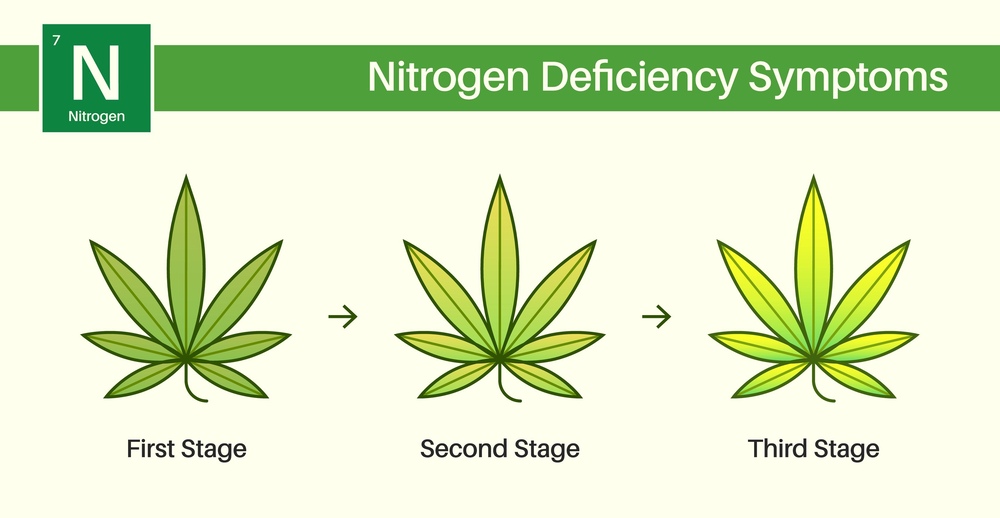
Nitrogen deficiency symptoms in cannabis are usually very easy to identify once you understand how the nutrient behaves inside the plant.
Unlike calcium or iron deficiencies that often affect new growth first, cannabis nitrogen deficiency targets older fan leaves because nitrogen is mobile within the plant tissue.
Symptoms often develop slowly over several days rather than appearing suddenly.
Lower leaves turning yellow cannabis symptoms explained.
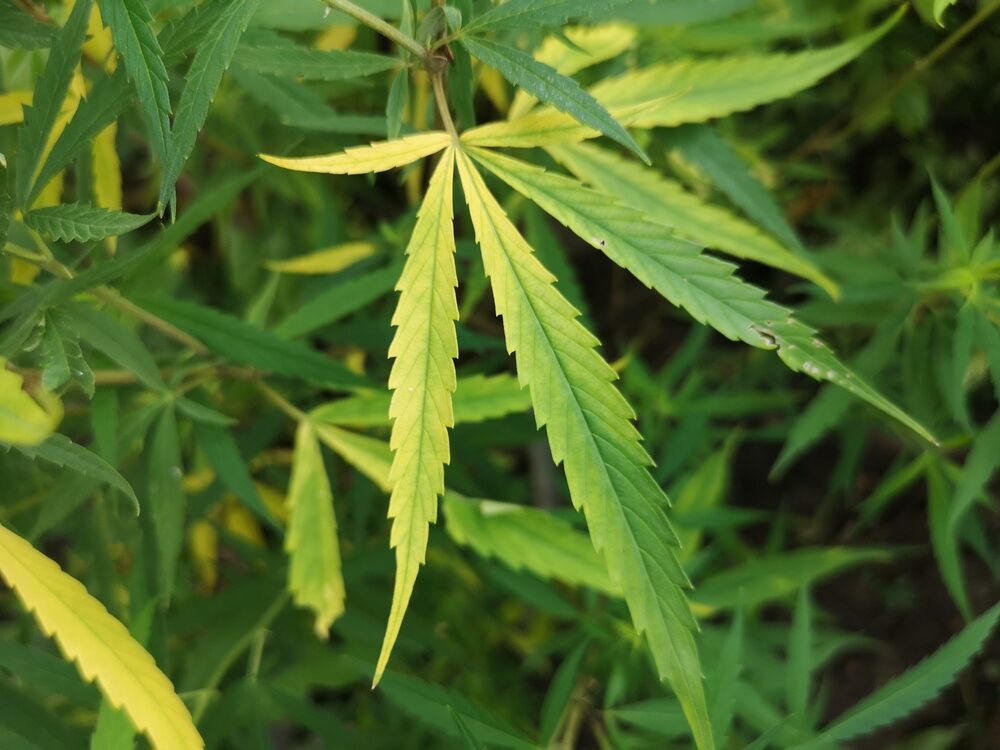
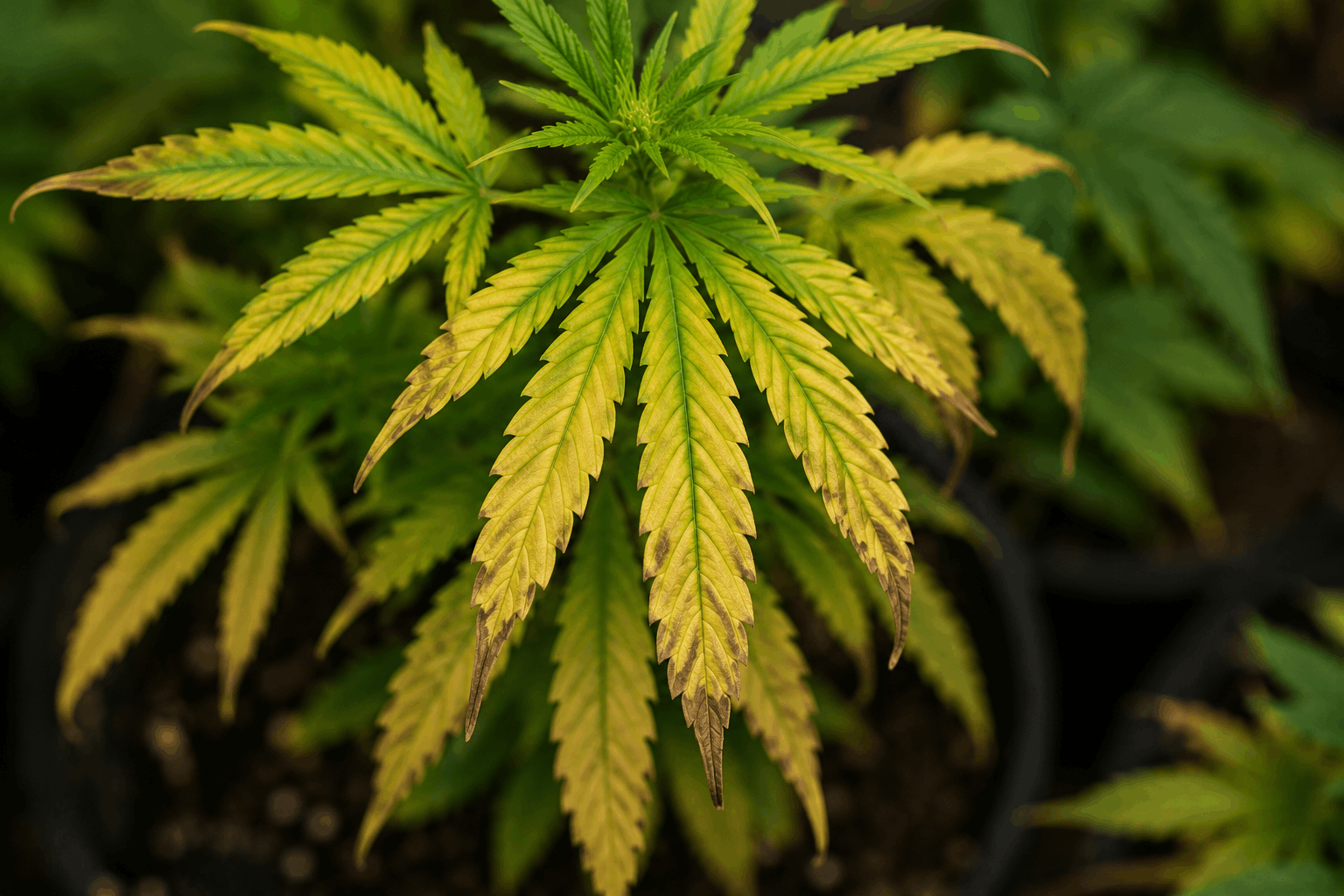
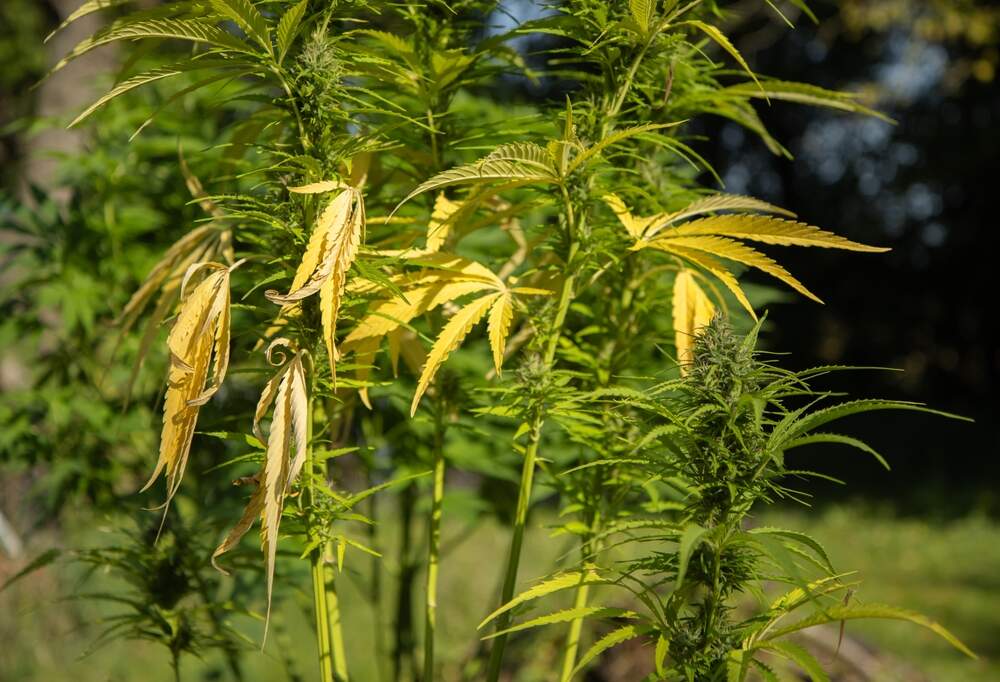
The classic symptom of cannabis nitrogen deficiency is yellowing lower leaves.
You will usually notice:
- Pale green lower foliage
- Yellow fan leaves cannabis plants develop near the base.
- Fading between leaf veins
- Leaves becoming completely yellow over time.
- Leaf drops from older growth.
The yellowing process typically starts at the tips and edges before spreading across the entire fan leaf.
As the deficiency progresses, the plant begins sacrificing older leaves entirely. These leaves eventually dry out, curl, and fall away.
This is the cannabis plant attempting to survive by relocating remaining nitrogen reserves into newer growth.
One important thing I always explain to beginner growers is this:
Yellow leaves cannabis growers see during veg are rarely normal.
During healthy vegetative growth, your plants should remain vibrant green and highly energetic.
Stunted growth cannabis plants experience from nitrogen deficiency
Stunted growth cannabis symptoms become more obvious when deficiency levels worsen.
Nitrogen directly supports cellular growth and tissue development. When supplies run low, the plant slows expansion dramatically.
You may notice:
- Slowed vertical growth.
- Weak branch development
- Thin stems
- Smaller leaves
- Sparse canopy structure
- Reduced vigour
In severe cases, your plants may appear significantly smaller than expected for their age.
This is especially damaging during vegetative growth because any slowdown during this stage directly impacts final canopy size and future yields.
I often compare nitrogen deficiency to trying to build a house without enough bricks. The structure simply cannot develop properly.
This also weakens your plant’s ability to resist:
- Environmental stress
- Heat stress
- Pest pressure
- Disease development
Weak cannabis plants are more vulnerable across the board.
Small and thin branches
Nitrogen is also essential for cell growth and division, which means it plays an important role in stem development. Without enough nitrogen, the developing branches may grow small, thin, and weak, making them more susceptible to breakage.
Nitrogen deficiency vs overwatering and magnesium deficiency
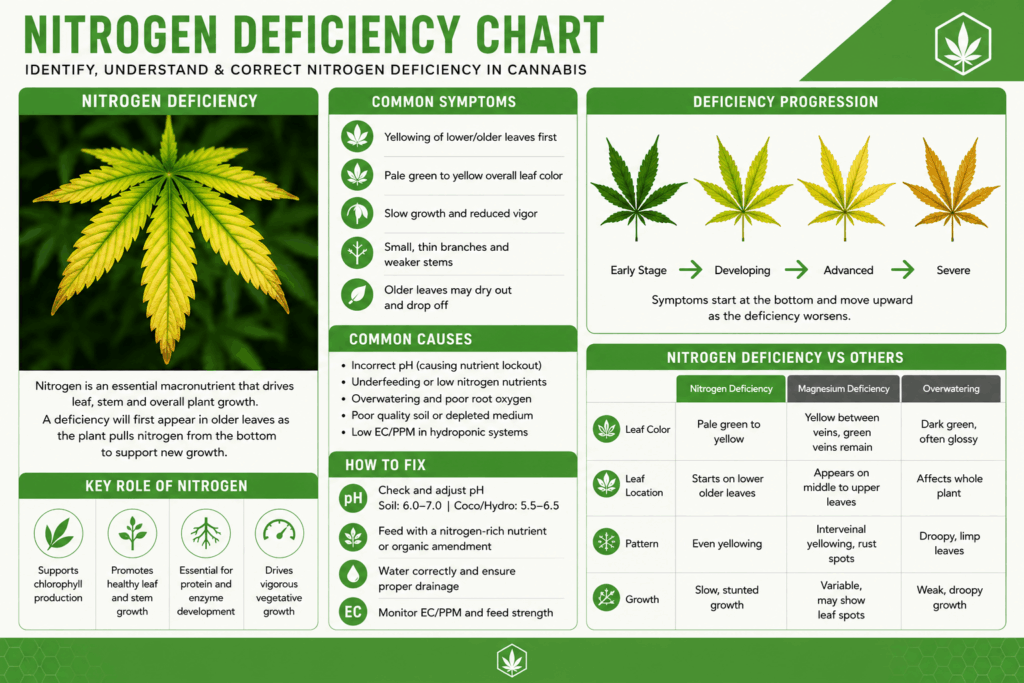
| Issue | Common Symptoms | Where Symptoms Appear | Overall Plant Appearance |
| Nitrogen Deficiency | Yellow lower leaves, pale foliage, slow growth | Starts at the bottom of the plant and gradually moves upward | Pale, faded, and uniformly weak growth |
| Magnesium Deficiency | Interveinal yellowing, rust spots, curling leaf edges | Usually appears higher in the canopy or on mid-level leaves | Patchy discoloration with spotted or striped leaves |
| Overwatering | Droopy swollen leaves, sagging foliage, poor oxygen uptake | Affects the entire plant rather than isolated leaves | Heavy, limp, and dark green appearance |
Almost all nutrient issues that affect weed plants first show up in the fan leaves, and nitrogen deficiency is no different. If you see the following signs slowly developing, then the chances are high that your weed plants may be low on nitrogen:
What Causes Cannabis Nitrogen Deficiency and How Do You Fix It?
Cannabis nitrogen deficiency is not always caused by low nutrient levels alone. In many cases, the nutrient is present in the root zone but unavailable to the plant due to environmental or pH-related issues.
This is why simply adding more nutrients does not always solve the problem.
Common causes of cannabis nutrient deficiency and nitrogen lockout
Several factors can trigger cannabis nutrient deficiency and nitrogen lockout.
The most common causes include:
- Incorrect root zone pH
- Underfeeding during vegetative growth
- Overwatering
- Poor-quality soil
- Low EC levels in hydro systems
- Root damage
- Cold root zones
- Salt buildup
Nitrogen lockout cannabis growers experience is often linked directly to improper ph.
If your root zone pH drifts outside the ideal range, your plants lose the ability to absorb available nutrients effectively.
Ideal pH ranges are:
- Soil: 6.0–7.0
- Coco/hydro: 5.5–6.5
I see pH problems more than anything else in beginner grow rooms.
Growers often assume they need stronger nutrients when the real issue is nutrient uptake failure.
How to fix nitrogen deficiency with proper nutrients and pH correction
The first thing I do when fixing cannabis nitrogen deficiency is check ph.
Never add extra nutrients blindly without confirming your root zone conditions first.
Start by testing:
- Feed water pH.
- Runoff pH
- EC or PPM levels
If pH is incorrect, flush the medium with properly adjusted water.
Once pH is stabilized, you can introduce nitrogen-rich nutrients.
Good nitrogen sources include:
- Fish emulsion
- Blood meal
- Compost tea
- Alfalfa meal
- High nitrogen veg nutrients.
Hydroponic growers should increase vegetative nutrient strength gradually while monitoring EC levels carefully.
I prefer slow corrections rather than aggressive feeding because overcorrecting can trigger nitrogen toxicity.
Signs of too much nitrogen include:
- Very dark green leaves
- Clawing foliage
- Excessive leafy growth
- Delayed flowering
Balance is everything in cannabis cultivation.
How long cannabis plants take to recover from nitrogen deficiency.
Recovery speed depends entirely on how early you catch the deficiency.
Mild cases often improve within:
- 3–5 days
Moderate deficiencies may take:
- 1–2 weeks
Severe deficiencies can require:
- Several weeks
One thing new grower should understand is that damaged yellow leaves rarely turn green again.
Instead, focus on:
- Healthy new growth
- Improved vigour
- Faster development
- Stronger coloration
When your plants recover successfully, you will notice fresh leaves emerging with vibrant healthy green coloration.
The plant’s overall posture also improves quickly once nitrogen uptake resumes.
Nitrogen Toxicity In Cannabis Plants
While nitrogen deficiency is a common issue among beginner growers, giving your plants too much nitrogen can create just as many problems. Nitrogen toxicity usually occurs when cannabis plants receive excessive feeding during the vegetative stage or continue receiving high-nitrogen nutrients deep into flowering.
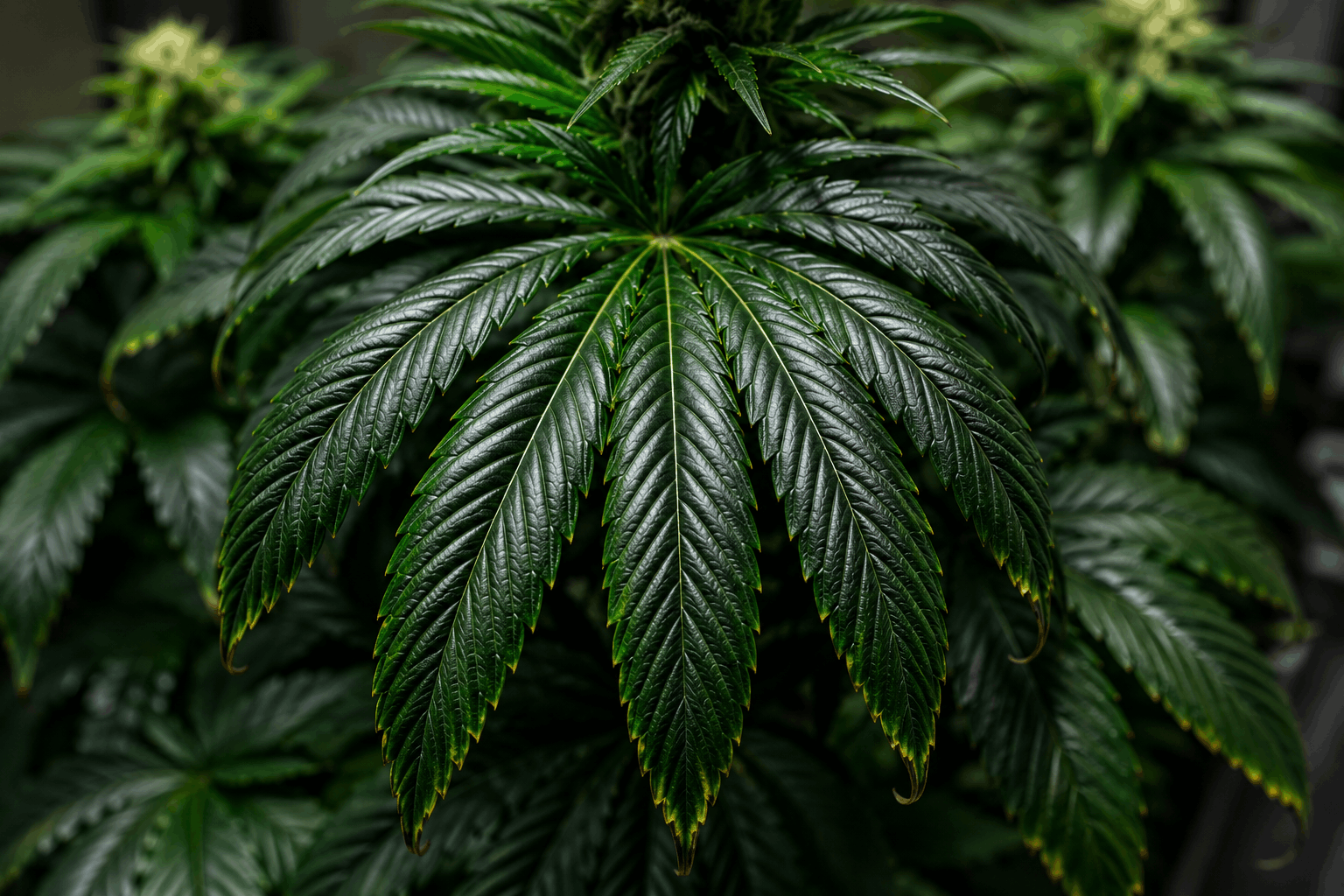
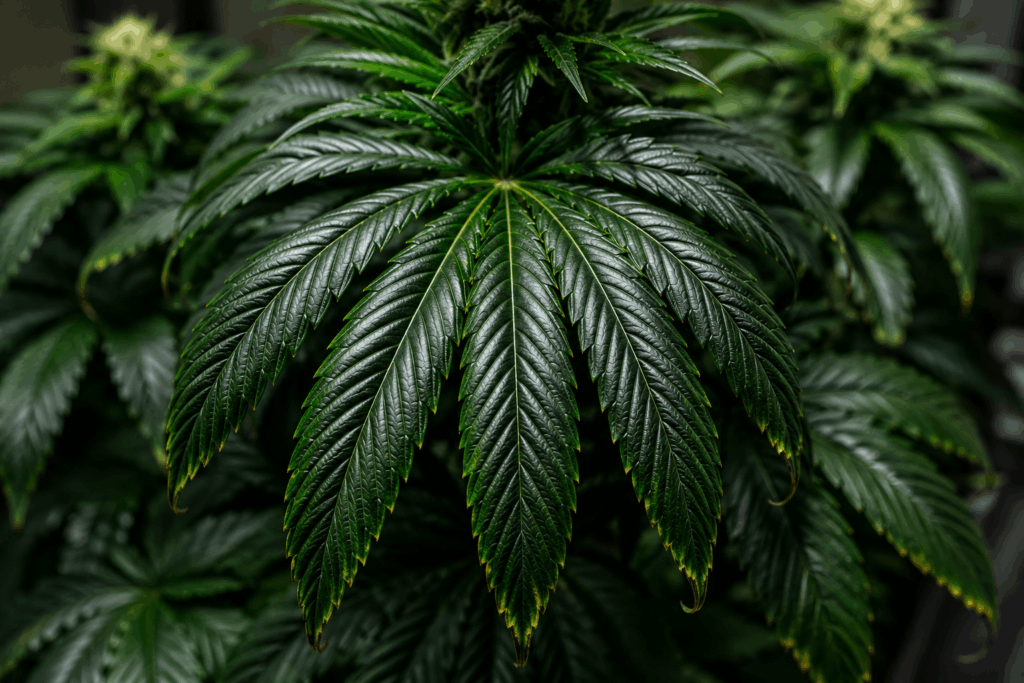
Unlike nitrogen deficiency, which causes pale green and yellow foliage, nitrogen toxicity often makes cannabis leaves appear extremely dark green, glossy, and overly lush. In severe cases, the leaves begin curling downward at the tips in what growers commonly call “the claw.”
Common symptoms of nitrogen toxicity
The most common signs of cannabis nitrogen toxicity include:
- Very dark green leaves
- Glossy or waxy foliage
- Clawing leaf tips
- Thick, overly soft leaves
- Slow or stalled growth
- Reduced bud development during flowering
Nitrogen toxicity also affects the plant’s ability to absorb other nutrients properly, which can eventually lead to additional nutrient imbalances and lockout issues.
Why excess nitrogen is a problem during flowering
Cannabis plants require less nitrogen once flowering begins. During bloom, the plant shifts its energy toward bud production, terpene development, and resin formation rather than leafy vegetative growth.
Excess nitrogen during flowering can cause:
- Airy buds
- Reduced resin production
- Delayed ripening
- Excess leaf growth
- Poor terpene expression
This is why most bloom nutrients contain lower nitrogen levels and higher phosphorus and potassium ratios.
How to fix nitrogen toxicity in cannabis
If your cannabis plants are showing signs of nitrogen toxicity, the first step is to reduce feeding strength immediately.
I typically recommend:
- Flushing the growing medium with properly pH-balanced water
- Reducing nutrient EC levels
- Switching to a lighter feeding schedule
- Removing severely damaged leaves only if necessary
- Monitoring new growth closely
Healthy new growth should begin appearing lighter green and more balanced within several days after correcting the issue.
The key is moderation. Cannabis plants grow best when nutrient levels remain balanced throughout the entire grow cycle rather than aggressively pushing heavy feeding schedules.
How to prevent cannabis nitrogen deficiency?
Preventing cannabis nitrogen deficiency is far easier than fixing severe deficiencies later in the grow cycle.
Healthy cultivation practices create stable nutrient availability while also preventing stress-related uptake issues.
How to maintain healthy nitrogen levels throughout the grow cycle
Cannabis plants require different nutrient ratios throughout each growth stage.
Vegetative plants demand higher nitrogen levels because they are building:
- Stems
- Branches
- Fan leaves
- Root systems
During flowering, nitrogen demand decreases gradually while phosphorus and potassium need increase.
I always recommend using stage-specific nutrients rather than feeding the same formula throughout the entire lifecycle.
High-quality soils and coco blends also help maintain nutrient stability while reducing deficiencies.
Regular monitoring matters too.
I check:
- Leaf colour
- Growth speed
- Runoff EC
- Runoff pH
- Overall plant vigour
every single day.
Small problems are easy to fix early.
Adjusting nitrogen levels during vegetative growth and flowering
One area that confuses many growers is nitrogen deficiency during flowering.
Some yellowing during late bloom is completely natural.
As cannabis plants mature, they begin redirecting nutrients away from fan leaves and into flower production. This process is known as senescence.
Natural late-flower fading usually appears:
- Slowly
- Evenly
- Near harvest
However, severe yellowing early in flower is not normal.
If your plant loses large amounts of foliage during early flowering, you may still have a nitrogen deficiency problem.
I reduce nitrogen gradually during flowering rather than cutting it suddenly. This helps maintain healthy leaf function without encouraging excessive leafy buds.
Too much nitrogen during bloom can reduce:
- Resin production
- Bud density
- Terpene development
Balanced nutrition always produces better flowers.
Best pH and feeding practices to prevent nutrient deficiencies.
Strong prevention starts with consistency.
The best growers are not constantly reacting to problems because they maintain stable root zone conditions from day one.
My prevention strategy includes:
- Maintaining proper pH
- Using quality nutrients
- Avoiding overwatering
- Monitoring runoff regularly
- Keeping roots warm and oxygenated
- Feeding according to growth stage
Overwatering is especially dangerous because waterlogged roots struggle to absorb nutrients efficiently.
Healthy roots equal healthy plants.
I also recommend keeping a grow journal. Tracking pH, EC, watering schedules, and feeding amounts helps identify patterns before problems escalate.
Cannabis cultivation rewards consistency more than anything else.
Conclusion
Cannabis nitrogen deficiency is one of the most common nutrient problems growers’ encounters, especially during vegetative growth. Fortunately, it is also one of the easiest deficiencies to identify and correct once you understand the warning signs.
Yellow lower leaves, pale foliage, slowed growth, and weak development are all classic symptoms that your plants may not be receiving enough nitrogen. In many cases, the issue is linked to pH imbalance or nutrient lockout rather than a complete lack of nutrients.
The key to healthy cannabis plants is balance. Stable pH, proper feeding schedules, healthy root zones, and close daily observation all work together to prevent deficiencies before they damage your crop.
As a grower, I have learned that cannabis plants communicate constantly through their leaves, structure, and growth patterns. The more time you spend observing your plants carefully, the faster you will identify problems and the easier they become to fix.
Healthy roots, balanced nutrients, and steady environmental conditions will always produce stronger plants, heavier harvests, and far fewer headaches in the grow room.
Frequently Asked Questions About Cannabis Nitrogen Deficiency
What are the first signs of cannabis nitrogen deficiency?
The earliest signs of cannabis nitrogen deficiency are usually pale green lower leaves, yellowing fan leaves, and slowed vegetative growth. Symptoms typically begin at the bottom of the plant before progressing upward.
Why are my cannabis leaves turning yellow from the bottom up?
Lower leaves turning yellow is commonly associated with nitrogen deficiency because nitrogen is a mobile nutrient. When supplies are low, the plant redirects nitrogen from older leaves into newer growth.
Can cannabis plants recover from nitrogen deficiency?
Yes, cannabis plants can often recover from nitrogen deficiency if the issue is identified early and corrected properly. New growth should return to a healthy green colour once nutrient uptake improves.
How long does it take to fix nitrogen deficiency in cannabis?
Mild deficiencies may begin improving within 3–7 days after correcting pH and feeding conditions. More severe cases can take several weeks depending on plant health and growing conditions.
What causes nitrogen deficiency in cannabis plants?
Common causes include incorrect pH levels, nutrient lockout, underfeeding, overwatering, poor-quality soil, root damage, and low nutrient strength in hydroponic systems.
Can overwatering cause cannabis nitrogen deficiency?
Yes, overwatering can contribute to nitrogen deficiency by damaging root health and reducing oxygen levels in the root zone, which limits nutrient absorption.
What pH is best for nitrogen absorption in cannabis?
Cannabis plants typically absorb nitrogen most efficiently at a pH of 6.0–7.0 in soil and 5.5–6.5 in hydroponic or coco systems.
Is nitrogen deficiency during flowering normal?
Some yellowing during late flowering is commonly observed as cannabis plants naturally redirect nutrients into bud production. However, severe yellowing early in flower may indicate an actual deficiency problem.
Can yellow cannabis leaves turn green again?
Leaves that have turned fully yellow usually do not recover completely. Instead, growers should focus on healthy new growth and preventing the deficiency from spreading further.
What nutrients help fix cannabis nitrogen deficiency?
Nitrogen-rich fertilizers and amendments such as fish emulsion, compost tea, blood meal, alfalfa meal, and vegetative-stage nutrients are commonly used to correct nitrogen deficiencies in cannabis plants.