
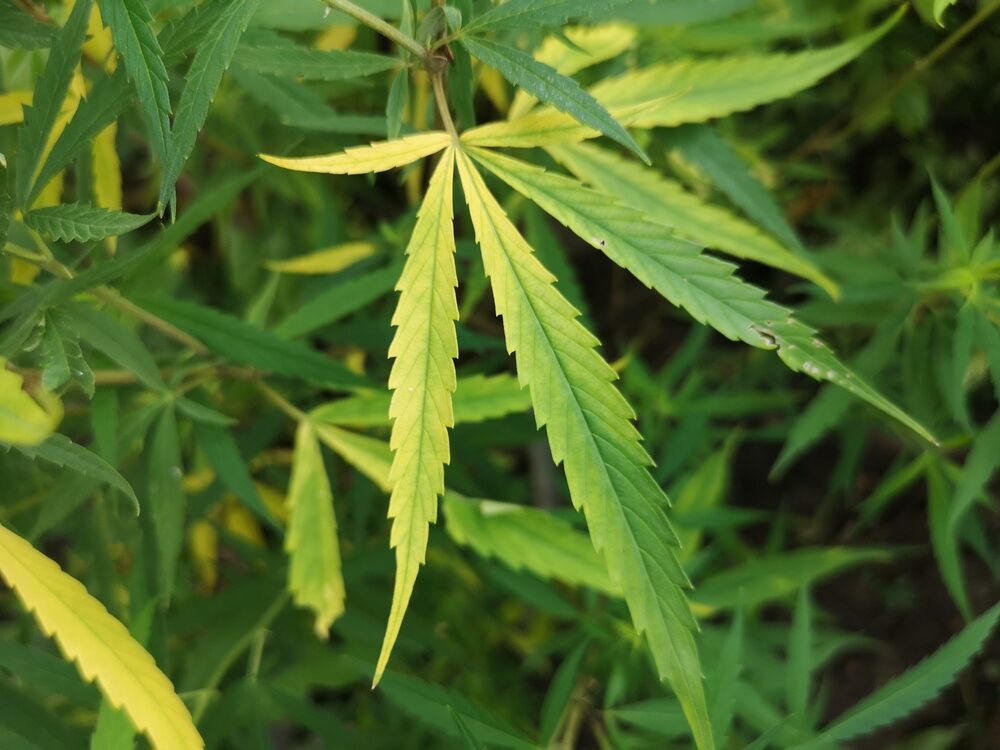
Nitrogen Deficiency in Autoflower Plants: Symptoms, Causes and Fixes
Nitrogen deficiency is one of the most common nutrient problems cannabis growers face, especially during the early stages of plant development. When cannabis plants do not receive enough available nitrogen, they struggle to produce healthy green foliage, strong stems, and vigorous new growth. The first signs usually appear as pale leaves, yellowing lower foliage, and slower overall development.
For autoflower cannabis plants, nitrogen deficiency can be especially damaging. Autoflowers grow quickly and follow a fixed lifecycle, which means they have less time to recover from early nutrient problems than photoperiod plants. A deficiency during the seedling or vegetative stage can reduce canopy size, limit bud sites, and affect final yield.
However, yellow leaves do not always mean your plant needs more nutrients. Incorrect pH, overwatering, root stress, and nutrient lockout can all prevent cannabis plants from absorbing nitrogen even when it is already present in the growing medium.
In this guide, we explain how to identify cannabis nitrogen deficiency, what causes it, how to fix it safely, and how to manage nitrogen levels throughout the autoflower lifecycle.
Article Insights
- Yellowing lower leaves are often one of the earliest visible signs of cannabis nitrogen deficiency.
- Cannabis plants typically require the highest nitrogen levels during vegetative growth when leaf and stem production are most active.
- Incorrect root zone pH can cause nutrient lockout, preventing nitrogen uptake even when nutrients are present in the growing medium.
- Mild nitrogen deficiencies often begin improving within 3–7 days after pH and feeding issues are corrected.
- Autoflower cannabis plants generally have less time to recover from nutrient deficiencies because of their shorter vegetative period.
- Excess nitrogen during flowering can encourage leafy growth and reduce flower development and ripening.
What Is Cannabis Nitrogen Deficiency and Why Is Nitrogen Important?
Nitrogen is one of the three primary macronutrients cannabis plants require throughout their lifecycle, alongside phosphorus and potassium. You will often see these nutrients listed as NPK ratios on cannabis fertilizers and nutrient bottles.
During the vegetative stage, cannabis plants require higher levels of nitrogen because the nutrient directly supports chlorophyll production, enzyme activity, photosynthesis, and rapid leaf and stem development. Without sufficient nitrogen in the root zone, plants struggle to produce energy efficiently, resulting in slower growth, reduced foliage production, and weaker overall development.
For autoflower cannabis plants, maintaining adequate nitrogen levels during early growth is particularly important. Most autoflowers complete their vegetative stage within just 3–5 weeks, giving growers a much smaller window to correct nutrient issues before flowering begins. A nitrogen deficiency during this critical period can stunt plant growth, reduce canopy size, and ultimately limit potential yields.
Nitrogen deficiency symptoms typically develop gradually rather than appearing overnight. Early signs often include pale foliage and yellowing lower leaves, making regular plant inspections one of the most effective ways to identify and correct the problem before it affects overall plant performance.
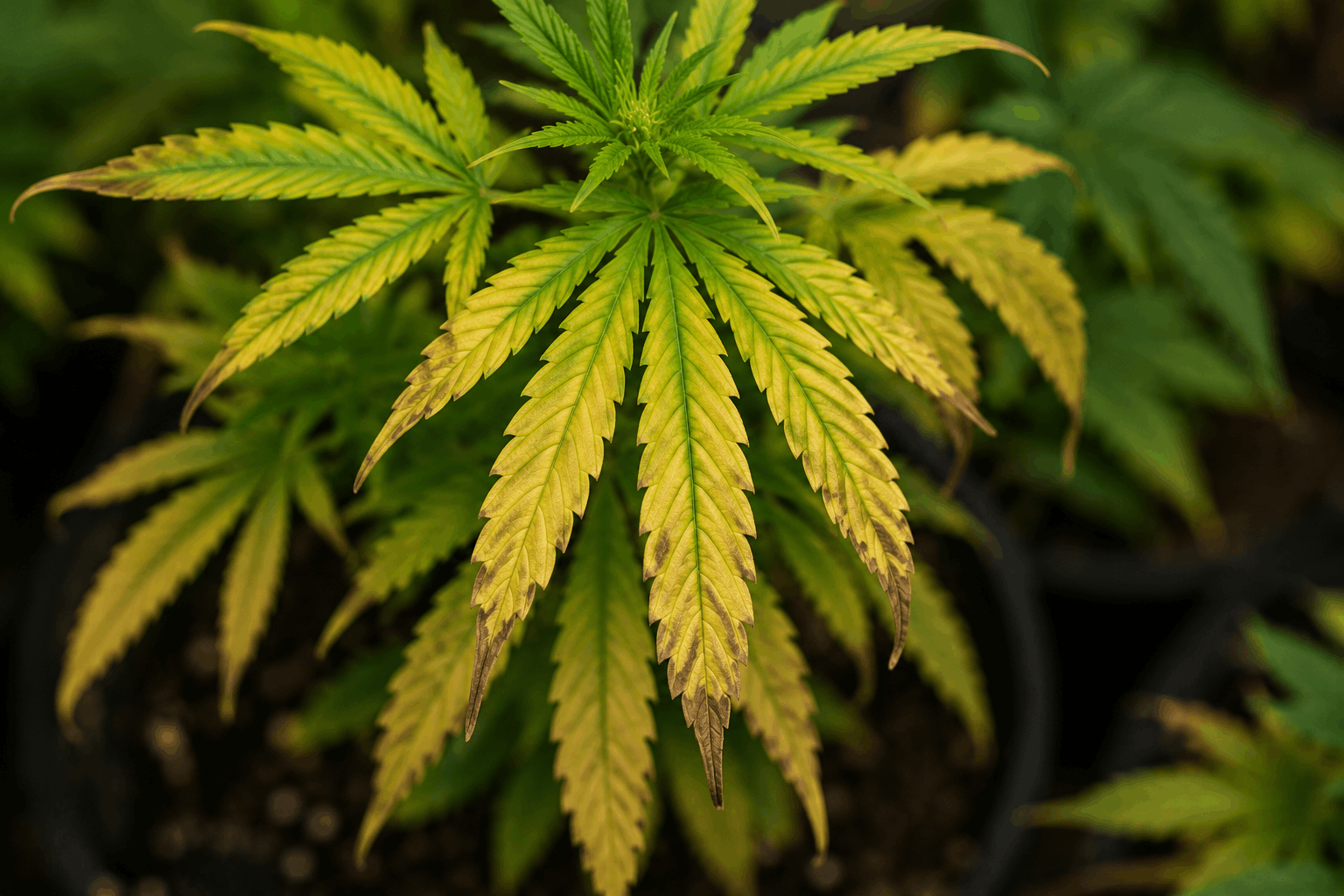
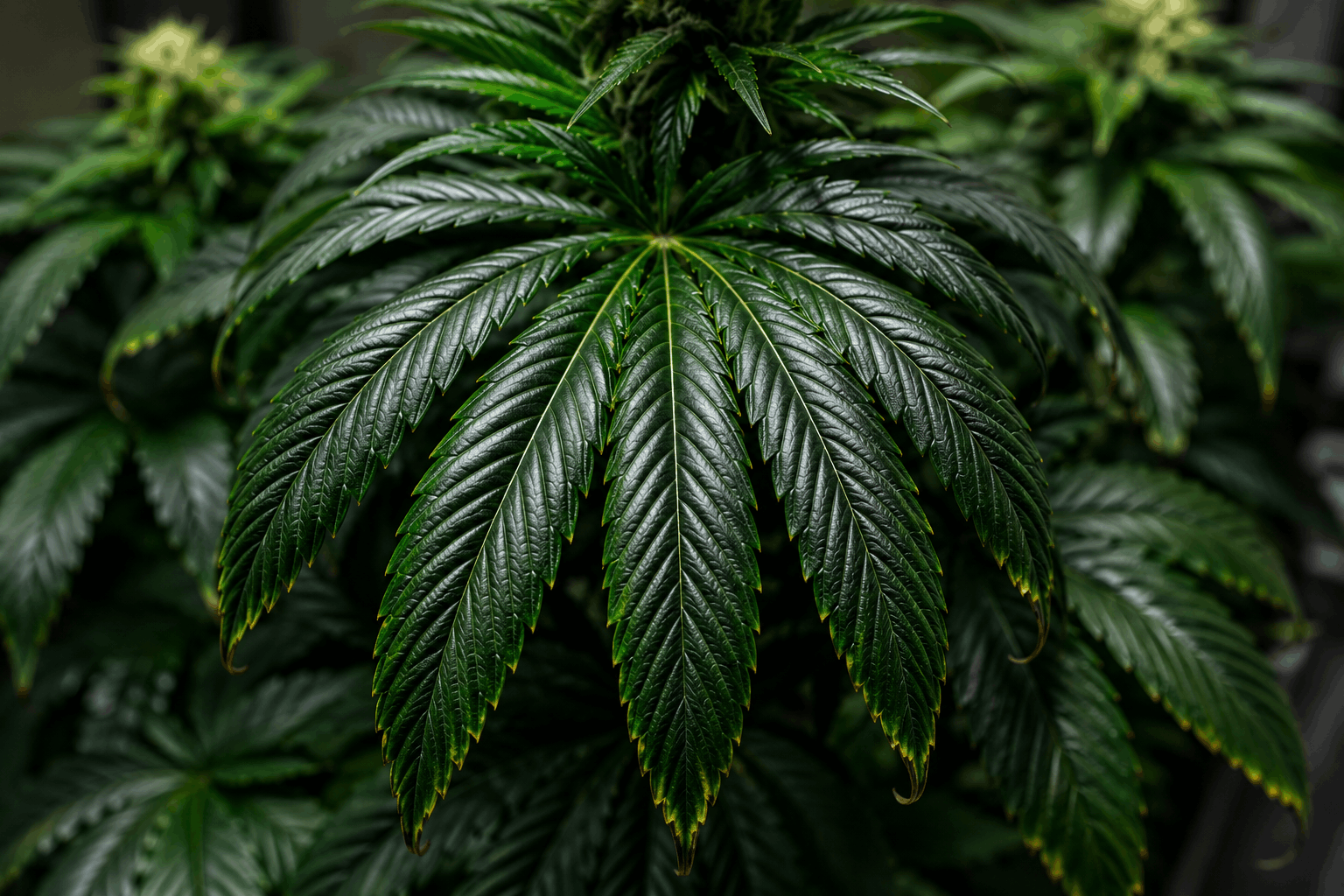
Why nitrogen is an essential mobile nutrient for cannabis plants.
Nitrogen is classified as a mobile nutrient, which means cannabis plants can move it from older growth into newer growth when supplies become limited.
When nitrogen levels drop, the plant prioritises survival by redirecting available nitrogen away from older fan leaves and into fresh shoots, stems, and upper foliage. This helps protect new growth temporarily, but it also causes older leaves to fade, turn yellow, dry out, and eventually fall away.
This is why yellowing lower leaves are usually one of the earliest signs of cannabis nitrogen deficiency. The problem often starts near the base of the plant before gradually moving upward if nitrogen availability is not corrected.
For autoflower cannabis plants, this early warning sign is especially important. Autoflowers move through vegetative growth quickly, so yellowing lower leaves during weeks 2–5 can indicate a problem that needs correcting before flowering begins. Unlike photoperiod plants, autoflowers cannot simply be kept in veg for longer to recover lost growth.
As a breeder and grower, I always recommend checking the lower fan leaves closely during early vegetative growth. These leaves often reveal what is happening in the root zone before the upper canopy starts showing clear symptoms.
Nitrogen also supports:
- Chlorophyll production
- Amino acid development
- Protein synthesis
- Stem and branch formation
- Leaf expansion
- Vigorous vegetative growth
Without sufficient nitrogen, cannabis plants struggle to maintain healthy metabolic activity, strong leaf development, and the vigorous early growth that autoflower strains depend on for strong final yields.
The role nitrogen plays in photosynthesis and plant growth.
Photosynthesis is the engine that powers cannabis growth. Your plants convert light energy into usable sugars, while also fuelling everything from root expansion to bud development.
Nitrogen plays a direct role in this process because chlorophyll molecules contain large amounts of nitrogen. When nitrogen becomes unavailable, chlorophyll production slows down rapidly. This is why cannabis leaves turning yellow is such a common symptom.
A healthy cannabis plant should display rich green foliage during vegetative growth. Pale green leaves, faded fan leaves, and yellowing lower growth usually indicate chlorophyll production is declining.
This also affects overall plant vigour. You may notice:
- Slower vertical growth
- Reduced side branching
- Thin stems
- Smaller fan leaves
- Weak node spacing
- Reduced leaf density
Plants suffering from mobile nutrient deficiency often appear tired and sluggish compared to healthy vigorous plants.
Healthy nitrogen levels are especially important during:
- Early vegetative growth
- Explosive canopy development
- Root establishment
- Pre-flowering stretch
Once flowering begins, nitrogen demand gradually decreases, although the plant still requires moderate amounts to remain healthy.
Cannabis Nitrogen Deficiency Symptoms
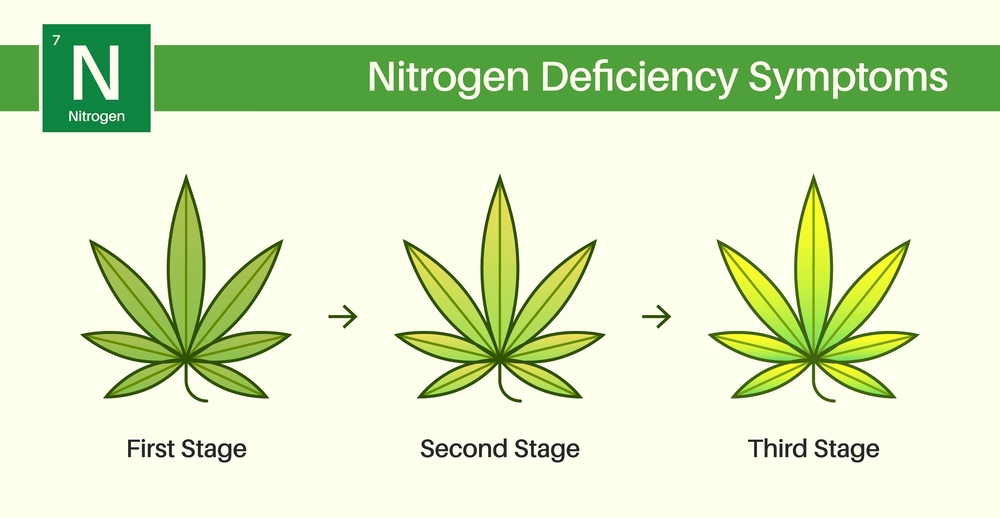
Nitrogen deficiency symptoms in cannabis are usually very easy to identify once you understand how the nutrient behaves inside the plant.
Unlike calcium or iron deficiencies that often affect new growth first, cannabis nitrogen deficiency targets older fan leaves because nitrogen is mobile within the plant tissue.
Symptoms often develop slowly over several days rather than appearing suddenly.
Lower leaves turning yellow cannabis symptoms explained.
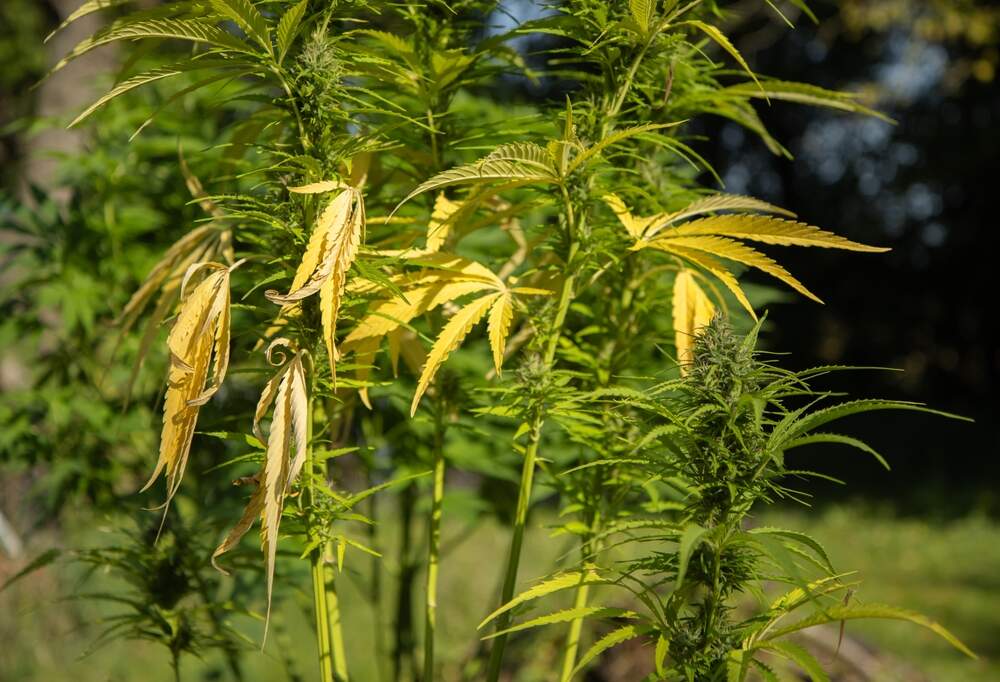
The classic symptom of cannabis nitrogen deficiency is yellowing lower leaves.
You will usually notice:
- Pale green lower foliage
- Yellow fan leaves cannabis plants develop near the base.
- Fading between leaf veins
- Leaves becoming completely yellow over time.
- Leaf drops from older growth.
The yellowing process typically starts at the tips and edges before spreading across the entire fan leaf.
As the deficiency progresses, the plant begins sacrificing older leaves entirely. These leaves eventually dry out, curl, and fall away.
This is the cannabis plant attempting to survive by relocating remaining nitrogen reserves into newer growth.
One important thing I always explain to beginner growers is this:
Yellow leaves cannabis growers see during veg are rarely normal.
During healthy vegetative growth, your plants should remain vibrant green and highly energetic.
Stunted growth cannabis plants experience from nitrogen deficiency
As nitrogen deficiency becomes more severe, stunted growth often becomes one of the most noticeable symptoms.
Nitrogen plays a vital role in cell division, tissue development, and overall plant expansion. When nitrogen availability drops, cannabis plants begin conserving resources, slowing growth in an attempt to survive rather than thrive.
Common signs of nitrogen-related stunted growth include:
- Slowed vertical growth
- Weak branch development
- Thin stems
- Smaller fan leaves
- Sparse canopy structure
- Reduced overall vigour
In severe cases, plants may appear significantly smaller than expected for their age and growth stage.
For autoflower cannabis plants, stunted growth can be particularly damaging. Because autoflowers have a fixed lifecycle and transition into flowering automatically, they have limited time to recover from early nutrient deficiencies. Any reduction in growth during the vegetative stage can lead to a smaller canopy, fewer bud sites, and lower final yields.
I often compare nitrogen deficiency to building a house without enough bricks. The structure can still be built, but it will never reach its full potential.
Nitrogen deficiency can also reduce a plant’s ability to cope with:
- Environmental stress
- Heat stress
- Pest pressure
- Disease development
Healthy autoflowers rely on strong early growth to maximise yield potential, making early identification and correction of nitrogen deficiencies essential for achieving the best possible harvest.
Small and thin branches
Nitrogen is also essential for cell growth and division, which means it plays an important role in stem development. Without enough nitrogen, the developing branches may grow small, thin, and weak, making them more susceptible to breakage.
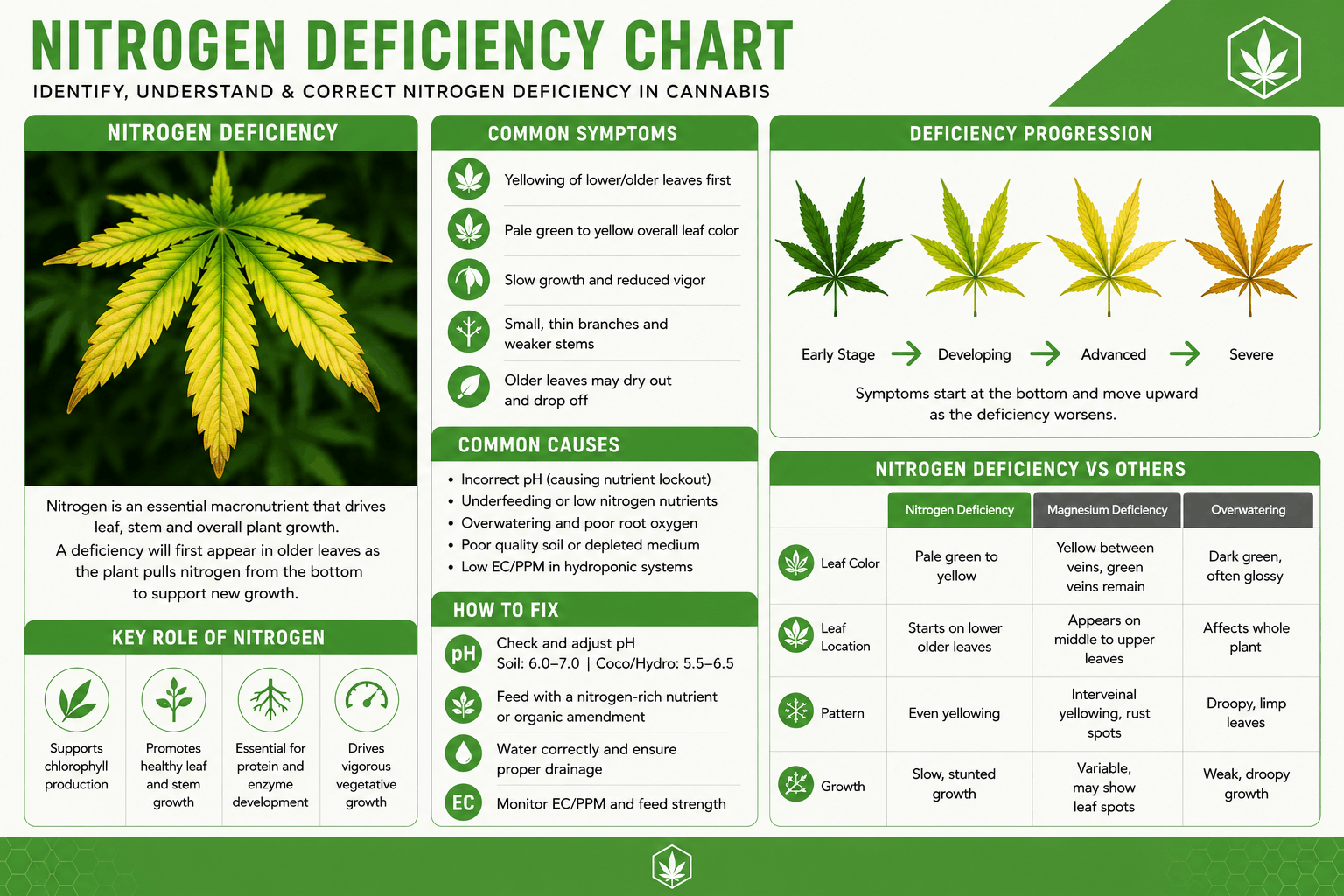
Nitrogen deficiency vs overwatering and magnesium deficiency
| Issue | Common Symptoms | Where Symptoms Appear | Overall Plant Appearance |
| Nitrogen Deficiency | Yellow lower leaves, pale foliage, slow growth | Starts at the bottom of the plant and gradually moves upward | Pale, faded, and uniformly weak growth |
| Magnesium Deficiency | Interveinal yellowing, rust spots, curling leaf edges | Usually appears higher in the canopy or on mid-level leaves | Patchy discoloration with spotted or striped leaves |
| Overwatering | Droopy swollen leaves, sagging foliage, poor oxygen uptake | Affects the entire plant rather than isolated leaves | Heavy, limp, and dark green appearance |
Almost all nutrient issues that affect weed plants first show up in the fan leaves, and nitrogen deficiency is no different. If you see the following signs slowly developing, then the chances are high that your weed plants may be low on nitrogen:
What Causes Cannabis Nitrogen Deficiency and How Do You Fix It?
Cannabis nitrogen deficiency is not always caused by a lack of nutrients in the growing medium. In many cases, nitrogen is present in the root zone but becomes unavailable due to pH imbalances, overwatering, root stress, or nutrient lockout.
This is why simply adding more nutrients does not always solve the problem. Before increasing feed strength, it is important to identify the underlying cause of the deficiency.
Common causes of cannabis nutrient deficiency and nitrogen lockout
Several factors can contribute to nitrogen deficiency in cannabis plants, including:
- Incorrect root zone pH
- Underfeeding during vegetative growth
- Overwatering
- Poor-quality soil or growing media
- Low EC levels in hydroponic systems
- Root damage
- Cold root temperatures
- Salt buildup from excessive feeding
Autoflower growers commonly encounter nutrient issues when following feeding schedules designed for photoperiod cannabis. While many autoflower strains prefer lighter nutrient concentrations, feeding too lightly during early vegetative growth can sometimes lead to nitrogen deficiencies that restrict plant development before flowering begins.
Nitrogen lockout is most often linked to improper pH levels and is one of the most common forms of nutrient lockout in cannabis plants. When the root zone falls outside the ideal range, cannabis plants struggle to absorb nutrients efficiently regardless of how much fertilizer is present.
Recommended pH ranges include:
- Soil: 6.0–7.0
- Coco and hydroponics: 5.5–6.5
In my experience, pH-related nutrient lockout is one of the most common causes of deficiency symptoms in beginner grow rooms. Many growers assume they need stronger nutrients when the real problem is poor nutrient uptake.
How to fix nitrogen deficiency with proper nutrients and pH correction
Whenever I diagnose a nitrogen deficiency, the first thing I check is pH.
Avoid adding additional nutrients until you have confirmed that your root zone conditions are within the correct range.
Start by testing:
- Feed water pH
- Runoff pH
- EC or PPM levels
If pH is outside the recommended range, flush the growing medium using properly pH-balanced water before adjusting your feeding program.
Once the root zone has stabilized, you can begin introducing nitrogen-rich nutrients where required.
Common nitrogen sources include:
- Fish emulsion
- Blood meal
- Compost tea
- Alfalfa meal
- High-nitrogen vegetative nutrients
For autoflower cannabis plants, gradual adjustments are usually safer than aggressive feeding increases. Autoflowers often react more quickly to nutrient imbalances than photoperiod plants, making overcorrection a common cause of nutrient toxicity.
Hydroponic growers should increase nutrient strength slowly while closely monitoring EC levels and plant response.
Signs of excessive nitrogen include:
- Very dark green leaves
- Clawing foliage
- Excessive leafy growth
- Delayed flowering
- Reduced bud development
Successful cannabis cultivation is all about maintaining balance. Providing enough nitrogen to support healthy growth is important, but excessive feeding can create just as many problems as a deficiency.
How long cannabis plants take to recover from nitrogen deficiency
Recovery time depends on how severe the deficiency is and how quickly the underlying issue is corrected. Because autoflowers have a fixed lifecycle and shorter vegetative period than photoperiod plants, identifying and correcting nitrogen deficiencies early is essential to minimise lost growth and yield potential.
| Deficiency Severity | Typical Recovery Time | What to Expect |
| Mild Deficiency | 3–5 days | New growth begins emerging greener and healthier, while yellowing slows or stops. |
| Moderate Deficiency | 1–2 weeks | Plant vigour improves, growth rate increases, and new foliage develops with better colour. |
| Severe Deficiency | Several weeks | Recovery is slower, and some growth loss may be permanent, especially if flowering has already begun. |
For autoflower growers, timing is critical. Unlike photoperiod cannabis plants, autoflowers continue progressing through their lifecycle regardless of nutrient problems, leaving less time to recover from setbacks.
It is also important to understand that leaves already damaged by nitrogen deficiency rarely return to their original healthy green colour. Instead of focusing on old yellow leaves, monitor the plant for signs of recovery such as:
- Healthy new growth
- Improved vigour
- Faster development
- Stronger green coloration
- Increased leaf size and canopy expansion
As nitrogen uptake improves, new leaves should emerge with healthy colour and structure, while overall plant growth and posture begin returning to normal.
Nitrogen Deficiency in Autoflower Cannabis Plants
Nitrogen management is especially important when growing autoflower cannabis plants. Because autoflowers follow a fixed lifecycle, nutrient deficiencies that occur early can affect growth and yields before there is time to recover.
While many autoflowers are sensitive to overfeeding, underfeeding can also cause problems. Insufficient nitrogen limits leaf development, canopy growth, and overall plant vigour. Understanding how nitrogen deficiency appears at different stages helps growers identify and correct issues quickly.
Seedling Stage (Weeks 1–2)
True nitrogen deficiencies are uncommon during the seedling stage. Young autoflowers require very little nutrition and can usually rely on nutrients already present in quality soil or starter media.
If seedlings appear pale or yellow, the cause is often overwatering, poor root development, incorrect pH, or other common cannabis seedling problems rather than a lack of nitrogen.
If yellowing occurs:
- Check moisture levels before adding nutrients, as an overwatered autoflower plant can often display symptoms that resemble nutrient deficiencies.
- Verify pH is within the correct range.
- Avoid increasing feed strength too early.
- Focus on the health of new growth.
Healthy seedlings should produce vibrant green leaves and establish a strong root system before significant feeding is required.
Vegetative Stage (Weeks 2–5)
The vegetative stage is when autoflowers need the most nitrogen. During this period, plants rapidly develop leaves, stems, branches, and canopy structure that support future flower production.
Common signs of nitrogen deficiency include:
- Yellowing lower leaves
- Pale green foliage
- Slow growth
- Reduced branching
- Smaller leaves
Because the vegetative window is short, deficiencies during this stage can significantly reduce final plant size and contribute to small autoflower plants with lower yield potential.
If nitrogen deficiency is suspected:
- Check feed water and runoff pH.
- Assess nutrient strength using EC or PPM readings.
- Ensure plants are not overwatered.
- Increase nitrogen levels gradually where necessary, as aggressive feeding adjustments can lead to nutrient burn in cannabis plants.
- Monitor new growth over the following week.
Correcting deficiencies early helps prevent long-term growth setbacks.
Flowering Stage (Weeks 5+)
Nitrogen demand decreases once autoflowers enter flowering. As the plant focuses on bud production, some yellowing of older fan leaves becomes normal, particularly later in the cycle.
The key challenge is distinguishing between nitrogen deficiency and natural fading.
| Symptom | Nitrogen Deficiency | Natural Fade |
| Appears early in flowering | Yes | Rarely |
| Yellowing progresses rapidly | Yes | Usually gradual |
| Growth slows noticeably | Yes | No |
| Bud development suffers | Often | Usually unaffected |
| Requires corrective feeding | Often | Usually unnecessary |
If yellowing develops shortly after flowering begins and is accompanied by poor growth or weak bud development, nitrogen deficiency may still be present. However, gradual yellowing during the final weeks before harvest is often a natural part of the plant’s lifecycle.
Preventing Nitrogen Deficiency in Autoflowers
Many nitrogen deficiencies are caused by poor nutrient uptake rather than a lack of nutrients. Incorrect pH, overwatering, root stress, and inconsistent feeding can all limit nitrogen availability.
To reduce the risk:
- Maintain proper root zone pH.
- Follow a balanced feeding schedule.
- Avoid overwatering.
- Monitor runoff and plant health regularly.
- Make small adjustments as soon as symptoms appear.
Maintaining healthy nitrogen levels throughout the grow cycle supports vigorous growth, efficient photosynthesis, and stronger yields at harvest.
Nitrogen Toxicity In Cannabis Plants
While nitrogen deficiency is a common issue among beginner growers, giving your plants too much nitrogen can create just as many problems. Nitrogen toxicity usually occurs when cannabis plants receive excessive feeding during the vegetative stage or continue receiving high-nitrogen nutrients deep into flowering.
Unlike nitrogen deficiency, which causes pale green and yellow foliage, nitrogen toxicity often makes cannabis leaves appear extremely dark green, glossy, and overly lush. In severe cases, the leaves begin curling downward at the tips in what growers commonly call “the claw.”
Common symptoms of nitrogen toxicity
Nitrogen toxicity occurs when cannabis plants receive more nitrogen than they can use. It commonly affects growers who continue using high-nitrogen vegetative nutrients too late into flowering or overfeed autoflower plants during early growth.
Common signs include:
- Very dark green leaves
- Glossy or waxy foliage
- Downward clawing leaf tips
- Thick, soft leaves
- Slow growth
- Excessive leafy growth
- Reduced bud development
Excess nitrogen can also interfere with nutrient uptake, leading to nutrient imbalances or lockout.
| Symptom | Likely Cause |
| Dark green, glossy leaves | Excess nitrogen |
| Clawing leaf tips | Overfeeding |
| Slow growth despite feeding | Nutrient imbalance |
| Excessive leafy growth | Too much nitrogen during bloom |
| Reduced bud development | Energy diverted to foliage |
Why excess nitrogen is a problem during flowering
Cannabis plants need less nitrogen once flowering begins. During bloom, energy shifts from vegetative growth to bud production, terpene development, and resin formation.
Too much nitrogen during flowering can cause:
- Airy buds
- Reduced resin production
- Delayed ripening
- Excess leaf growth
- Poor terpene expression
This is especially important for autoflower cannabis plants. Because autoflowers transition into flowering automatically, excess nitrogen can encourage foliage growth at the expense of flower development.
For this reason, bloom nutrients typically contain lower nitrogen levels and higher phosphorus and potassium ratios.
How to fix nitrogen toxicity in cannabis
If your plants show signs of nitrogen toxicity, reduce feeding strength and assess root zone conditions.
Recommended steps:
- Flush with pH-balanced water if necessary
- Lower nutrient EC levels
- Switch to a lighter feeding schedule
- Stop using high-nitrogen vegetative nutrients during bloom
- Monitor new growth closely
Autoflower growers should avoid aggressive corrections, as sudden nutrient changes can create additional stress.
Healthy new growth should appear lighter green within several days. Existing dark or clawed leaves may not recover, so focus on improved new growth and flower development.
The best approach is balance. Maintaining appropriate nutrient levels throughout the grow cycle helps prevent both deficiencies and toxicities.
How to prevent cannabis nitrogen deficiency?
Preventing cannabis nitrogen deficiency is far easier than fixing severe deficiencies later in the grow cycle.
Healthy cultivation practices create stable nutrient availability while also preventing stress-related uptake issues.
How to maintain healthy nitrogen levels throughout the grow cycle
Cannabis plants require different nutrient ratios throughout each growth stage.
Vegetative plants demand higher nitrogen levels because they are building:
- Stems
- Branches
- Fan leaves
- Root systems
During flowering, nitrogen demand decreases gradually while phosphorus and potassium need increase.
I always recommend using stage-specific nutrients rather than feeding the same formula throughout the entire lifecycle. When growing autoflowers, many cultivators start with reduced nutrient strength and gradually increase feeding as the plant develops. This approach helps avoid nutrient lockout while still providing sufficient nitrogen during the rapid vegetative growth stage.
High-quality soils and coco blends also help maintain nutrient stability while reducing deficiencies.
Regular monitoring matters too.
I check:
- Leaf colour
- Growth speed
- Runoff EC
- Runoff pH
- Overall plant vigour
every single day.
Small problems are easy to fix early.
Adjusting nitrogen levels during vegetative growth and flowering
One area that confuses many growers is nitrogen deficiency during flowering.
Some yellowing during late bloom is completely natural. Autoflower strains often begin this natural fading process earlier than photoperiod plants due to their shorter flowering periods. Growers should distinguish between normal late-flower senescence and genuine nitrogen deficiencies that appear too early in bloom.
As cannabis plants mature, they begin redirecting nutrients away from fan leaves and into flower production. This process is known as senescence.
Natural late-flower fading usually appears:
- Slowly
- Evenly
- Near harvest
However, severe yellowing early in flower is not normal.
If your plant loses large amounts of foliage during early flowering, you may still have a nitrogen deficiency problem.
I reduce nitrogen gradually during flowering rather than cutting it suddenly. This helps maintain healthy leaf function without encouraging excessive leafy buds.
Too much nitrogen during bloom can reduce:
- Resin production
- Bud density
- Terpene development
Balanced nutrition always produces better flowers.
Best pH and feeding practices to prevent nutrient deficiencies.
Strong prevention starts with consistency.
The best growers are not constantly reacting to problems because they maintain stable root zone conditions from day one.
My prevention strategy includes:
- Maintaining proper pH
- Using quality nutrients
- Avoiding overwatering
- Monitoring runoff regularly
- Keeping roots warm and oxygenated
- Feeding according to growth stage
Overwatering is especially dangerous because waterlogged roots struggle to absorb nutrients efficiently.
Healthy roots equal healthy plants.
I also recommend keeping a grow journal. Tracking pH, EC, watering schedules, and feeding amounts helps identify patterns before problems escalate.
Cannabis cultivation rewards consistency more than anything else.
Conclusion
Cannabis nitrogen deficiency is a common nutrient problem that can slow growth, reduce plant vigour, and impact overall performance if left untreated. Early symptoms typically include yellowing lower leaves, pale foliage, and slowed development, making it easier to identify before serious damage occurs.
In many cases, the issue is not a lack of nutrients but factors such as pH imbalances, nutrient lockout, overwatering, or inconsistent feeding practices that prevent proper nitrogen uptake. Identifying the underlying cause and making gradual corrections can help restore healthy growth while avoiding additional stress.
For autoflower cannabis plants, early intervention is particularly important because their shorter growth cycle leaves less time to recover from nutrient deficiencies.
Maintaining proper pH levels, using a balanced feeding schedule, and monitoring plant health regularly can help prevent both nitrogen deficiencies and toxicities. Consistent growing practices and careful observation are key to supporting healthy cannabis plants throughout the entire grow cycle.
Frequently Asked Questions About Cannabis Nitrogen Deficiency
Can autoflower cannabis plants recover from nitrogen deficiency?
Yes, autoflower cannabis plants can recover from nitrogen deficiency if the problem is identified and corrected early. However, because autoflowers have a shorter vegetative stage than photoperiod plants, prolonged deficiencies may reduce plant size and final yields even after recovery.
Why are the lower leaves on my autoflower turning yellow?
Yellowing lower leaves are commonly associated with nitrogen deficiency because nitrogen is a mobile nutrient. When nitrogen levels become limited, the plant redirects available reserves from older leaves into newer growth, causing lower foliage to fade and yellow first.
How quickly should I fix nitrogen deficiency in autoflowers?
Nitrogen deficiencies should be addressed as soon as symptoms appear. Autoflower plants progress through their lifecycle quickly, and growth lost during early vegetative development is often difficult to fully recover before flowering begins.
Do autoflowers require less nitrogen than photoperiod cannabis plants?
Many autoflower strains are more sensitive to overfeeding than photoperiod varieties, but they still require adequate nitrogen during vegetative growth. Feeding too lightly can lead to deficiencies that limit canopy development, plant vigour, and yield potential.
What is the best pH range for nitrogen uptake in autoflower cannabis plants?
Autoflower cannabis plants typically absorb nitrogen most efficiently when the root zone pH remains within the correct range. For soil grows, a pH of 6.0–7.0 is generally recommended, while coco and hydroponic systems typically perform best between 5.5–6.5.
Should I remove yellow leaves caused by nitrogen deficiency?
In most cases, it is best to leave yellowing leaves on the plant until they are completely damaged or can be removed easily with a gentle pull. Cannabis plants continue drawing nutrients from partially affected leaves while recovering from a nitrogen deficiency. Once the underlying problem has been corrected, focus on healthy new growth rather than removing every yellow leaf immediately.
Can autoflower cannabis plants still produce good yields after a nitrogen deficiency?
Yes. Mild nitrogen deficiencies that are identified and corrected early rarely have a significant impact on final yields. However, severe deficiencies during vegetative growth can reduce canopy development, limit bud site formation, and affect overall plant size. Autoflower cannabis plants have less time to recover than photoperiod varieties, making early diagnosis particularly important.
How much nitrogen should I add to fix a deficiency?
Avoid making large feeding adjustments immediately. Before increasing nutrients, check pH levels and root zone conditions to rule out nutrient lockout. If additional nitrogen is required, increase feeding strength gradually and monitor new growth over the following several days. Healthy new growth is the best indicator that nitrogen uptake has improved.
Can yellow leaves turn green again after fixing nitrogen deficiency?
Leaves that have already turned completely yellow rarely regain their original healthy colour. Instead, growers should focus on the appearance of new growth. As nitrogen availability improves, new leaves should emerge greener, larger, and more vigorous while overall plant growth begins returning to normal.
Is yellowing during late flowering always a nitrogen deficiency?
No. Many cannabis plants naturally begin yellowing older fan leaves as they approach harvest. This process, known as senescence, occurs as the plant redirects resources into flower development and ripening. If yellowing develops gradually during the final weeks of flowering while buds continue maturing normally, it is often a natural part of the plant’s lifecycle rather than a nutrient deficiency.


