
Scale Insects on Autoflower Cannabis: How to Identify, Treat & Prevent Infestations
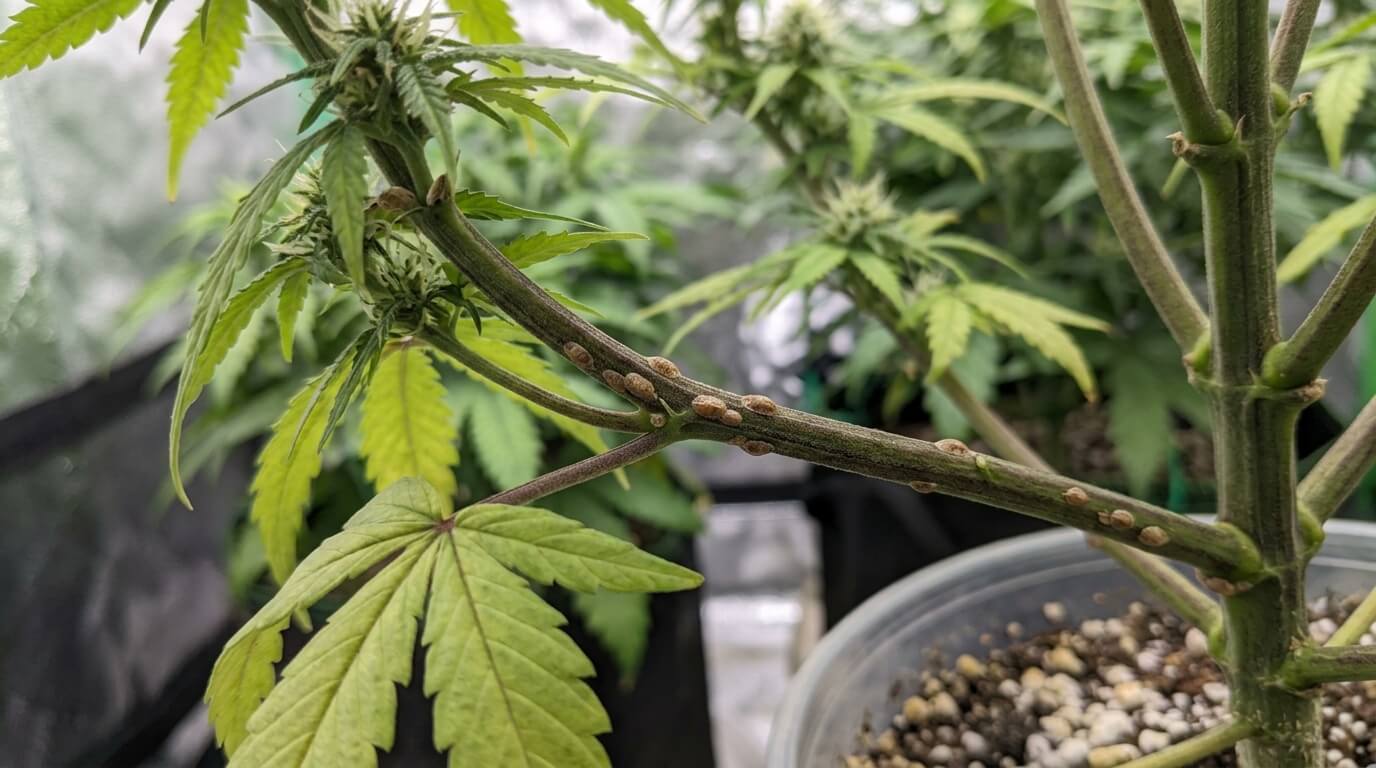
Scale insects, often referred to by growers as “barnacles on cannabis,” are sap-feeding pests that attach themselves to stems, branches, and leaves, where they gradually drain resources needed for healthy growth. Because they resemble harmless bumps or plant blemishes, infestations frequently go unnoticed until populations become established and visible plant stress begins to appear.
While scale insects can affect any cannabis plant, they can be particularly disruptive to autoflower cultivars, where uninterrupted development is essential for maximising plant size, flower production, and overall quality. As these pests feed, they reduce the plant’s ability to efficiently transport water, nutrients, and carbohydrates, potentially affecting canopy development, bud formation, and resin production.
Fortunately, scale insect infestations are manageable when identified early. With routine inspections, appropriate treatment methods, and preventative cultivation practices, growers can protect their plants, minimise damage, and prevent minor infestations from becoming serious problems.
- What Are Scale Insects on Cannabis?
- How to Identify Barnacles on Cannabis Plants Early
- Damage Caused by Scale Insects on Autoflower Cannabis Plants
- How to Get Rid of Barnacles on Autoflower Cannabis Plants
- Preventing Future Scale Insect Infestations on Autoflower Cannabis Plants
- Conclusion
- Frequently Asked Questions
What Are Scale Insects on Cannabis?
Scale insects are sap-feeding pests that attach themselves to cannabis stems, branches, and leaves, where they feed directly from the plant’s vascular system. Unlike aphids, thrips, or spider mites that remain mobile throughout much of their lifecycle, mature scale insects become permanently anchored to the plant beneath a waxy or armored protective shell. This hard outer covering is the reason many growers refer to them as cannabis barnacles.
Because they remain attached in one location, scale insects often go unnoticed during the early stages of an infestation. Over time, continuous feeding places stress on the plant by diverting water, nutrients, and carbohydrates away from healthy growth and flower development.
For growers using easy autoflower strains, early detection is especially important. Autoflower cannabis plants have a predetermined lifecycle, leaving less time to recover from pest-related stress during vegetative growth. Even a small infestation can become more problematic if left unchecked during the plant’s early development.
Why Are Scale Insects Called Cannabis Barnacles?
Scale insects earn the nickname “barnacles on cannabis” because of their appearance and behaviour. Similar to marine barnacles that attach themselves to boats and rocks, scale insects lock onto plant tissue and remain fixed while feeding.
Common signs of scale insects on cannabis include:
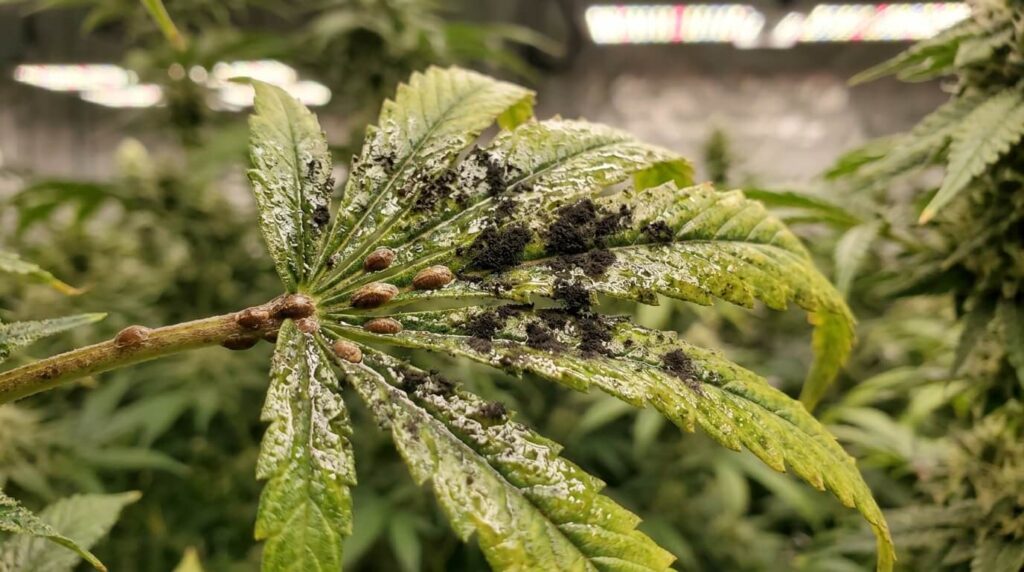
- Hard, dome-shaped bumps on stems or branches
- White, tan, amber, or brown shell-like growths
- Clusters forming around nodes and branch junctions
- Insects that remain stationary when disturbed
- Sticky honeydew residue on nearby leaves
One reason scale infestations become difficult to control is that mature insects are protected beneath their outer shell, making them more resistant to contact-based treatments than many other common cannabis pests.
Types of Scale Insects Found on Cannabis Plants
Cannabis plants are most commonly affected by two categories of scale insects:
| Type | Characteristics | Primary Risk |
| Soft Scale | Waxy coating that produces honeydew | Sooty mold and ant activity |
| Armored Scale | Hard protective shell with little or no honeydew production | Persistent infestations and treatment resistance |
Soft scale species are frequently associated with humid growing environments where honeydew accumulation can encourage fungal growth. Armored scale insects are typically harder to eliminate because their protective covering shields them from many foliar treatments.
Why Scale Insects Appear on Cannabis Stems and Leaves
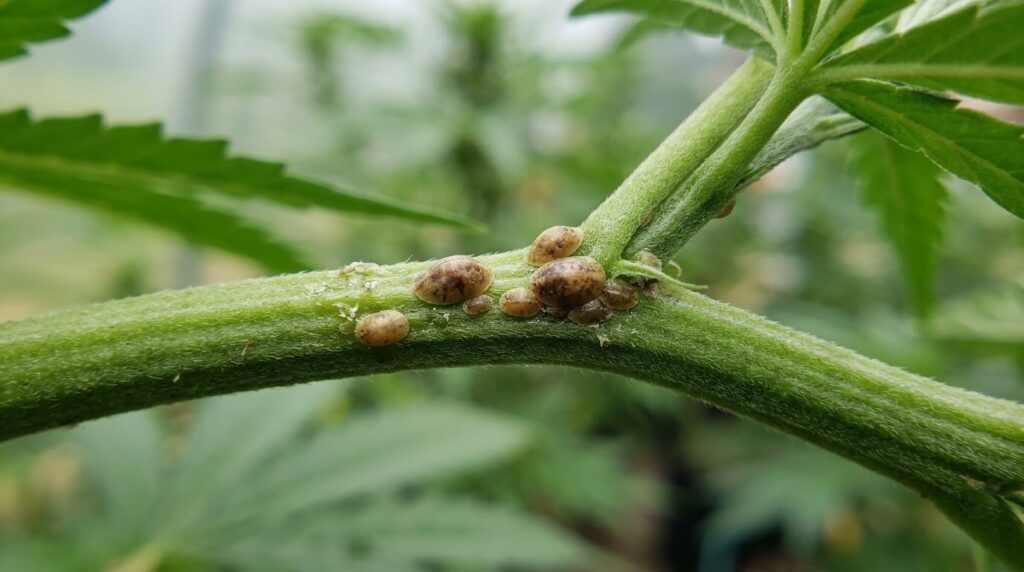
Scale insects favour sheltered areas where environmental conditions remain stable and undisturbed. They are most commonly found on:
- Lower branches
- Stem joints and nodes
- Leaf veins
- Undersides of fan leaves
- Dense canopy zones with restricted airflow
Indoor infestations are often linked to overcrowded plants, poor autoflower grow room ventilation, or contaminated clones introduced into the grow space. Regular inspections of these high-risk areas can help identify scale insects before populations become established
How to Identify Barnacles on Cannabis Plants Early
Early identification is the most effective way to prevent a small scale insect population from becoming a serious infestation, as scale damage is sometimes confused with symptoms caused by cannabis leaf miners. Because scale insects spend much of their lifecycle attached to plant tissue, many growers do not notice them until clusters have already formed on stems and branches.
For autoflower growers, routine inspections are particularly important because plant development moves quickly from vegetative growth into flowering. Identifying scale insects before populations become established allows corrective action to be taken while the infestation is still localised.
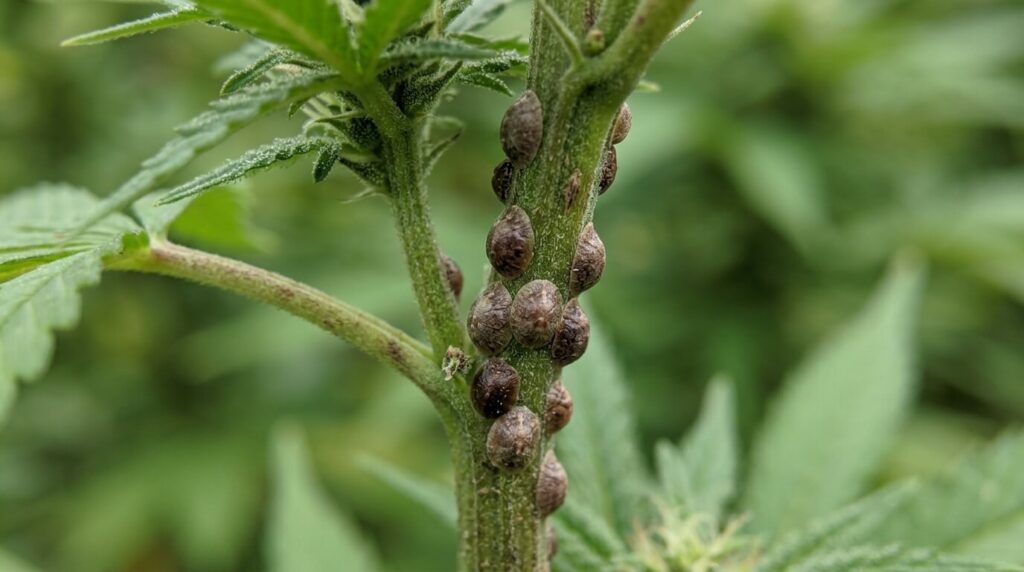
Quick Identification Guide
You may be dealing with scale insects on cannabis plants if you notice:
| Sign | What It Looks Like |
| Hard bumps on stems | Small shell-like growths attached to plant tissue |
| White, tan, amber, or brown spots | Raised insect coverings rather than leaf discoloration |
| Sticky leaves | Honeydew produced by soft scale species |
| Black patches on foliage | Sooty mold growing on honeydew deposits |
| Clusters around nodes | Multiple insects gathering at branch junctions |
| Ant activity | Ants attracted to honeydew secretions |
If several of these signs appear together, inspect the plant immediately.
What Do Scale Insects Look Like on Autoflower Cannabis Plants?
Scale insects can appear differently depending on their species and stage of development.
| Infestation Stage | Appearance |
| Early Stage | Tiny white, amber, or translucent dots attached to stems or leaf veins |
| Developing Colony | Small raised bumps becoming more visible around nodes |
| Mature Infestation | Hard shell-like growths ranging from tan to dark brown |
| Heavy Infestation | Dense clusters accompanied by honeydew and mold development |
One reason scale insects are frequently missed on autoflowers is that early infestations often blend into stem colouration and branch growth, making them appear harmless at first glance.
Where to Check Autoflower Plants First
While scale insects can establish themselves anywhere on a cannabis plant, certain areas are more likely to harbour early infestations.
| Inspection Area | Why It Matters |
| Main stem nodes | Common attachment points for young scale insects |
| Side branch junctions | Protected feeding locations with limited disturbance |
| Leaf veins | Easy access to nutrient-rich sap flow |
| Fan leaf undersides | Favoured settlement areas during early development |
| Interior canopy growth | Often hidden from routine visual checks |
During routine plant maintenance, inspect these areas under good lighting. A small handheld magnifier can make early-stage infestations much easier to spot.
How to Confirm a Scale Insect Infestation
Many growers confuse scale insects with dried sap, corking, or natural stem abnormalities. A simple physical inspection can help confirm whether the growth is actually a pest.
| Inspection Method | Positive Scale Insect Indicator |
| Visual inspection | Raised shell-like bump attached to the stem |
| Gentle scrape test | Outer shell lifts away from the plant |
| Close examination | Soft-bodied insect visible beneath the shell |
| Touch test | Insect remains attached and does not move |
If the bump lifts away and reveals an insect underneath, the plant is almost certainly affected by scale insects.
Scale Insects vs Other Common Cannabis Pests
Correct identification is important because treatment strategies vary between pest species.
| Pest | Appearance | Movement |
| Scale Insects | Hard shell-like bumps | Immobile when mature |
| Aphids | Soft pear-shaped insects | Mobile |
| Mealybugs | White cotton-like masses | Slow-moving |
| Spider Mites | Tiny dots often accompanied by webbing | Highly mobile |
The easiest way to distinguish scale insects from other cannabis pests is their protective shell and lack of movement once mature.
Damage Caused by Scale Insects on Autoflower Cannabis Plants
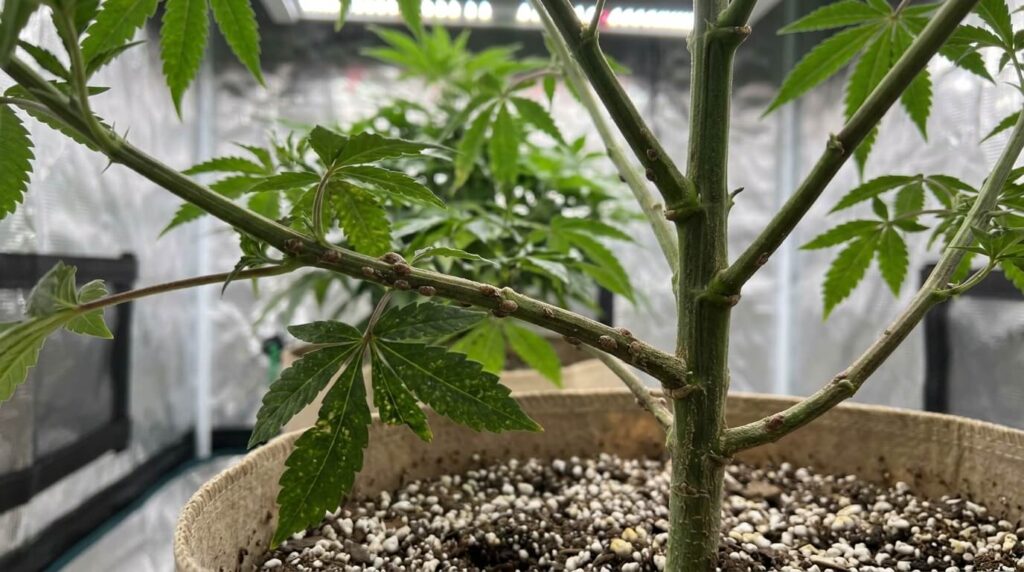
Scale insects damage autoflower cannabis plants by feeding on sap within the vascular system, removing water, nutrients, and carbohydrates needed for growth and flower production. As feeding continues, plants divert energy toward survival rather than building structure, supporting buds, or producing resin.
While minor infestations may cause limited stress, prolonged feeding can significantly reduce plant performance, especially in autoflowers with short growth cycles.
Why Scale Insects Are Problematic for Autoflowers
Autoflowers rely on rapid, uninterrupted development. Each stage contributes directly to final plant size and yield. When scale insects feed during active growth, they limit the plant’s ability to build the structure needed for productive flowering.
| Autoflower Characteristic | Impact of Scale Insects |
| Rapid development | Limited time to recover from damage |
| Compact plant size | Small growth losses have larger overall impact |
| Short vegetative phase | Reduced canopy affects future flower production |
| Automatic flowering transition | Damage continues into bloom without recovery time |
Unlike photoperiod plants, autoflowers cannot extend vegetative growth to compensate for early damage.
Impact on Development Stages
The timing of infestation strongly influences severity.
| Growth Stage | Potential Impact |
| Seedling Stage | Slower establishment and reduced vigour |
| Early Vegetative Growth | Smaller canopy and fewer branches |
| Pre-Flower | Reduced bud site potential |
| Early Flowering | Less energy for flower formation |
| Mid to Late Flowering | Smaller buds and reduced overall yield |
Infestations during weeks 2–4 are particularly damaging, as this is when autoflowers build their structural foundation.
Effects on Canopy and Bud Sites
Scale insects can limit canopy expansion by reducing branch development and overall plant size. This leads to fewer flowering sites and lower yield potential, as bud production depends on early structural growth.
Impact on Resin and Flower Quality
During flowering, plants allocate resources to trichome, terpene, and cannabinoid production. Persistent pest pressure reduces available energy, potentially leading to:
| Quality Factor | Potential Effect |
| Trichome Coverage | Reduced resin production |
| Terpene Expression | Weaker aroma profiles |
| Flower Density | Smaller, less compact buds |
| Overall Flower Quality | Lower visual and market value |
Secondary Problems Caused by Honeydew
Soft scale insects produce honeydew, which creates additional issues.
| Secondary Problem | Effect on Autoflowers |
| Sooty Mold | Blocks light and reduces photosynthesis |
| Ant Activity | Protects scale insects from predators |
| Sticky Foliage | Traps dust and debris |
| Reduced Photosynthetic Efficiency | Limits energy production |
These secondary effects can compound stress and increase the likelihood of mold on cannabis, further reducing plant performance throughout the flowering cycle.
How to Get Rid of Barnacles on Autoflower Cannabis Plants
Successfully eliminating scale insects from autoflower cannabis plants requires a combination of physical removal, targeted treatments, and ongoing monitoring. Because mature scale insects are protected by a hard outer shell, they are rarely eliminated with a single application. Effective control depends on reducing existing populations, targeting newly emerging insects, and preventing reinfestation throughout the grow cycle.
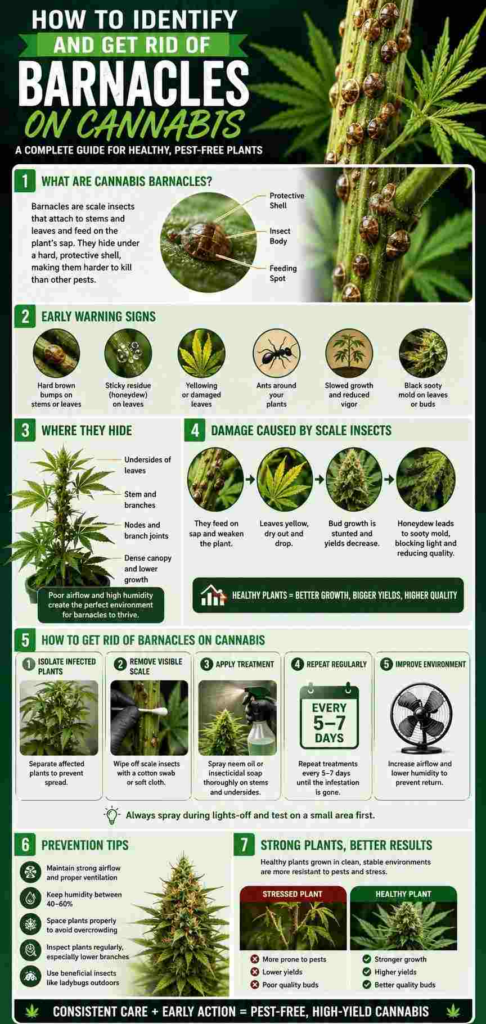
Step 1: Remove Visible Scale Insects
Manual removal is often the quickest way to reduce pest pressure, especially when infestations are confined to a few branches.
| Manual Removal Method | Purpose |
| Gently scrape insects from stems | Removes mature insects immediately |
| Wipe affected areas with diluted isopropyl alcohol | Helps break down protective coatings |
| Remove heavily infested leaves | Reduces population density |
| Dispose of plant material away from the grow space | Prevents reinfestation |
When removing scale insects, avoid damaging stems or branch tissue, as unnecessary wounds can create additional stress.
Step 2: Apply Organic Treatments
Organic treatments are often preferred by autoflower growers because they can be used strategically without relying on systemic pesticides.
| Treatment | How It Works | Best Used During |
| Neem Oil | Disrupts feeding and development | Vegetative growth |
| Insecticidal Soap | Breaks down soft-bodied insects | Light infestations |
| Horticultural Oil | Suffocates exposed insects | Early infestations |
| Diluted Alcohol Solution | Assists with spot treatment | Localised outbreaks |
For best results:
- Treat affected stems and branch junctions thoroughly
- Reapply according to product instructions
- Rotate treatments when necessary
- Monitor plants between applications
Multiple treatment cycles are usually required because newly emerging insects are more vulnerable than mature adults.
Treating Scale Insects During Autoflower Flowering
Flowering plants require a more cautious approach, as some treatments can affect bud quality.
| Flowering Stage | Treatment Consideration |
| Pre-Flower | Most organic treatments remain viable |
| Early Flower | Spot treat affected areas only when necessary |
| Mid Flower | Avoid coating developing buds |
| Late Flower | Prioritise manual removal and sanitation |
Many growers avoid spraying flowers directly, particularly during mid to late bloom, to reduce the risk of residue buildup, excess moisture, and diminished flower quality.
Supporting Autoflower Recovery
Removing scale insects is only part of the process. After treatment, the goal is to help the plant resume healthy growth with minimal additional stress.
| Recovery Focus | Benefit |
| Consistent irrigation | Supports nutrient transport |
| Balanced nutrition | Encourages healthy development |
| Stable temperatures | Minimises environmental stress |
| Appropriate airflow | Promotes overall plant health |
Avoid unnecessary transplanting, heavy defoliation, or aggressive training during recovery. Autoflowers generally perform best when growing conditions remain stable after pest pressure has been reduced.
When an Autoflower Is Too Infested to Save
In severe cases, removing a plant may be the best option to protect the rest of the grow.
| Situation | Recommended Action |
| Small localised infestation | Treat and monitor |
| Several affected branches | Implement a full treatment programme |
| Heavy infestation across the plant | Consider removal |
| Nearby plants becoming infected | Remove the source plant immediately |
While removing a plant is never ideal, sacrificing one heavily infested autoflower can prevent larger losses across the grow space.
Integrated Pest Management for Long-Term Control
The most effective strategy combines treatment with prevention.
| IPM Component | Purpose |
| Routine monitoring | Detects problems before populations expand |
| Treatment rotation | Prevents overreliance on a single control method |
| Grow room sanitation | Removes potential pest reservoirs |
| Quarantine procedures | Prevents introducing pests on new plants |
| Biological controls | Supports natural pest suppression |
Many autoflower growers run continuous cultivation cycles. In these environments, cleaning tents, tools, and equipment between grows is particularly important, as scale insects can persist and spread to younger plants introduced into the same space.
Successful control is not simply about killing existing pests. It is about creating an environment where future infestations struggle to establish themselves.
Preventing Future Scale Insect Infestations on Autoflower Cannabis Plants
Preventing scale insects is far easier than treating an established infestation. For autoflower growers, prevention is especially important because pest pressure can affect plant development long before visible damage appears. A few simple routines can dramatically reduce the likelihood of future outbreaks.
Start With Clean Plant Material
Many infestations begin when pests are introduced from outside sources.
| Prevention Measure | Benefit |
| Inspect incoming clones | Prevents hidden pests entering the grow |
| Quarantine new plants | Reduces the risk of spreading infestations |
| Clean propagation equipment | Limits cross-contamination |
| Avoid sharing tools between grows | Prevents accidental transfer |
Growers starting directly from autoflower seeds generally face a lower introduction risk than those bringing in external clones.
Maintain a Pest-Resistant Environment
Healthy plants growing in stable conditions are less vulnerable to prolonged pest pressure.
| Environmental Factor | Prevention Benefit |
| Consistent airflow | Makes pest establishment more difficult |
| Moderate humidity | Reduces favourable pest conditions |
| Proper plant spacing | Improves canopy management |
| Clean grow surfaces | Removes potential pest reservoirs |
| Sanitised tools | Prevents pest spread between plants |
Build Inspections Into Your Routine
Rather than performing occasional pest checks, make inspections part of normal plant care.
| Autoflower Stage | Inspection Focus |
| Seedling | Stem and leaf development |
| Vegetative Growth | Branch junctions and new growth |
| Flowering | Interior canopy and support branches |
Checking plants while watering or feeding makes it easier to spot problems before they spread.
Prevent Problems in Continuous Autoflower Grows
Many autoflower growers run perpetual harvest systems with plants at different stages of development. This increases the risk of pests moving between younger and older plants.
To reduce risk:
- Remove plant debris promptly
- Clean tents between harvests
- Sterilise tools regularly
- Inspect younger plants frequently
Consistent sanitation, routine inspections, and careful introduction of new plant material remain the most effective ways to prevent scale insects from becoming established in an autoflower grow.
Conclusion
Scale insects may appear harmless at first, but established infestations can have a significant impact on autoflower cannabis development, flower production, and overall plant health. By combining early intervention, appropriate treatment methods, and preventative cultivation practices, most infestations can be controlled before they become severe.
For autoflower growers, prevention is often the most effective strategy. Regular plant inspections, clean growing environments, and careful introduction of new plant material help minimise the risk of scale insects becoming established in the first place.
Successful cannabis cultivation is not simply about reacting to pests when they appear. It is about creating a stable, well-managed environment where plants can complete their lifecycle with minimal stress. When preventative habits become part of your routine, scale insects are far less likely to affect the quality, yield, and performance of your autoflower harvests.
Frequently Asked Questions
Can Scale Insects Kill an Autoflower Cannabis Plant?
A small infestation is unlikely to kill a healthy autoflower, but severe infestations can significantly weaken plants by continuously removing water, nutrients, and carbohydrates. Young autoflowers and heavily infested plants are most vulnerable to stunted growth, reduced flower development, and poor overall performance.
Are Scale Insects More Harmful to Autoflowers Than Photoperiod Plants?
Scale insects can damage any cannabis plant, but autoflowers are often less forgiving because they progress through their lifecycle on a fixed schedule. Growth lost during early development cannot always be recovered before flowering begins, making early intervention especially important.
Can You Harvest Cannabis After a Scale Insect Infestation?
In many cases, yes. If the infestation has been controlled and flowers remain free from mold, rot, or significant contamination, plants can usually be harvested normally. However, heavily contaminated flowers affected by sooty mold or other secondary issues should be inspected carefully before consumption.
Should You Remove a Heavily Infested Autoflower?
If scale insects have spread across most of the plant and treatments repeatedly fail, removing the plant may be the best option. This is particularly important when nearby plants are at risk of becoming infested, as protecting the rest of the grow often prevents larger losses.
Do Scale Insects Live in Grow Tents Between Grows?
Scale insects can survive on plant debris, contaminated equipment, and untreated plant material left in the grow environment. Thorough cleaning and sanitation between cultivation cycles help reduce the risk of future infestations.


