
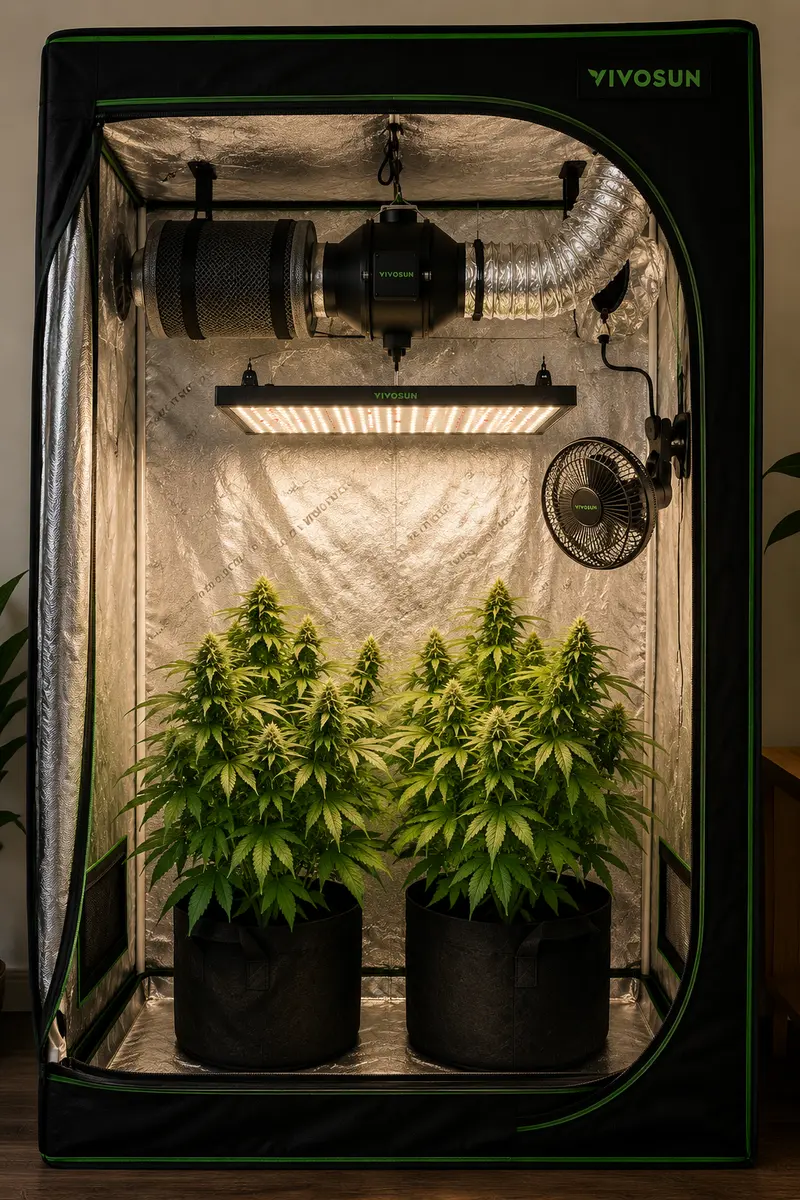
Autoflower Grow Room Ventilation: Complete Guide to Grow Tent Airflow, Fans, and Setup
Indoor cannabis cultivation depends on more than lighting, nutrients, and genetics. Without proper ventilation, even well-designed grow rooms can struggle with excess heat, rising humidity, poor air exchange, and environmental instability that limits plant performance. Effective cannabis grow room ventilation helps regulate temperature, manage moisture levels, replenish CO₂, strengthen plant structure, and create the stable conditions needed for healthy growth from seedling to harvest.
These principles are important for all indoor cannabis plants, including autoflowers. Because autoflower cannabis plants progress through their lifecycle automatically and often have shorter growth cycles, maintaining consistent airflow and environmental control can be especially beneficial throughout each stage of development.
In this guide, you’ll learn how cannabis grow room ventilation systems work, how to calculate airflow requirements, choose the right equipment, and create an efficient ventilation setup for both grow tents and larger indoor grow rooms.
Article Insights
- Most cannabis grow tents perform best when the air is fully replaced at least once every minute.
- Inline extractor fans paired with carbon filters are commonly used to remove heat, humidity, and cannabis odors.
- Passive intake systems are often sufficient for small grow tents, while larger grow rooms may benefit from active intake systems.
- Humidity levels are typically maintained around 55–70% during vegetative growth and reduced to 40–50% during flowering.
- HPS grow lights generally require stronger ventilation systems than LED grow lights due to their higher heat output.
- Proper airflow and negative pressure help reduce the risk of mold, pests, heat stress, and odor leaks.
- Autoflower cannabis plants benefit from stable humidity levels and consistent air exchange because their rapid lifecycle leaves less time to recover from environmental stress.
Why Cannabis Grow Room Ventilation Is Essential for Healthy Plants
Indoor cannabis plants rely entirely on the environment you create. Without proper airflow, your grow tent quickly becomes hot, humid, and stagnant. Cannabis plants consume CO2 rapidly while also releasing large amounts of moisture through transpiration. If stale air stays trapped around the canopy, growth slows and disease pressure increases.
Good cannabis grow room ventilation removes stale air while continuously replacing it with fresh oxygen-rich air. This creates healthier conditions for photosynthesis, nutrient uptake, and vigorous development.
How airflow affects cannabis growth, temperature, humidity, and CO2 levels
Cannabis plants need a steady supply of fresh CO2 to photosynthesise efficiently. In sealed or poorly ventilated spaces, CO2 becomes depleted surprisingly fast. Once this happens, your plants lose growth momentum and overall vigor.
I always aim to replace the air inside my grow space at least once every minute. This keeps fresh CO2 flowing while also helping control temperature and humidity.
Ventilation also regulates environmental conditions produced by grow lights, making it important to choose the right lighting setup from the start. HPS systems generate intense heat, while LEDs still produce enough warmth to increase humidity and raise temperatures in enclosed tents.
While environmental control is especially important indoors, growers using outdoor autoflower seeds can also benefit from strong airflow and humidity management throughout the season. If temperatures fluctuate significantly or humidity remains elevated for extended periods, plants have limited time to recover before flowering begins. Maintaining consistent air exchange throughout the entire lifecycle helps support steady development while reducing environmental stress that could affect final flower production.
Common ventilation problems that cause mold, pests, and weak yields
Poor ventilation creates the ideal environment for fungal diseases and pests. I have seen growers lose entire harvests because airflow was neglected.
Common ventilation-related problems include:
- Powdery mildew
- Bud rot during flowering
- Fungus gnats breeding in damp soil
- Spider mites thriving in hot stagnant air
- Weak stems caused by still air
- Heat stress reducing terpene production
Humidity buildup becomes especially dangerous during flowering because dense buds trap internal moisture.
Dense indica strains and high-yield indoor strains are often more vulnerable to excess humidity because compact flower structures can restrict airflow deep within the canopy. Many growers prefer cannabis genetics specifically suited for indoor grow tents because shorter plant structures are usually easier to ventilate and manage in controlled environments.
One issue we occasionally see reported by autoflower growers is late-flowering bud rot developing inside dense colas even when the grow room appears healthy overall. In many cases, the problem is not room humidity alone but restricted airflow through crowded canopies. Compact autoflower cultivars can develop surprisingly dense flower structures, making good air movement around developing buds increasingly important during the final weeks before harvest.
Why proper air circulation improves plant structure and bud development
Internal air circulation is just as important as extraction. Oscillating fans help mimic natural outdoor wind conditions, which encourages cannabis plants to strengthen their stems and branches.
This also improves transpiration and nutrient movement throughout the plant. Strong airflow beneath and above the canopy helps prevent humidity pockets while also keeping leaf surfaces dry.
Healthy airflow usually produces:
- Stronger stems
- Tighter node spacing
- Better bud support
- More even canopy development
Understanding the Core Components of a Cannabis Ventilation System
Every cannabis grow room ventilation system revolves around moving stale air out while bringing fresh air in. The exact equipment you need depends on your grow size, lighting type, and environmental conditions, but the core setup remains similar across most indoor gardens.
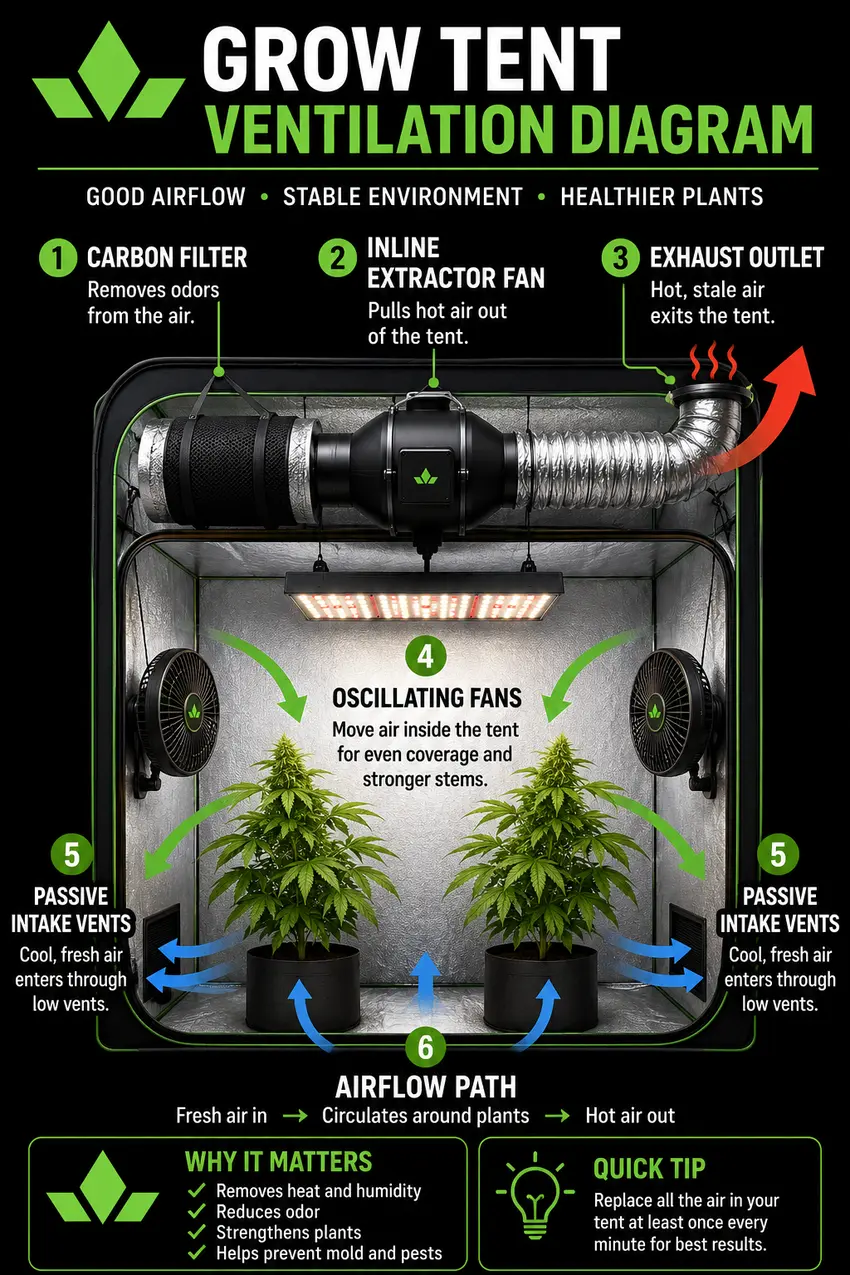
Inline extractor fans and how they work in cannabis grow rooms
The inline extractor fan is the engine of your ventilation system. It pulls hot stale air out of your grow tent while creating negative pressure inside the environment.
In most setups, extractor fans perform best when mounted near the top of the tent because heat naturally rises. The fan connects to ducting, which vents air outside the room or building.
Fans are rated using CFM, or cubic feet per minute. This measurement tells you how much air the fan can move.
A good rule is to replace the air inside your grow tent at least once per minute.
Passive vs active intake systems for grow tent ventilation
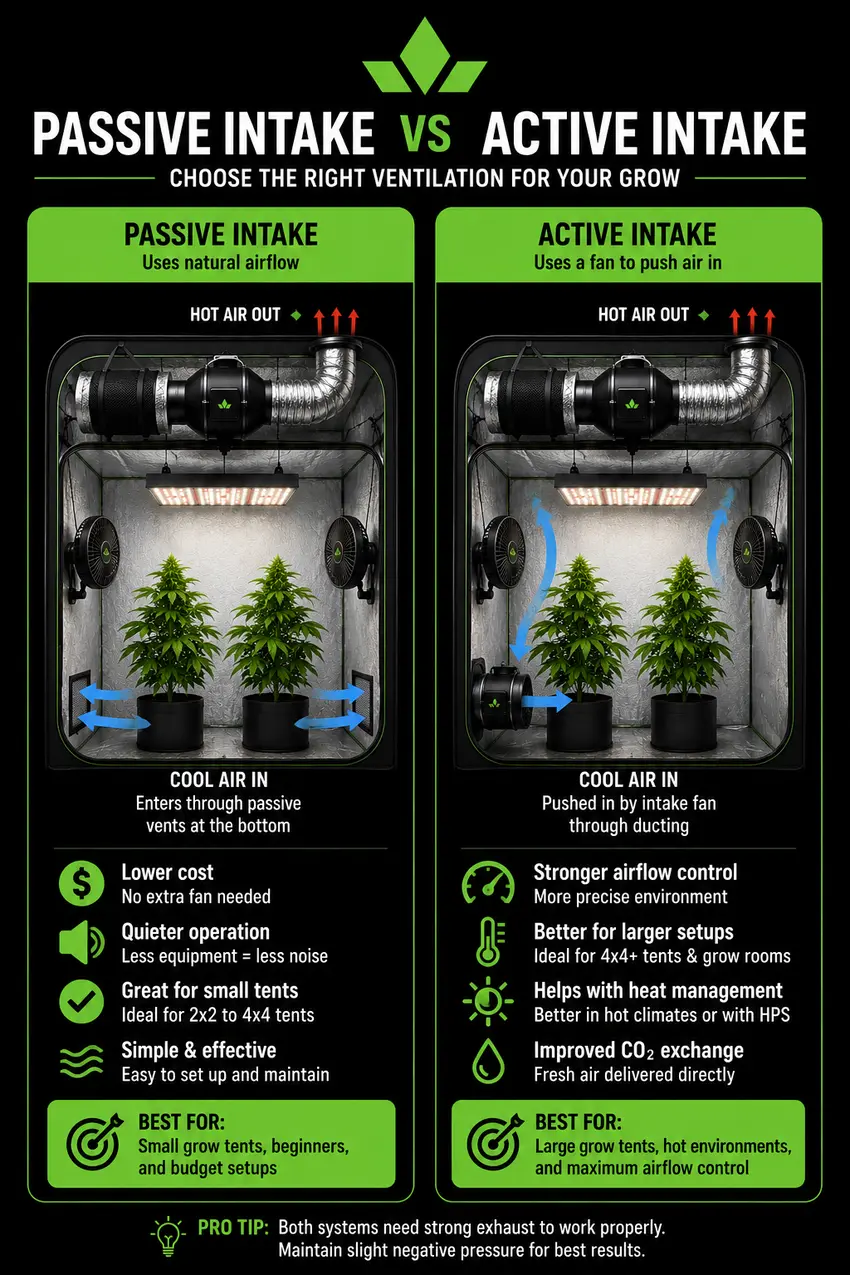
Passive intake systems rely on negative pressure created by the extractor fan. Fresh air naturally enters through intake vents near the bottom of the grow tent.
This method works extremely well for smaller setups because it is simple and cost effective.
Many autoflower growers use compact grow tents where passive intake systems are often sufficient when paired with a properly sized extraction fan. In 2×2 and 3×3 environments, the negative pressure created by an inline fan typically provides enough fresh air exchange without the additional complexity of powered intake equipment. This approach keeps airflow efficient while reducing noise, equipment costs, and maintenance requirements.
Active intake systems use an additional fan to push fresh air into the room. I usually recommend active intake for:
- Larger grow rooms
- Multi-light setups
- Hot climates
- Long duct runs
| Feature | Passive Intake | Active Intake |
| Uses Intake Fan | No | Yes |
| Best For | Small grow tents | Large grow rooms |
| Cost | Lower | Higher |
| Installation Complexity | Simple | Moderate |
| Airflow Control | Moderate | Precise |
| Noise Level | Lower | Higher |
Carbon filters, ducting, and oscillating fans explained
Carbon filters remove cannabis odors from extracted air before it leaves the grow room. I always install the filter inside the tent near the ceiling because this pulls odor-filled air directly through the carbon before extraction.
Ducting connects your equipment together and directs airflow outside the grow area. I prefer insulated ducting because it reduces noise while also improving efficiency.
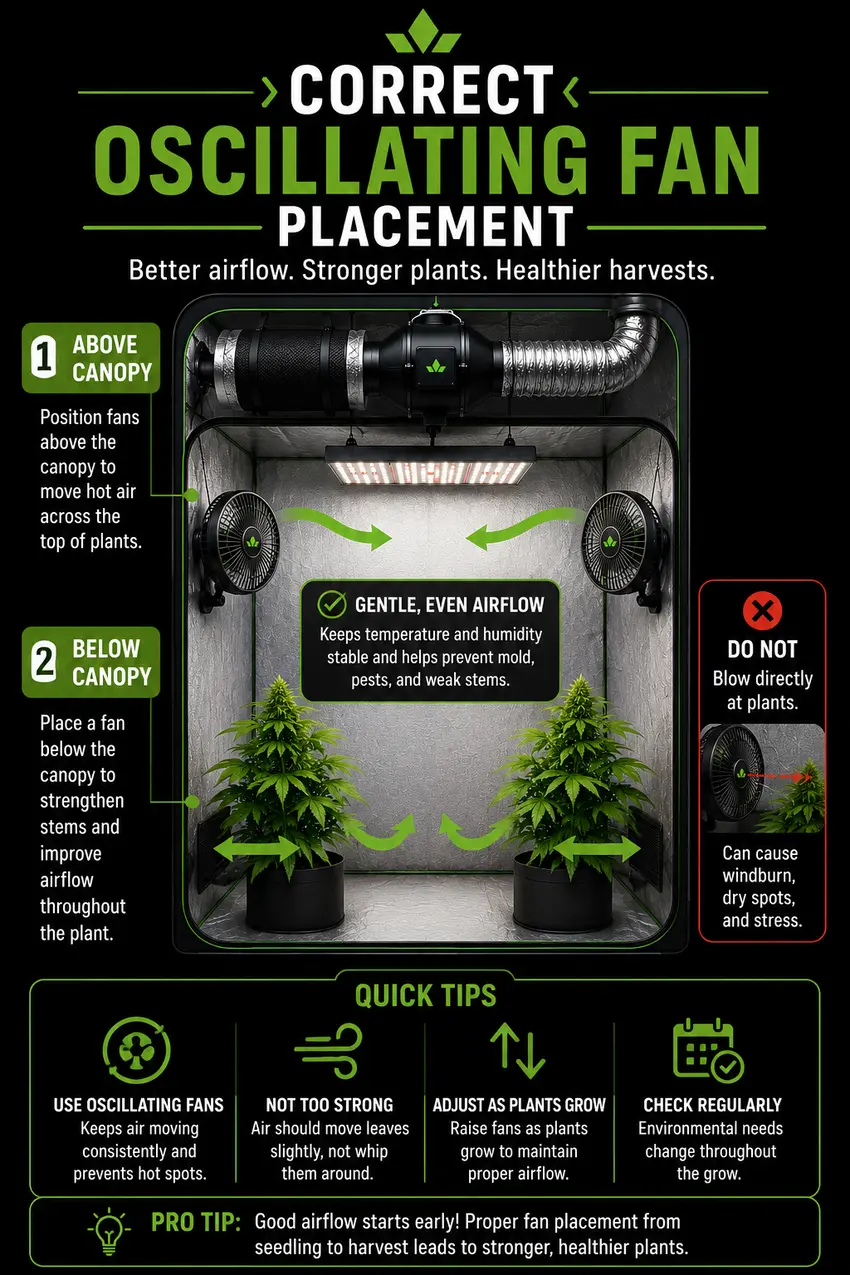
Oscillating fans maintain internal circulation. I usually position:
- One fan beneath the canopy
- One fan above canopy level
This creates layered airflow throughout the tent.
| Equipment | Purpose |
| Inline Extractor Fan | Removes hot stale air |
| Carbon Filter | Controls cannabis odor |
| Ducting | Directs airflow outside |
| Oscillating Fan | Improves canopy circulation |
| Hygrometer | Measures humidity |
| Thermometer | Tracks temperature |
| Fan Speed Controller | Adjusts airflow strength |
How to Set Up a Cannabis Grow Tent Ventilation System
Setting up cannabis grow tent ventilation is relatively straightforward once you understand airflow direction and heat management. The goal is creating smooth vertical airflow where cool air enters low while hot air exits high.
Step-by-step guide to setting up cannabis grow tent ventilation
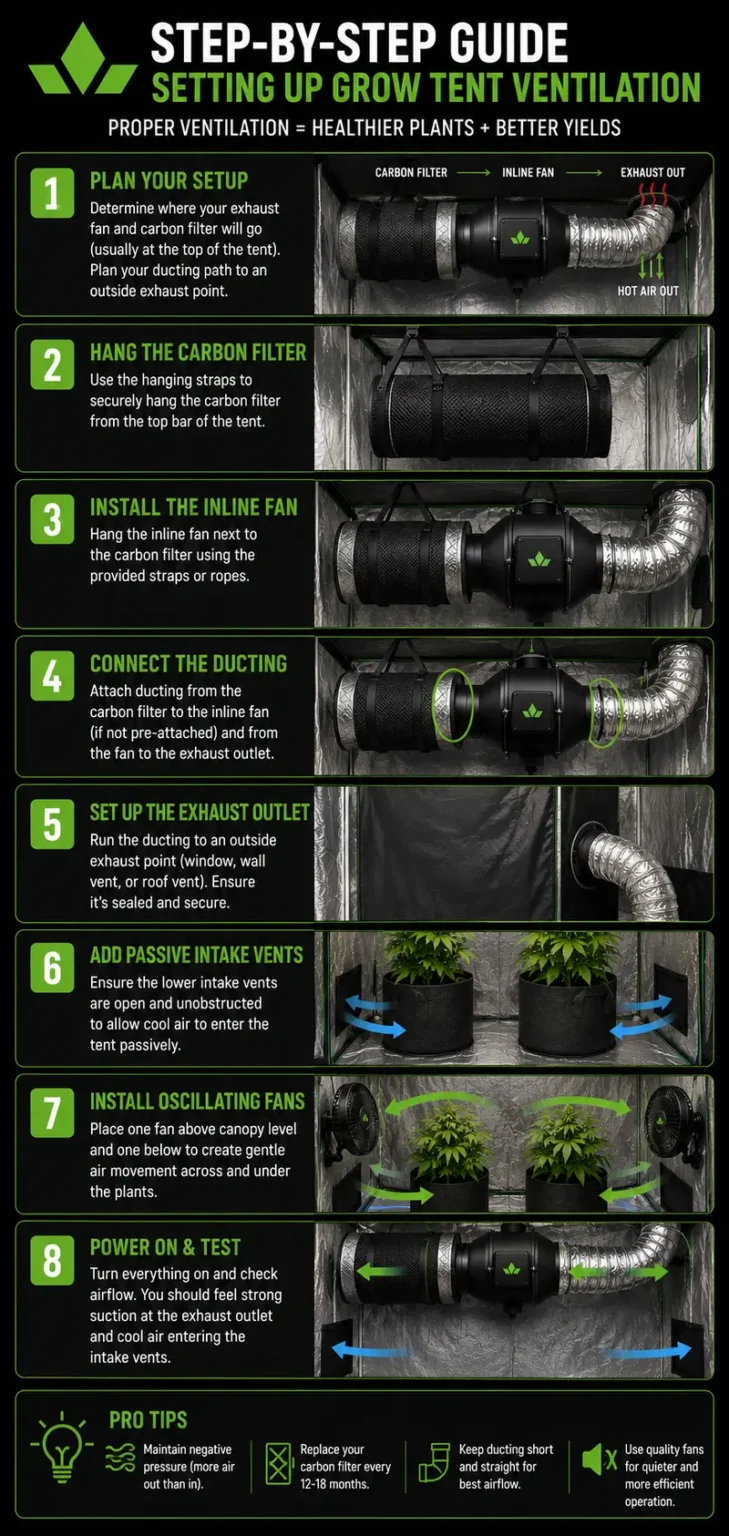
My standard ventilation setup process looks like this:
- Install the carbon filter near the top of the tent
- Attach the inline extractor fan directly to the filter
- Connect ducting from the fan to an external vent
- Open passive intake vents near the floor
- Position oscillating fans inside the canopy
This creates efficient airflow throughout the grow space while also helping maintain negative pressure.
I also keep ducting runs short and straight because excessive bends reduce extraction performance.
How to calculate CFM requirements and choose the right fan size
Calculating CFM requirements is simple but extremely important.
First calculate your grow tent volume:
Length × Width × Height = Cubic Feet
Example:
4 × 4 × 6.5 = 104 cubic feet
You should choose a fan capable of replacing that air volume at least once every minute. I usually add 25–40% extra capacity to compensate for duct resistance and carbon filters.
| Grow Tent Size | Tent Volume | Recommended Fan Size | Typical CFM Range |
| 2x2x5 ft | 20 cu ft | 4-inch inline fan | 100–150 CFM |
| 3x3x6 ft | 54 cu ft | 4–6 inch fan | 150–250 CFM |
| 4x4x6.5 ft | 104 cu ft | 6-inch inline fan | 250–400 CFM |
| 5x5x7 ft | 175 cu ft | 6–8 inch fan | 400–600 CFM |
| 8×8 Grow Room | 512 cu ft | 8-inch+ inline fan | 700+ CFM |
For autoflower setups, it is generally better to choose a fan that offers some adjustment flexibility rather than selecting equipment that operates at maximum capacity continuously. Environmental conditions often change throughout the grow cycle as plants increase in size and release more moisture into the air. A fan speed controller allows growers to fine-tune airflow as humidity levels and canopy density increase during flowering.
Where to position intake vents, exhaust fans, and carbon filters
Equipment positioning directly affects airflow efficiency. I always follow a simple vertical airflow principle.
Best positioning practices include:
- Carbon filter mounted near ceiling level
- Extractor fan positioned high inside the tent
- Intake vents opened near floor level
- Oscillating fans aimed across the canopy
You should also watch for negative pressure. When your tent walls pull inward slightly, airflow balance is correct.
Optimising Cannabis Grow Room Airflow for Maximum Yields
Once your ventilation system is operational, optimisation becomes the next step. Fine-tuning environmental conditions improves plant health, terpene retention, and overall flower quality.
Ideal temperature and humidity levels during veg and flowering
Cannabis plants prefer different environmental conditions depending on growth stage.
During vegetative growth, plants tolerate warmer temperatures and higher humidity. Flowering plants require lower humidity to reduce mold risk.
| Growth Stage | Temperature Lights On | Temperature Lights Off | Ideal Humidity |
| Seedling | 72–78°F | 68–72°F | 65–70% |
| Vegetative Stage | 72–82°F | 65–75°F | 55–70% |
| Early Flowering | 70–80°F | 65–72°F | 45–55% |
| Late Flowering | 68–78°F | 62–70°F | 40–50% |
| Drying Stage | 60–68°F | 60–68°F | 55–60% |
Stable airflow helps maintain these ranges consistently while also preventing humidity spikes during lights-off periods.
These environmental targets apply equally to autoflower cannabis plants, although many growers pay particularly close attention to humidity management during flowering. Because autoflowers often complete their lifecycle quickly, excessive moisture can become problematic if conditions remain elevated for multiple days. Lowering relative humidity gradually as flowers mature helps create a healthier environment while reducing the likelihood of mold developing within dense bud structures.
Autoflower ventilation requirements and best practices
Autoflower ventilation follows the same environmental principles as any indoor cannabis setup, but the shorter lifecycle of autoflowering plants leaves less room for error. Unlike photoperiod varieties that can remain in vegetative growth for extended periods, autoflowers transition into flowering based on age. Environmental problems that occur during the first few weeks can affect plant size, structure, and final harvest potential before growers have time to make corrections.
Because of this accelerated development, maintaining stable air movement, temperature control, and humidity management from day one becomes particularly important.
Managing Airflow During the Autoflower Seedling Stage
Young autoflower seedlings benefit from fresh air circulation, but they do not require strong direct airflow. One of the most common mistakes I see is positioning an oscillating fan too close to newly emerged plants. Constant force against fragile stems can slow development and create unnecessary stress.
During the seedling phase, the goal is gentle air movement throughout the grow space rather than wind directed at the plants themselves. A lightly circulating environment helps strengthen stem tissue, reduces stagnant moisture around the soil surface, and discourages fungal problems without overwhelming young growth.
In small tents, a low-speed circulation fan combined with an appropriately sized extraction system is usually sufficient during the first two weeks.
When testing new autoflower lines, we generally see stronger early development when seedlings receive gentle air movement rather than direct fan exposure. Seedlings rarely benefit from aggressive airflow, and allowing them to establish healthy roots before increasing circulation often produces more vigorous growth during the first few weeks.
Humidity Control for Autoflower Cannabis Plants
Humidity management becomes increasingly important as autoflowers progress through their lifecycle. Since many autoflower cultivars complete flowering within eight to ten weeks from seed, environmental conditions can change rapidly as biomass accumulates.
During early growth, slightly elevated humidity supports healthy transpiration and root development. As flowers begin forming, moisture levels should gradually decrease to minimise the likelihood of mold developing within dense bud sites.
As a general guideline:
| Growth Stage | Recommended Relative Humidity |
| Seedling | 65-70% |
| Early Vegetative Growth | 55-65% |
| Early Flowering | 45-55% |
| Late Flowering | 40-50% |
Monitoring humidity becomes especially important in compact tents where transpiration can raise moisture levels quickly during lights-off periods.
One pattern we frequently see when helping growers troubleshoot flowering issues is humidity creeping higher than expected after lights-out. Small tents can appear perfectly dialed in during the day, only for moisture levels to rise significantly overnight when airflow slows and temperatures drop. Monitoring both day and night conditions often reveals issues that are easy to miss when relying on daytime readings alone.
Ventilation Strategies for Small Autoflower Grow Tents
Many indoor cultivators grow autoflowers in 2×2, 2×4, or 3×3 grow tents. These environments are highly efficient but can experience rapid environmental fluctuations because of their limited air volume.
For most small setups, a passive intake system paired with a quality inline extractor fan provides adequate air exchange. Fresh air enters through lower vents while warm, moisture-laden air exits through the extraction system positioned near the top of the tent.
I generally recommend keeping duct runs as short as possible and avoiding unnecessary bends. Every restriction reduces extraction efficiency and forces the fan to work harder to maintain stable conditions.
A properly balanced setup should maintain slight negative pressure while continuously exchanging air throughout the enclosure.
During indoor testing, overcrowding consistently creates more ventilation problems than fan size alone. Even with adequate extraction, tightly packed plants can restrict airflow through the canopy and create pockets of trapped humidity around developing flowers. In many cases, slightly fewer plants with better spacing produce a healthier environment than trying to maximize every square inch of tent space.
Preventing Wind Stress in Autoflower Gardens
Autoflowers respond well to consistent environmental conditions, but excessive air movement can create avoidable problems. Wind stress occurs when circulation fans are aimed directly at foliage for extended periods, causing leaves to curl, dry out, or develop damaged edges.
Rather than focusing airflow directly on plants, position oscillating fans so air moves across the canopy and around the grow space. This approach improves environmental uniformity while avoiding unnecessary mechanical stress.
A simple test is to observe leaf movement. Foliage should gently sway rather than bend aggressively.
Wind stress is often mistaken for nutrient deficiencies because affected leaves can curl, twist, or develop symptoms similar to cannabis leaves turning yellow. When troubleshooting grower photos, fan placement is frequently one of the first things worth checking before adjusting feeding schedules or environmental settings.
LED Lighting and Autoflower Ventilation
Modern autoflower cultivation is commonly associated with full-spectrum LED lighting. These fixtures produce less radiant heat than traditional HPS systems, making environmental control easier in smaller growing areas.
However, lower temperatures do not eliminate the need for proper air exchange. LED gardens often experience increased humidity because plants continue transpiring while ambient temperatures remain lower. Without adequate extraction, moisture can accumulate quickly as flowering progresses.
For this reason, I pay close attention to relative humidity readings during the final weeks before harvest. Maintaining steady environmental conditions during this period helps protect flower quality and reduces disease pressure.
Creating a Stable Environment From Seed to Harvest
Ventilation is only one part of creating a productive indoor setup, and growers should also understand the fundamentals of how to grow autoflower indoors successfully.
The most effective autoflower ventilation strategy is not necessarily the most powerful one. Success comes from consistency rather than maximum airflow. Reliable extraction, balanced circulation, and controlled humidity create an environment where plants can complete their lifecycle without interruption.
When temperature, humidity, and air exchange remain within suitable ranges, autoflowers can focus their energy on growth and flower production instead of responding to environmental stress. Over multiple cycles, this stability often contributes more to harvest quality than any single piece of equipment.
How LED and HPS grow lights affect ventilation requirements
Grow lights dramatically influence cannabis ventilation requirements.
HPS lighting produces large amounts of radiant heat. Older growers often joke that HPS fixtures double as room heaters because of the intense temperatures they create.
When using HPS lights, I usually increase extraction speed while also adding extra circulation fans.
LED grow lights run cooler overall, but they still require ventilation because enclosed grow tents trap humidity rapidly. LED systems are particularly popular for autoflower cultivation because they make it easier to maintain stable environmental conditions in smaller indoor spaces. While reduced heat output simplifies temperature management, growers should continue monitoring humidity closely as plants mature. In many cases, moisture accumulation becomes a greater challenge than excessive heat, especially during late flowering when transpiration rates remain high.
| Feature | LED Grow Lights | HPS Grow Lights |
| Heat Output | Low to Moderate | High |
| Ventilation Demand | Moderate | High |
| Humidity Build-Up | Higher risk | Lower risk |
| Energy Efficiency | High | Moderate |
| Cooling Equipment Needed | Usually minimal | Often required |
| Recommended Exhaust Strength | Medium | Strong |
Airflow strategies for small grow tents and larger grow rooms
Small grow tents require highly efficient airflow because environmental changes happen quickly inside confined spaces.
For compact tents, I focus heavily on:
- Strong extraction
- Minimal duct bends
- Stable negative pressure
- Gentle canopy circulation
These principles are especially important for autoflower cultivation because smaller tents are among the most common environments used for these plants. Limited space can cause temperature and humidity levels to change quickly, making consistent extraction and circulation particularly valuable. Maintaining steady conditions throughout the grow cycle often contributes to more uniform plant development and easier environmental management from seedling through harvest.
Larger grow rooms require layered airflow systems that combine extraction, intake, circulation, and humidity management.
Commercial-style environments often use:
- Multiple extractor fans
- Dehumidifiers
- Environmental controllers
- Horizontal airflow fans
- Dedicated intake systems
Common Cannabis Ventilation Mistakes and How to Avoid Them
Ventilation mistakes are extremely common during a first indoor grow and are often easier to fix than most people realize.
Choosing the wrong extractor fan size for your grow room
Undersized extractor fans struggle to:
- Remove heat
- Maintain negative pressure
- Control humidity
- Filter odors properly
This usually results in excessive humidity, heat buildup, and weak airflow.
Oversized fans can also create problems by drying plants too aggressively or causing wind stress inside small tents.
Balanced airflow always performs better than excessive airflow.
Poor duct routing, weak airflow, and humidity buildup issues
Long duct runs with excessive bends dramatically reduce extraction performance.
Common ducting mistakes include:
- Crushed ducting
- Sharp bends
- Long unsupported runs
- Poor sealing
Weak airflow often creates stagnant humidity pockets beneath dense canopies. Adding oscillating fans beneath the canopy usually improves this problem quickly.
Signs your cannabis grow tent ventilation system is not working properly
Your plants often reveal ventilation problems before equipment does.
| Problem | Likely Cause | Solution |
| High Humidity | Weak airflow | Increase extraction fan speed |
| Heat Stress | Undersized exhaust fan | Upgrade inline fan |
| Mold or Bud Rot | Poor circulation | Add oscillating fans |
| Odor Leaks | Weak negative pressure | Improve extraction setup |
| Weak Plant Stems | Stagnant air | Increase canopy airflow |
| Windburn | Fan pointed directly at plants | Redirect airflow |
Daily monitoring with a hygrometer and thermometer helps identify environmental issues before they affect plant health.
Recommended Cannabis Genetics for Indoor Grow Tent Setups
Choosing cannabis genetics suited for indoor environments can make airflow management significantly easier, especially in smaller grow tents. From a breeding and cultivation perspective, compact autoflower cultivars are often easier to manage in smaller grow tents because canopy density, plant height, and airflow are generally easier to control. During indoor testing, we typically find that medium-sized autoflower plants with balanced branching allow better air movement through the canopy than extremely dense or heavily crowded growth patterns. Regardless of genetics, maintaining adequate spacing between plants remains one of the simplest ways to improve airflow and reduce humidity-related issues during flowering.
Conclusion
Cannabis grow room ventilation is one of the foundations of successful indoor cultivation. Proper airflow controls temperature, humidity, odor management, and CO2 exchange while also helping prevent mold, pests, and environmental stress.
When you understand how to set up cannabis grow tent ventilation properly, you create a stable environment where your plants can thrive from seedling to harvest. Balanced extraction, strong internal circulation, efficient ducting, and proper intake airflow all work together to improve plant health and flower production.
After working with autoflower cultivars across multiple indoor environments, one lesson remains consistent: ventilation problems are far easier to prevent than correct. Even high-performing genetics can struggle when airflow, humidity, and temperature drift outside optimal ranges for extended periods.
Keep your air fresh, keep it moving, and your cannabis plants will reward you with dense buds, louder terpenes, and healthier harvests every cycle.
Frequently Asked Questions About Cannabis Grow Room Ventilation
What is the best ventilation setup for a cannabis grow tent?
Most indoor cannabis grow tents use an inline extractor fan, carbon filter, ducting, and one or two oscillating fans for internal airflow. The extractor fan is typically mounted near the top of the tent to remove heat and stale air, while passive intake vents near the bottom allow fresh air to enter naturally.
How much airflow does a cannabis grow tent need?
A common recommendation is to replace all the air inside the grow tent at least once every minute. Growers usually calculate this using the tent’s cubic footage and then choose an extractor fan with a slightly higher CFM rating to compensate for ducting and carbon filter resistance.
Do cannabis grow tents need intake fans?
Small grow tents often work well with passive intake systems, where fresh air enters through lower vents naturally. Larger grow rooms or setups with multiple grow lights may benefit from active intake fans to improve airflow and maintain stable temperatures.
Should grow room ventilation systems run 24/7?
Most growers run ventilation systems continuously or at reduced speeds throughout the entire grow cycle. Constant airflow helps maintain stable humidity, temperature, and CO2 levels while also reducing the risk of mold and stagnant air buildup.
What humidity level is best for indoor cannabis plants?
Humidity levels usually vary depending on the growth stage. Seedlings and vegetative plants commonly prefer 55–70% humidity, while flowering cannabis plants generally perform better around 40–50% humidity to reduce the risk of bud rot and mold.
Are LED grow lights easier to ventilate than HPS lights?
LED grow lights typically produce less heat than HPS systems, which can reduce overall ventilation demands. However, enclosed grow tents using LEDs can still develop humidity buildup, so proper airflow and extraction remain important.
Why is negative pressure important in a cannabis grow tent?
Negative pressure helps control odors and improves airflow efficiency by ensuring more air is being extracted than pushed into the tent. A properly balanced system usually causes the tent walls to pull inward slightly, which is a common sign of effective ventilation.
Can poor ventilation reduce cannabis yields?
Poor airflow can contribute to heat stress, humidity buildup, weak growth, mold problems, and reduced photosynthesis. Over time, these environmental issues may negatively affect plant structure, flower development, and overall yield quality.
Where should oscillating fans be placed inside a grow tent?
Oscillating fans are usually positioned above and below the canopy to maintain even airflow throughout the grow space. Fans should move air gently across the plants without blowing directly at leaves continuously, as this can cause windburn.
Do carbon filters remove all cannabis odor?
Carbon filters are commonly used to significantly reduce cannabis odors in indoor grow setups, although performance varies depending on filter quality, airflow balance, and maintenance. Most filters become less effective over time and eventually need replacing.
Do autoflowers need different ventilation than photoperiod plants?
Autoflower cannabis plants generally use the same ventilation principles as photoperiod varieties, including regular air exchange, internal circulation, and humidity management. However, because autoflowers progress through their lifecycle automatically, maintaining stable environmental conditions from an early stage can be especially important for supporting healthy growth and flower development.
Can autoflowers receive too much airflow?
Yes. While air movement helps strengthen plant structure and improve environmental consistency, fans that blow directly onto plants for extended periods can cause wind stress. Leaves should move gently rather than bend continuously under strong airflow.
What size extractor fan is best for an autoflower grow tent?
The ideal fan size depends on tent dimensions, lighting equipment, and ducting configuration. For most 2×2 or 3×3 autoflower grow tents, a quality 4-inch or 6-inch inline extractor fan is usually sufficient to replace the air inside the tent at least once per minute.


