
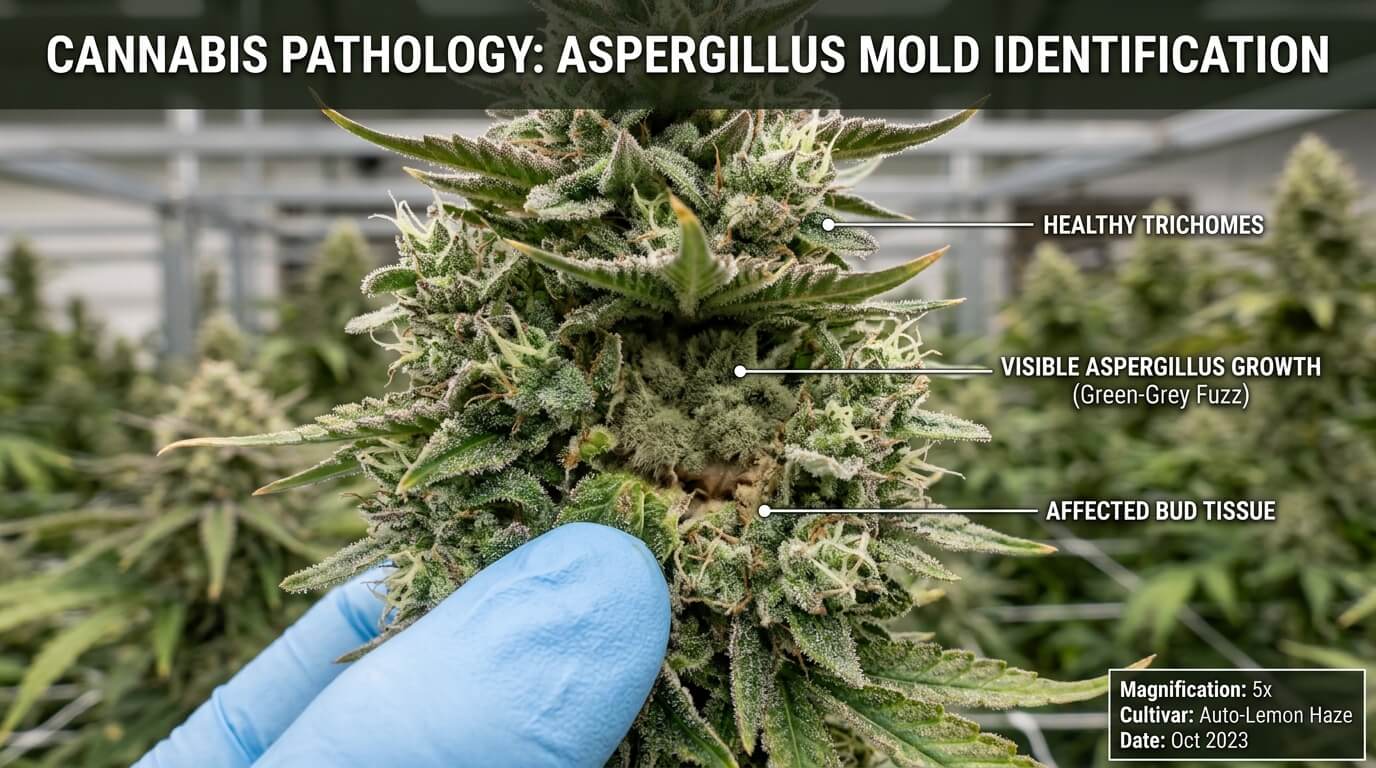
Aspergillus Mold in Autoflowers: How to Identify, Prevent, and Protect Your Harvest
Aspergillus mold on cannabis is one of the more serious fungal issues growers can run into, mainly because it can develop inside the buds before you notice anything is wrong. Unlike powdery mildew, which shows up on leaf surfaces, Aspergillus cannabis contamination tends to form deep within dense flowers where airflow is limited and moisture gets trapped. This is especially important for autoflower growers, as modern autoflower strains often produce tight, resin-heavy colas and move through their lifecycle quickly, leaving less time to fix environmental problems late in flowering.
Aspergillus spores are naturally present in soil, dust, and the air, so the goal isn’t to eliminate them completely. Instead, it’s about managing the conditions that allow them to grow. Keeping humidity in check, maintaining good airflow, and handling drying properly all play a key role in preventing issues.
In this guide, you’ll learn how to spot aspergillus mold on cannabis, understand why autoflowers can be more vulnerable, and apply practical steps from early growth through harvest and storage to protect your plants and your final yield.
What Is Aspergillus Mold and Why Is It a Threat to Autoflower Growers?
Aspergillus is one of several types of mold on cannabis that can affect plants during cultivation, drying, and storage. Its microscopic spores are constantly moving through the environment and can easily enter an indoor grow space through ventilation systems or settle on outdoor cannabis plants. Because these spores are so widespread, completely eliminating them isn’t realistic. Instead, successful cultivation comes down to preventing the conditions that allow them to develop into active fungal growth.
For autoflower growers, this creates a specific challenge. Modern autoflower genetics are bred to produce dense, resin-rich flowers in as little as 8 to 12 weeks from seed. While these compact colas can deliver impressive yields and potency, they also create tight internal spaces where moisture and stagnant air can build up. If humidity stays elevated during late flowering, these hidden pockets can become ideal environments for mold to develop before anything is visible on the surface.
Rather than thinking of Aspergillus contamination as something caused by spores alone, it’s more accurate to see it as an environmental issue. Spores are always present, but they only become a problem when conditions allow them to grow. High humidity, poor airflow through the canopy, wet plant surfaces, and limited air exchange all contribute to creating an environment where fungal growth can take hold. In a well-managed grow, spores often remain inactive from start to finish.
The table below highlights the main environmental factors that increase the risk of Aspergillus in autoflower cannabis.
| Factor | Why It Increases Risk in Autoflowers |
| High relative humidity | Provides the moisture spores need to germinate. |
| Dense autoflower colas | Restrict airflow and trap humidity inside the buds. |
| Poor canopy airflow | Slows down moisture evaporation around leaves and flowers. |
| Dead plant material | Acts as a food source for fungal growth. |
| Poor sanitation | Allows spores to build up on surfaces and equipment. |
| Incorrect drying conditions | Can lead to mold developing after harvest, even if plants looked healthy. |
How Aspergillus Contaminates Cannabis Plants
Unlike many plant diseases that spread directly from one plant to another, Aspergillus usually starts when airborne spores land on flowers and encounter the right conditions to grow. Since spores are already present in most environments, contamination rarely comes from a single source. It typically develops when several risk factors come together at the same time.
A simple way to think about it is that spores are always there, but your environment determines whether they stay inactive or begin to grow. During late flowering, dense autoflower canopies with limited airflow can hold more moisture inside the central cola than the surrounding air. Even if your hygrometer shows acceptable humidity levels, the inside of a mature bud can stay damp enough for fungal activity if air movement is insufficient.
Aspergillus Species Found on Cannabis
Although there are hundreds of Aspergillus species, only a few are commonly linked to cannabis cultivation and microbial testing.
| Species | Significance |
| Aspergillus fumigatus | Often found in compost and organic matter and commonly associated with contamination. |
| Aspergillus flavus | Known for its ability to produce aflatoxins under certain conditions. |
| Aspergillus niger | Recognisable by its dark spores and widespread presence in the environment. |
| Aspergillus terreus | A naturally occurring soil fungus sometimes detected on cannabis. |
For most home growers, identifying the exact species isn’t practical without lab testing, and it usually doesn’t change how the issue should be handled. Preventing fungal growth through proper environmental control is far more important than trying to identify specific species.
Where Aspergillus Spores Commonly Enter an Autoflower Grow
Many growers focus only on their plants and overlook how spores enter the grow space in the first place. In reality, contamination often begins long before any signs appear on the plant.
| Source | Risk Level |
| Organic potting mixes and compost | High |
| Unfiltered intake air | High |
| Outdoor dust and wind | High |
| Dirty extraction ducts and fans | Medium to High |
| Dead leaves and plant debris | Medium |
| Trimming scissors and tools | Medium |
| Drying rooms with poor airflow | Medium to High |
Outdoor autoflowers are constantly exposed to spores carried by wind, rain, dust, and nearby vegetation, which makes environmental awareness and harvest timing especially important. Indoor growers have more control, but that advantage can quickly disappear if filters aren’t maintained, dead plant material is left in the grow space, or humidity rises during flowering. Keeping equipment clean, maintaining steady airflow, and managing the environment carefully are the most reliable ways to reduce the risk of contamination.
How to Identify Aspergillus Mold on Autoflower Cannabis
Identifying aspergillus mold can be difficult because early contamination usually develops inside dense flowers before obvious symptoms appear. Unlike powdery mildew, which often forms a visible white coating on leaf surfaces, Aspergillus typically establishes itself within the center of mature buds where humidity remains highest. By the time fungal growth becomes visible on the outside of an autoflower cola, contamination may already have spread through the inner flower.
Modern autoflower cultivars require particularly close inspection during the final weeks before harvest. Their compact bud structure, high resin production, and short flowering period leave little opportunity to correct environmental problems once fungal growth begins.
Rather than looking for one obvious symptom, inspect each plant using the same routine every few days throughout late flowering.
A Simple Inspection Routine for Autoflowers
During late flowering, we inspect every mature autoflower using the same routine during breeding and cultivation trials because following the same order each time makes subtle changes much easier to spot.
- Examine the sugar leaves surrounding each main cola for unexpected yellowing, browning, or curling.
- Smell the flower before touching it. Healthy buds should have a strong terpene aroma, while contaminated flowers often develop a damp, earthy, or musty smell.
- Gently separate the outer calyxes without damaging the bud and inspect the center of the cola.
- Compare any suspicious flower with healthy buds elsewhere on the same plant.
- Repeat the inspection every day during the final week before harvest, particularly after periods of high humidity.
This routine only takes a few minutes per plant but often identifies developing fungal problems before they affect the entire harvest.
The table below summarizes the most common warning signs.
| Warning Sign | Possible Aspergillus Indicator |
| Localized flower discoloration | Yes |
| Musty or earthy odor | Yes |
| Dust-like fungal growth | Yes |
| Premature flower degradation | Yes |
| Uneven drying within a cola | Yes |
| White coating on leaves | Usually powdery mildew |
| Brown collapsing buds | Often Botrytis (bud rot) |
Early Signs of Aspergillus in Autoflower Buds
Early signs of Aspergillus are often subtle rather than obvious. During late flowering, a healthy autoflower should continue producing swollen calyxes, sticky resin, and a strong, characteristic aroma. If a single cola begins to fade prematurely, develops an unusual earthy smell, or a few sugar leaves start to die back while the rest of the plant remains healthy, it’s worth taking a closer look.
In practice, inspecting only the outer surface of the buds isn’t enough. Gently opening up dense colas and checking the inner calyxes—where moisture tends to build up—can reveal hidden problems early on. This is particularly important when working with dense autoflower genetics.
Visual Symptoms of Aspergillus Cannabis
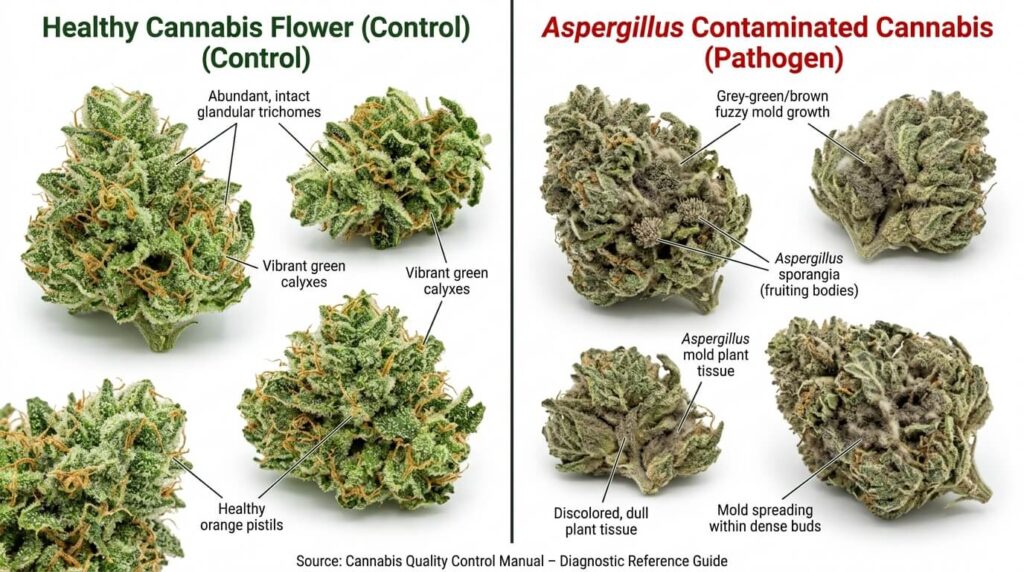
The appearance of Aspergillus can vary depending on environmental conditions and how far the infection has progressed. There isn’t a single color or texture that confirms contamination, so it’s important to consider multiple symptoms together.
| Symptom | Description |
| Dust-like fungal growth | Fine fungal material forming on flowers |
| Discoloration | Gray, green, yellow, or black patches within buds |
| Dry or brittle flowers | Loss of normal flower texture |
| Premature tissue breakdown | Flowers deteriorating before harvest |
| Uneven drying | Sections of the bud drying at different rates |
| Musty odor | Earthy smell replacing the natural terpene profile |
Where Aspergillus Commonly Develops in Autoflowers
Aspergillus rarely starts on the outside of a healthy flower. Instead, it usually develops where moisture remains trapped for extended periods.
Pay particular attention to:
- Large central colas.
- Tightly packed secondary buds.
- Flowers touching tent walls or neighboring plants.
- Shaded sections of the canopy with limited airflow.
- Buds damaged by insects, pruning, or physical handling.
These areas retain moisture longer than exposed flowers and should be inspected more frequently during late flowering.
Aspergillus vs Powdery Mildew vs Bud Rot
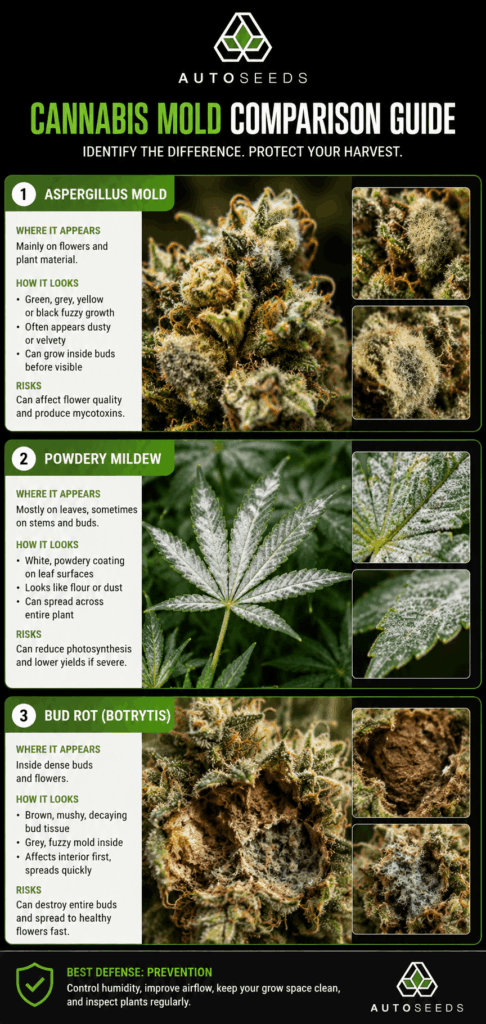
Fungal issues can look very similar, which often leads to confusion.
| Condition | Appearance | Typical Location | Common Cause |
| Aspergillus | Gray, green, yellow, or black growth | Inside buds | High humidity and stagnant air |
| Powdery Mildew | White powder-like coating | Leaves and stems | High humidity and poor airflow |
| Bud Rot (Botrytis) | Brown decaying flowers with gray mold | Center of dense buds | Excess moisture trapped in flowers |
Powdery mildew usually appears on exposed leaf surfaces, making it easier to spot early. Bud rot, on the other hand, develops inside dense flowers and causes rapid decay. Aspergillus can resemble both at different stages, which is why laboratory testing is the only reliable way to confirm the exact species.
Week-by-Week Aspergillus Risk in Autoflowers
Because autoflowers grow quickly, it’s important to increase inspection frequency as the plant matures. Understanding the autoflower life cycle also makes it easier to anticipate when mold risk begins increasing and when daily inspections become worthwhile.
| Autoflower Stage | Risk Level | What to Monitor |
| Weeks 1–3 | Low | Healthy seedlings and steady growth |
| Weeks 4–5 | Moderate | Increasing canopy density and airflow |
| Weeks 6–8 | High | Dense cola formation and internal humidity pockets |
| Weeks 8–10+ | Very High | Daily inspection of mature buds and sugar leaves |
| Drying | High | Slow drying, poor airflow, uneven moisture loss |
| Curing | Moderate | Stable humidity and regular inspection of stored buds |
Many growers focus heavily on the growing phase but overlook what happens after harvest. In reality, drying and curing are just as critical. Even buds that appear healthy can develop contamination if they dry too slowly or are stored with too much moisture. Keeping a close eye on conditions from late flowering through storage is one of the most effective ways to protect both quality and yield.
Aspergillus Autoflower Risks and Environmental Triggers
Aspergillus does not specifically target autoflower cannabis plants, but certain characteristics of modern autoflower genetics can create conditions that favor fungal development. Dense flower formation, rapid flowering, and compact plant structure all influence how moisture moves through the canopy and how easily contamination can develop if environmental conditions become unfavorable.
Unlike many plant diseases, Aspergillus is rarely the result of a single mistake. Fungal spores are already present in most growing environments, but they require moisture and suitable conditions to colonize plant tissue. For autoflower growers, understanding when and where those conditions develop is one of the most effective ways to reduce the risk of contamination before harvest.
Why Dense Autoflower Buds Can Create Mold-Prone Conditions
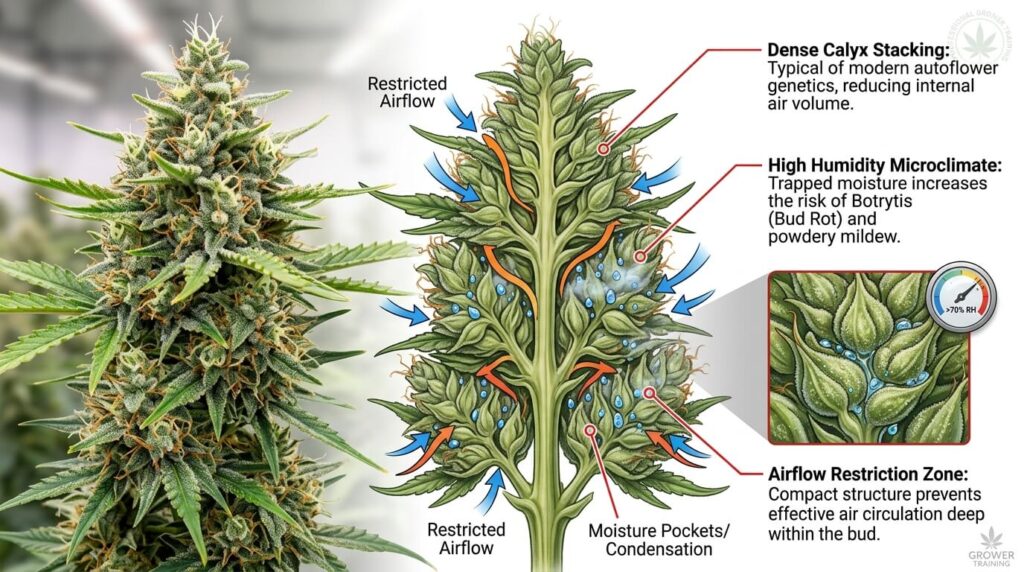
Modern autoflower cultivars are capable of producing large, compact flowers that rival many photoperiod varieties. While this has significantly improved yields and flower quality, dense bud structure also changes the environment inside the cola.
As flowers mature, swollen calyxes press tightly together, reducing airflow through the center of the bud. Moisture from high humidity, irrigation, rainfall, or overnight condensation can take longer to evaporate from these protected areas than from the outside of the plant. If moisture remains trapped for extended periods, it creates favorable conditions for aspergillus moldto develop within the flower before external symptoms become visible.
The table below highlights why dense autoflower flowers increase Aspergillus risk.
| Bud Characteristic | Impact on Aspergillus Risk |
| Dense flower structure | Restricts airflow through the center of the bud. |
| Large central colas | Retain moisture for longer after humid conditions. |
| Tight calyx formation | Creates small pockets where humidity can accumulate. |
| Heavy resin production | Can slow moisture evaporation from flower surfaces. |
| Closely spaced branches | Reduces airflow between neighboring buds. |
This is one reason Aspergillus contamination is often discovered inside mature flowers rather than on exposed surfaces. A cola can appear healthy externally while fungal growth is already developing within its densely packed interior.
One thing we’ve noticed while testing modern autoflower lines is that the highest-yielding plants are often the ones that require the closest inspection during late flower. Dense, golf-ball-hard colas are excellent for production, but they also restrict airflow deep inside the flower. During phenotype evaluations, those are always the buds we inspect first after periods of elevated humidity because problems nearly always begin there before smaller side branches show any symptoms.
How Humidity, Temperature and Airflow Influence Aspergillus Growth
Environmental conditions determine whether naturally occurring Aspergillus spores remain inactive or begin colonizing cannabis flowers. Moisture is the single most important requirement, but it rarely acts alone. Temperature, airflow, and ventilation all influence how quickly moisture evaporates from developing buds.
The table below outlines the main environmental factors that encourage Aspergillus development.
| Environmental Factor | Why It Increases Risk |
| High relative humidity | Provides the moisture spores need to germinate. |
| Warm temperatures with elevated humidity | Encourage fungal growth. |
| Poor airflow | Slows moisture evaporation around flowers. |
| Dense canopies | Reduce air movement between buds. |
| Inadequate ventilation | Allows humid air to remain inside the grow space. |
| Condensation | Leaves prolonged surface moisture on flowers. |
One important point for autoflower growers is that room conditions don’t always reflect conditions inside the flowers themselves. A hygrometer may indicate acceptable relative humidity, but the center of a mature cola can remain noticeably more humid because airflow cannot easily reach the inner calyxes. This is why dense flowers should be inspected carefully whenever humidity remains elevated for extended periods.
Indoor vs Outdoor Aspergillus Risks for Autoflower Cannabis
Both indoor and outdoor autoflowers can be affected by Aspergillus, although the environmental triggers differ.
Indoor cultivation allows growers to regulate temperature, humidity, and airflow more precisely, reducing the likelihood of fungal development when environmental conditions remain stable. However, prolonged humidity spikes, poor ventilation, or inadequate air circulation during flowering can still create favorable conditions for contamination.
Outdoor autoflowers are continuously exposed to airborne Aspergillus spores carried by wind, dust, and rain. Morning dew, extended rainfall, and prolonged periods of high humidity can leave dense flowers damp for hours, particularly late in flowering when buds are fully developed. While growers cannot eliminate these natural spores, selecting an appropriate growing season and monitoring flowers during wet weather can reduce the opportunity for contamination to become established.
| Growing Environment | Primary Aspergillus Risk |
| Indoor grow tent | Humidity spikes and restricted airflow. |
| Indoor grow room | Poor ventilation and stagnant air. |
| Greenhouse | Condensation and fluctuating humidity. |
| Outdoor garden | Rain, dew, and airborne spores. |
| Balcony grows | Limited airflow and prolonged surface moisture. |
Whether growing indoors or growing outdoors, Aspergillus becomes a concern when moisture remains around developing flowers for long enough to support fungal growth. Understanding how dense autoflower buds influence airflow and humidity allows growers to identify higher-risk conditions before contamination affects flower quality.
How to Prevent Aspergillus Mold in Cannabis From Seed to Storage
The best way to deal with aspergillus mold is to stop the conditions that allow it to develop. Once Aspergillus establishes itself inside a dense autoflower bud, the affected flower should be treated as compromised. Prevention matters more with autoflowers because they move from seedling to harvest quickly, giving growers less time to correct problems once flowering begins.
Preventing aspergillus autoflower contamination means managing moisture, airflow, sanitation, and handling at every stage of the plant’s lifecycle. The goal is not to eliminate every spore, which is unrealistic, but to prevent those spores from finding damp, stagnant areas where they can colonize flower tissue.
| Autoflower Stage | Aspergillus Prevention Focus |
| Seedling | Start clean and avoid excess moisture. |
| Early growth | Maintain airflow around young plants. |
| Pre-flower | Prevent overcrowding before buds form. |
| Flowering | Keep dense colas dry and well ventilated. |
| Harvest | Handle flowers carefully and remove suspect material. |
| Drying | Let moisture leave buds gradually and evenly. |
| Curing | Avoid sealing flowers before internal moisture stabilizes. |
| Storage | Keep flowers clean, dry, and regularly inspected. |
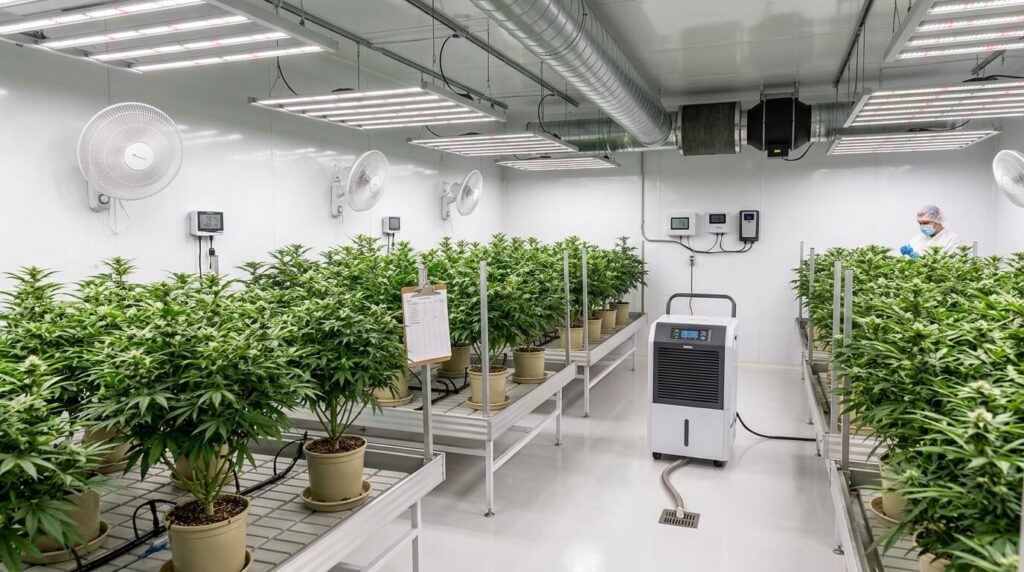
How to Prevent Aspergillus Mold in Cannabis During Growth and Flowering
Prevention starts before buds are fully formed. Autoflowers grow fast, so small problems can become serious quickly once flowering begins.
This is one reason autoflower seeds for beginners are often recommended alongside good environmental management practices. Developing consistent habits early, such as maintaining airflow and avoiding overwatering, helps prevent many of the problems that appear later in flowering.
| Step | Action | Why It Matters |
| 1 | Start with a clean grow area | Clean trays, pots, tent walls, fans, and tools before germination. Aspergillus spores collect in dust, debris, and reused equipment, so reducing contamination pressure early lowers overall risk. |
| 2 | Avoid overwatering young autoflowers | Constantly wet media increases humidity and encourages fungal activity around the root zone. Allow the top layer of the medium to dry slightly between watering. |
| 3 | Create space before flowering begins | By weeks 3–5, autoflowers begin forming bud sites. Prevent branches and future colas from crowding, as airflow becomes harder to improve once buds are dense. |
| 4 | Remove dead or dying plant material quickly | Decaying leaves and debris provide organic material where fungi can persist. Removing them reduces potential fungal reservoirs. |
| 5 | Monitor humidity from early flower onward | Aim for roughly 40–50% relative humidity in late flowering. Dense autoflower colas can trap moisture internally even when room humidity appears acceptable. |
| 6 | Keep air moving through the canopy | Use gentle airflow around and beneath the plant. Avoid direct fan blast on buds. Separate touching flowers to prevent trapped moisture between them. |
| 7 | Inspect the largest colas first | Dense central buds are the highest-risk areas. During weeks 6–10, check for musty smells, discoloration, dead sugar leaves, or hidden damp patches. |
One mistake we regularly see from newer autoflower growers is assuming that adding more fans automatically solves humidity problems. Air should circulate through the canopy rather than blasting directly onto developing flowers. Gentle air exchange throughout the plant is far more effective than creating strong airflow on the outside of the buds.
How to Prevent Aspergillus Mold on Autoflowers Step by Step
Preventing aspergillus mold isn’t about one single technique. It’s the result of small, consistent actions throughout the entire grow. By the time dense autoflower buds reach late flowering, you’ve already done most of the work that determines whether fungal problems develop.
Use the following routine to reduce the conditions that allow Aspergillus to establish.
| Step | What to Do | Why It Helps Prevent Aspergillus |
| 1 | Keep your grow space clean before every cycle. Remove old plant material, disinfect tools, wipe down tent walls, and clean fans and filters. | Reduces the number of fungal spores and organic material inside the grow environment. |
| 2 | Water plants shortly after the lights switch on rather than just before lights-off. | Gives excess moisture time to evaporate while temperatures and airflow are highest, reducing prolonged humidity around flowers. |
| 3 | Check humidity and temperature every day during flowering. | Small environmental changes are easier to correct before they create favourable conditions for fungal growth. |
| 4 | Maintain gentle airflow through the entire canopy. Leaves should move slightly without flowers constantly bending in the airflow. | Prevents humid air from becoming trapped around dense buds while avoiding unnecessary stress to developing flowers. |
| 5 | Inspect the largest cola first during every plant check. Gently separate the outer calyxes and look inside the flower. | Dense central colas usually retain moisture longer than smaller buds and are often where Aspergillus develops first. |
| 6 | Remove dead leaves, damaged flowers and fallen plant material as soon as you notice them. | Decaying organic matter provides an ideal surface for fungi to survive and reproduce. |
| 7 | Increase inspection frequency during the final two weeks before harvest, especially after humid weather or unexpected humidity spikes. | Mature autoflower buds are at their highest risk because flowers are fully developed and airflow through the cola is naturally reduced. |
| 8 | Harvest as soon as the crop reaches maturity rather than delaying unnecessarily during humid conditions. | Leaving mature flowers exposed to prolonged humidity increases the opportunity for fungal contamination before harvest. |
Rather than trying to create a completely sterile grow environment, focus on consistency. Stable humidity, steady airflow, clean equipment and frequent inspections make it far more difficult for aspergillus autoflower contamination to establish, even though spores remain naturally present in the surrounding environment.
We’ve occasionally seen perfectly healthy plants develop mold after growers delayed harvest for several extra days waiting for a little more ripening during humid weather. If the crop is already within its harvest window and conditions are deteriorating, protecting healthy flowers is usually the better decision.
Drying and Curing Practices That Reduce Mold Risk
Drying is one of the most important stages for preventing aspergillus cannabis contamination. A flower can look healthy at harvest but still develop mold if moisture remains trapped inside the bud after cutting.
| Step | Action | Why It Matters |
| 1 | Remove suspect flowers before drying | Do not mix questionable buds with healthy ones. Any musty smell or discoloration may indicate early fungal development. |
| 2 | Avoid overcrowding the drying area | Dense autoflower buds need space for even moisture release. Overcrowding traps humidity and slows internal drying. |
| 3 | Use stable drying conditions | Aim for 18–21°C and 55–60% RH. Drying too fast traps internal moisture, while slow drying increases fungal risk. |
| 4 | Maintain gentle airflow | Circulate air without directing it at flowers. Direct airflow can dry the exterior too quickly while the interior remains damp. |
| 5 | Check the largest buds before curing | Dense colas retain moisture longer. Ensure they are not damp, spongy, or cool inside before sealing. |
| 6 | Cure slowly and monitor closely | Open containers regularly to release moisture. Condensation or musty smells indicate excess moisture and increased mold risk. |
Large central colas almost always dry more slowly than smaller branches. During drying trials, we routinely check the thickest flowers first because they retain internal moisture long after smaller buds feel ready for curing.
Storage Conditions That Protect Cannabis Flowers Long-Term
Storage is the final stage of Aspergillus prevention. Even properly dried autoflower buds can become contaminated if they are stored with excess moisture or in dirty containers.
Use clean, dry jars or airtight containers, and avoid storing flowers in warm or humid areas. Keep stored cannabis away from direct light and temperature swings, as changing conditions can cause moisture to move in and out of the flower.
When checking stored buds, inspect them like you would during late flowering:
- Smell the container first.
- Look for condensation.
- Check the largest buds.
- Watch for gray, green, yellow, or black patches.
- Separate anything suspicious immediately.
A stable storage environment helps preserve aroma, potency, and flower quality while reducing the chance of late Aspergillus development. From seedling to storage, the most reliable prevention strategy is simple: keep autoflower buds clean, dry, well spaced, and regularly inspected.
Frequently Asked Questions
Can Aspergillus grow on healthy autoflower cannabis plants?
Yes. Aspergillus spores are naturally present in most growing environments and can land on healthy autoflower plants at any stage. However, spores only become a problem when environmental conditions allow them to germinate. Dense flowers, prolonged humidity, poor airflow, and wet plant surfaces during flowering create the conditions where aspergillus mold on cannabis can develop.
What are the first signs of Aspergillus in autoflower buds?
The earliest signs are often subtle. A single cola may develop a musty smell, a few sugar leaves may yellow or die back unexpectedly, or the flower may begin drying unevenly while the rest of the plant appears healthy. Because Aspergillus often develops inside dense buds first, regularly inspecting the largest colas during late flowering gives growers the best chance of identifying contamination early.
What does Aspergillus mold on cannabis look like?
Aspergillus can appear as grey, green, yellow, black or dust-like fungal growth within cannabis flowers. Unlike powdery mildew, which normally develops on exposed leaves, Aspergillus frequently begins inside dense buds where it remains hidden until contamination becomes more advanced.
Are dense autoflower buds more likely to develop Aspergillus?
Dense buds do not cause Aspergillus, but they can create favourable conditions for fungal growth. Modern autoflower genetics often produce compact, resin-rich colas that restrict airflow through the centre of the flower. If humidity remains elevated, moisture can stay trapped inside these dense buds for longer, increasing the risk of contamination.
Can Aspergillus spread from one autoflower to another?
Aspergillus spores are already present in the surrounding environment, but contaminated flowers can release additional spores into the grow space. If favourable conditions remain, nearby plants may also become affected. Removing contaminated plant material promptly and maintaining good environmental control helps reduce further spread.
Can you prevent Aspergillus without using fungicides?
Yes. Most home growers prevent aspergillus cannabis contamination by controlling the growing environment rather than relying on fungicides. Maintaining appropriate humidity, providing consistent airflow, removing dead plant material, inspecting dense flowers regularly, and drying harvested buds correctly are the most effective preventative measures.
What humidity level helps prevent Aspergillus in autoflowers?
During late flowering, many growers aim for approximately 40–50% relative humidity where practical to reduce the amount of moisture surrounding dense buds. During drying, maintaining around 55–60% relative humidity with gentle airflow helps flowers dry evenly while reducing the risk of fungal development.
Can Aspergillus develop during drying or curing?
Yes. Dense autoflower buds often retain moisture in their centre after harvest. If flowers are dried too slowly, packed too closely, or sealed into curing jars before their internal moisture has stabilised, Aspergillus and other fungi can continue developing even though the plants appeared healthy at harvest.
Does Aspergillus only affect indoor cannabis grows?
No. Indoor and outdoor autoflowers both face Aspergillus risks, although the environmental triggers differ. Outdoor plants are continually exposed to airborne spores carried by wind, rain and dust, while indoor contamination is more commonly associated with prolonged humidity, inadequate ventilation or stagnant air during flowering and drying.
Can cannabis contaminated with Aspergillus be recovered?
Once Aspergillus has colonised cannabis flowers, the affected material should be considered unsuitable for use. Cutting away visible mold does not remove microscopic fungal growth or spores that may already be present elsewhere in the bud. Early detection and preventing contamination from developing remain the most reliable ways to protect your harvest.


