

Can You FIM Autoflowers?
Cannabis growers often ask whether you can FIM autoflowers without harming yield or slowing growth, and the answer is yes but only when timing and plant health are on your side. Autoflowers grow on a fixed lifecycle, so mistakes during training can limit their final size and structure. This article explains how FIMing works, when to apply it, and how it compares to other techniques like topping or low-stress training. If you understand the risks and apply the method correctly, you can improve canopy shape and bud site development while keeping your plants on track.
- Article Insights
- What Is Fimming?
- Can You FIM Autoflowers and Does It Work?
- What FIMing Means and How It Differs From Topping
- Pros and Cons of FIMing Autoflowers vs Leaving Them Natural
- When to FIM Autoflower Plants for Best Results
- Autoflower FIM or Top: Which Training Method Is Better?
- Should I FIM an Autoflower? Key Considerations Before You Decide
- Conclusion
- Frequently Asked Questions
Article Insights
- Autoflowers can be FIMed during early vegetative growth, typically around the 3rd to 5th node stage.
- FIMing involves removing about 70–80% of the top growth tip to encourage multiple new shoots.
- Timing is limited, as autoflowers usually begin flowering within 3–5 weeks from germination.
- Healthy, fast-growing plants recover more quickly, while stressed plants may show reduced growth.
- FIMing results can vary depending on genetics, environment, and overall plant vigor.
- Low-stress training is often a more consistent option for beginners or sensitive autoflower strains.
What Is Fimming?
Fimming is a high-stress cannabis training technique that involves partially removing the plant’s top growth to encourage multiple new shoots. The name “FIM” comes from the phrase “F**k, I Missed,” which reflects the imperfect nature of the cut. Unlike topping, which removes the entire apical tip cleanly, Fimming intentionally leaves part of that growth behind.
When you FIM a plant, you are disrupting apical dominance. This is the natural process where the main central cola grows stronger than the side branches. By partially cutting the top, you force the plant to redistribute its growth hormones, specifically auxins, across multiple sites. This results in a bushier plant with several potential colas instead of one dominant top.
I explain it simply: topping splits the plant into two main shoots, while Fimming can create three, four, or even more, depending on how the plant responds.
Can You FIM Autoflowers and Does It Work?
FIMing autoflowers is possible, but it is not always predictable. Autoflowers operate on a fixed lifecycle, which means they don’t have time to recover from stress in the same way photoperiod plants do. When I FIM an auto, I am always balancing risk and reward.
The technique can increase colas, improve light distribution, and create a bushier structure. This also depends heavily on genetics, environment, and timing. Some autos respond beautifully, while others slow down and reduce yield.
What FIMing Means and How It Differs From Topping
I explain it like this: topping is clean and controlled, while FIMing is less precise but potentially more productive. When I FIM, I remove around 70–80% of the new growth tip instead of cutting it completely. This partial damage causes the plant to redirect hormones and produce multiple new growth points.
Can You FIM Autoflowers Successfully Without Stunting Growth?
- The plant is growing vigorously
- The environment is stable
- The genetics are known to be resilient
If your plant is already stressed from poor lighting, overwatering, or nutrient imbalance, FIMing will slow it down further. Autoflowers don’t pause their lifecycle, so any slowdown translates directly into smaller yields.
Pros and Cons of FIMing Autoflowers vs Leaving Them Natural
Pros of FIMing:
- More colas and bud sites
- Better canopy distribution
- Improved light penetration
Cons of FIMing:
- Risk of stunting growth
- Reduced recovery time
- Inconsistent results depending on genetics
If you are growing high-quality modern autos, they often perform very well without high-stress training. Sometimes less is more.
When to FIM Autoflower Plants for Best Results
When to FIM an Autoflower Based on Growth Stage and Node Count
At this point:
- The plant is established but still flexible
- Growth is rapid
- Recovery time is still available
If you wait too long and the plant starts pre-flowering, you are already out of time. FIMing at that stage will likely reduce yield instead of increasing it.
Timing Differences Between Autoflowers and Photoperiod Strains
With autos:
- The clock starts immediately after germination
- Vegetative growth is short
- Flowering begins automatically
This means your training window is narrow. I usually have a 7–10 day window where FIMing makes sense. Miss that window, and I leave the plant alone.
Signs Your Autoflower Is Healthy Enough for FIMing
- Fast vertical growth
- Thick stems
- Vibrant green leaves
- No signs of nutrient deficiency or stress
If your plant looks sluggish or pale, don’t FIM it. Instead, fix the environment first. Healthy plants recover quickly, while weak plants struggle.
How to FIM Autoflower Plants Step by Step
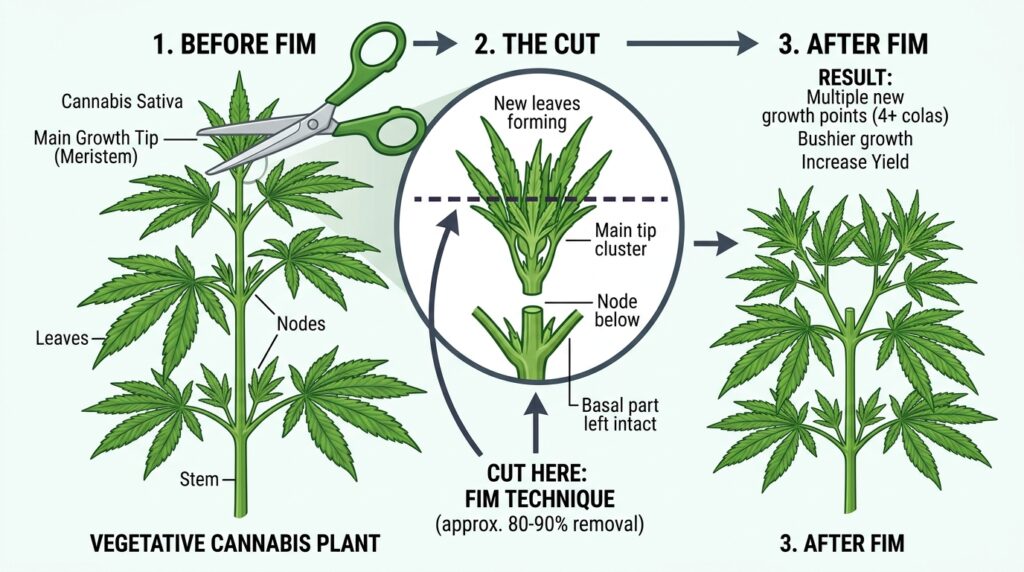
FIMing is simple in theory, but the execution requires precision, timing, and a steady hand. With autoflowers, I treat this as a one-shot technique. You are working within a short vegetative window, so you need to get it right the first time and then allow the plant to recover without interference.
The goal is to partially damage the apical growth tip so the plant redirects hormones and produces multiple new shoots. You are not removing the entire top. You are interrupting apical dominance while still leaving enough tissue for the plant to respond aggressively.
How to FIM an Autoflower Correctly Without Damaging the Plant
To FIM an autoflower correctly, you need to focus on the newest growth at the very top of the plant. This is the soft, tightly packed cluster of fresh leaves at the apex. It is lighter in colour and more delicate than the older fan leaves.
I approach it methodically and calmly. Here is exactly how I do it:
• Identify the newest growth at the apex
• Gently spread the top leaves so you can clearly see the central growth tip
• Hold the stem steady without applying pressure
• Use clean scissors or pinch with your fingers
• Cut or pinch away roughly 70–80% of the growth tip
• Leave a small portion of the tip intact so the plant can branch out
The key is precision. Too much removal turns it into topping, while too little may not trigger the desired response. A correct FIM cut often looks slightly uneven or “messy,” and that is completely fine. You are not aiming for a clean cut, you are aiming for a controlled disruption of growth.
I always remind growers that confidence matters. Hesitation leads to poor cuts. Make one clean, deliberate move and then leave the plant alone.
Tools, Hygiene, and Preparation Before Making the Cut
Clean tools are non-negotiable. I always sterilize my scissors with alcohol before making any cut. This reduces the risk of infection and keeps the plant from dealing with unnecessary biological stress on top of physical stress.
I prefer using small, sharp trimming scissors because they give me control. While also keeping the cut precise, they reduce crushing damage to the plant tissue. Some growers use their fingers, and while that works, it can be less consistent.
Preparation also includes setting up the plant for success before you even make the cut:
• Watering the plant beforehand so it is hydrated but not overwatered
• Ensuring optimal light intensity without excessive heat on the canopy
• Maintaining stable temperature and humidity levels
• Checking that the plant is not nutrient deficient or stressed
• Avoiding additional stressors on the same day such as transplanting or heavy feeding
This also helps the plant recover faster. Think of it like surgery—clean, controlled, and deliberate. I treat the grow room like a stable environment before and after the cut. No sudden changes, no stacking stress.
What to Expect in the Days After FIMing an Autoflower
After FIMing, the plant may pause growth for a short period. This is normal and part of the recovery process. The plant is redirecting energy into healing and producing new shoots rather than pushing vertical growth.
Here is what I typically observe:
• Day 1–2: Slight slowdown in growth, the cut site may look rough or slightly dry
• Day 3–5: New growth points begin forming around the cut area
• Day 5–7: Multiple shoots become visible and start extending outward
• Day 7+: The plant develops a bushier structure with more tops
During this period, I do very little. I avoid feeding aggressively, avoid pruning, and avoid making further cuts. I let the plant stabilise and respond naturally.
If the plant does not recover quickly, it usually means something else is off in your grow environment. I check airflow, root health, watering habits, and lighting conditions. FIMing exposes weaknesses, so if recovery is slow, it is often a sign that something needs correcting.
Once the plant resumes healthy growth, I often combine the result with light LST. This helps spread out the new tops, improve light penetration, and maximise the benefit of the FIM.
Some growers also combine this with light defoliation of autoflowers to further improve light penetration.
Autoflower FIM or Top: Which Training Method Is Better?
Autoflower FIM or Top: Key Differences in Plant Response
I see it like this:
- Topping is controlled and reliable
- FIMing is experimental but potentially higher reward
Autos tend to prefer less stress, so topping is often the safer option.
Yield Comparisons Between FIMing and Topping Autoflowers
However:
- Poorly timed FIM = reduced yield
- Clean topping = consistent results
In my grows, topping usually delivers stable yields, while FIMing occasionally produces standout plants.
When Topping May Be Safer Than FIMing for Beginners
Beginners benefit from:
- Clear outcomes
- Lower risk of stunting
- Simpler technique
Once you gain confidence, you can experiment with FIMing and refine your approach.
Should I FIM an Autoflower? Key Considerations Before You Decide
Should I FIM an Autoflower in Short Grow Cycles?
In short cycles:
- Recovery time is limited
- Stress has a bigger impact
- Simplicity often wins
I usually avoid FIMing fast-finishing strains unless I know they can handle it.
Environmental Factors That Impact FIMing Success
Key factors include:
- Strong, consistent lighting
- Stable temperatures
- Proper humidity levels
- Balanced nutrition
If any of these are off, FIMing becomes a gamble rather than a strategy.
Alternative Low-Stress Training Methods for Autoflowers
LST involves:
- Bending stems gently
- Tying down branches
- Creating an even canopy
This method improves light exposure while also avoiding the risks of high-stress techniques. It is simple, effective, and beginner-friendly.
Conclusion
FIMing autoflowers is possible, but it requires precision, timing, and a bit of confidence. From my experience, the technique can produce excellent results when done correctly, while also carrying real risks if done poorly.
If you are growing strong genetics in a controlled environment, FIMing can help you maximise your plant’s structure and yield. However, if you are still learning or working with sensitive strains, simpler methods like topping or LST may serve you better.
At the end of the day, autoflowers reward careful decisions. You are working against the clock, so every action needs to count. Start simple, learn your plants, and then experiment once you understand how they respond.
Frequently Asked Questions
Can you FIM autoflowers without reducing yield?
Yes, you can FIM autoflowers without reducing yield if the plant is healthy and the timing is correct. When done early in the vegetative stage, FIMing can increase the number of bud sites and improve canopy structure. However, if done too late or on a stressed plant, it may slow growth and reduce overall yield.
When should I FIM an autoflower plant?
You should FIM an autoflower during early vegetative growth, typically when the plant has 3 to 5 nodes. This is usually within the first 2–3 weeks from germination. After this stage, the plant may begin pre-flowering, and recovery time becomes limited.
How do I know if I FIMed correctly?
You will know you FIMed correctly when multiple new shoots begin forming at the top of the plant within 3–7 days. The cut site may look uneven or slightly messy, which is normal. If only two shoots form, you likely topped the plant instead.
Is FIMing better than topping for autoflowers?
FIMing is not always better than topping for autoflowers. FIMing can produce more shoots, but it is less predictable. Topping is more consistent and easier to control, which makes it a safer option for beginners or for growers working with sensitive genetics.
Should I FIM an autoflower or use low-stress training?
If you are new to growing or working with delicate autoflower strains, low-stress training is often the safer choice. It allows you to shape the plant and improve light exposure without causing significant stress. FIMing is more suitable when you have experience and a stable growing environment.
Can all autoflower strains handle FIMing?
Not all autoflower strains respond well to FIMing. Some modern, vigorous genetics handle stress better, while older or more sensitive strains may struggle to recover. Results often vary based on breeder genetics and growing conditions.
What happens if I FIM too late?
If you FIM too late, especially after the plant has entered pre-flowering, the plant may not recover properly. This can lead to stunted growth, fewer bud sites, and reduced yield. Autoflowers do not have time to bounce back from late-stage stress.
How long does it take for an autoflower to recover after FIMing?
Most healthy autoflowers begin to recover within 3–5 days after FIMing. New shoots typically appear within a week. Full structural changes, such as a bushier canopy, develop over the following 1–2 weeks.
Can I FIM an autoflower more than once?
It is generally not recommended to FIM an autoflower more than once. Due to their short lifecycle, repeated high-stress training can slow growth and negatively affect yield. I usually limit it to a single, well-timed cut.
What are the risks of FIMing autoflowers?
The main risks include stunted growth, reduced yield, and inconsistent results. These risks increase if the plant is unhealthy, the timing is off, or the growing environment is not stable.


