
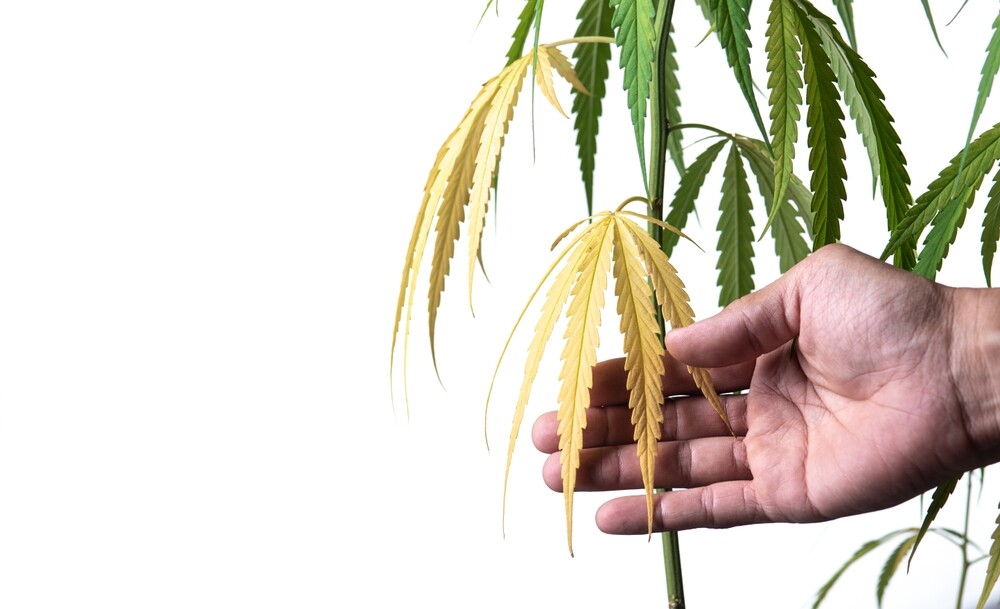
Cannabis Deficiencies: Symptoms and Fixes
Cannabis deficiencies can cause yellow leaves, brown spots, curling foliage, slow growth, and weaker flower development if they are not spotted early. In most cases, the issue is not just a lack of nutrients, but a problem with pH, watering, root health, or nutrient lockout that stops the plant from absorbing what it needs. This guide explains how to identify common cannabis deficiency symptoms, understand the difference between deficiencies and toxicities, and correct nutrient problems in soil, coco, and hydro systems before they spread through the plant.
Article Insights
- Healthy new growth is the clearest sign that a cannabis deficiency treatment is working.
- Yellow lower leaves commonly point to nitrogen deficiency, while yellow new growth often suggests iron or pH-related lockout.
- Brown spots on cannabis leaves are often linked to calcium deficiency, poor uptake, or root zone imbalance.
- Soil-grown cannabis typically performs best around pH 6.0–7.0, while coco and hydro usually prefer pH 5.5–6.5.
- Nutrient lockout can mimic several cannabis deficiencies even when nutrients are already present in the medium.
- Older leaves usually show mobile nutrient deficiencies first, while new growth often shows immobile nutrient problems.
What Are Cannabis Deficiencies?
Cannabis deficiencies happen when your plants cannot access the nutrients they need for healthy growth, development, and flower production. This can happen because nutrients are missing from the growing medium, locked out due to incorrect pH, or unavailable because of root zone issues.
Cannabis plants require a balance of macronutrients and micronutrients to perform properly. Macronutrients like nitrogen, phosphorus, and potassium are needed in larger amounts, while micronutrients such as iron, zinc, and boron are required in smaller concentrations. Even though micros are needed in tiny amounts, a deficiency can still create major growth problems.
One thing I have learned over the years is that deficiencies rarely happen in isolation. A magnesium deficiency may actually be caused by pH imbalance. Calcium deficiency may come from excess potassium. Iron deficiency often appears because root zone conditions prevent uptake. This also means that simply adding more nutrients is not always the answer.
Cannabis nutrient lockout is one of the most common causes of deficiencies. Lockout happens when nutrients exist in the medium but your plant cannot absorb them properly. Incorrect pH is usually the main culprit. In soil, cannabis generally prefers a pH range between 6.0 and 7.0. In hydroponics or coco, the sweet spot is closer to 5.5 to 6.5.
When nutrient uptake becomes restricted, you start seeing classic cannabis deficiency symptoms such as:
- Yellowing fan leaves
- Brown spots on cannabis leaves
- Curling leaf edges
- Purple stems
- Rust-colored patches
- Slow growth
- Weak stems
- Small buds
- Interveinal chlorosis
I always tell growers to think of fan leaves as diagnostic tools. Older leaves usually reveal mobile nutrient deficiencies first because the plant transfers nutrients to new growth. New growth problems often point toward immobile nutrient deficiencies that cannot move freely within the plant.
| Nutrient Type | Nutrients | Main Function in Cannabis Plants |
| Macronutrients | Nitrogen (N), Phosphorus (P), Potassium (K) | Drive overall growth, root development, and flowering |
| Secondary Nutrients | Calcium, Magnesium, Sulfur | Support cell structure, chlorophyll production, and nutrient transport |
| Micronutrients | Iron, Zinc, Boron, Copper, Manganese, Molybdenum | Assist enzyme activity, metabolism, and plant health |
What Causes Cannabis Nutrient Deficiencies?
In my experience, the majority of cannabis deficiencies come down to grower error rather than faulty nutrients.
Common causes include:
- Incorrect pH levels
- Overfeeding
- Underfeeding
- Salt buildup
- Poor watering habits
- Cheap or nutrient-poor soil
- Root damage
- Overwatering
- Underwatering
- Cold root zones
- Improper EC or PPM levels
Overwatering is especially common among beginner growers. Saturated roots struggle to absorb oxygen, which directly impacts nutrient uptake. The plant may look deficient even when nutrients are present.
Environmental stress also plays a huge role. High humidity, excessive heat, low temperatures, and weak airflow can all interfere with nutrient transport and transpiration.
Genetics matter too. Some cultivars are heavy feeders while others burn easily. I have worked with certain OG and Cookies lines that demanded extra calcium and magnesium throughout flower, while some old-school landrace genetics barely needed feeding at all.
Cannabis Nutrient Lockout and pH Imbalance Symptoms
Nutrient lockout is one of the biggest headaches in cannabis cultivation because it mimics almost every deficiency imaginable.
You may see:
- Yellowing leaves
- Burnt tips
- Brown spotting
- Curling foliage
- Stunted growth
- Multiple deficiencies at once
This is why I always check pH first before adding more nutrients. Many growers make the mistake of feeding harder when problems appear, which only worsens the situation.
When pH drifts outside the proper range, nutrients become chemically unavailable to the plant. Iron, calcium, magnesium, and phosphorus are especially sensitive to pH fluctuations.
I always recommend:
- Testing runoff pH
- Monitoring EC/PPM
- Flushing excess salts when needed
- Avoiding aggressive feeding schedules
A simple flush with properly pH-adjusted water often fixes the issue faster than dumping more nutrients into the root zone.
How to Identify Cannabis Deficiency Symptoms Early
Early diagnosis is everything. The faster you catch a nutrient issue, the easier it is to correct without damaging yield potential.
I always inspect:
- Lower fan leaves
- New growth
- Leaf edges
- Vein coloration
- Stem color
- Overall vigor
Patterns matter more than isolated symptoms.
For example:
- Yellow lower leaves usually indicate nitrogen deficiency
- Interveinal chlorosis often points to magnesium or iron issues
- Brown rust spots commonly indicate calcium problems
- Twisted new growth can signal boron deficiency
- Dark green clawing leaves often suggest nutrient toxicity
Take your time before reacting. I have seen growers create five new problems trying to fix one small deficiency overnight.
Common Signs of Weed Plant Deficiencies
Most cannabis plant nutrient deficiencies produce visible leaf symptoms first.
Some of the most common signs include:
- Yellowing leaves
- Pale green foliage
- Brown necrotic spots
- Leaf curling
- Crispy edges
- Purple stems
- Weak branches
- Slow vertical growth
- Small flowers
- Premature leaf drop
The location of symptoms is equally important.
Older growth affected first usually means:
- Nitrogen
- Magnesium
- Potassium
- Phosphorus
New growth affected first often points toward:
- Calcium
- Iron
- Zinc
- Boron
Understanding this distinction helps you diagnose cannabis nutrient problems much faster and more accurately.
Cannabis Plant Deficiencies and Excesses Chart
Cannabis plants display nutrient problems through changes in leaf color, texture, growth rate, and overall vigor. Learning how to read these signs is one of the most important skills you can develop as a grower. In many cases, cannabis deficiency symptoms start subtly before becoming severe, so catching issues early can save your harvest from reduced yields and poor bud quality.
The chart below gives you a quick-reference guide to diagnosing common cannabis nutrient deficiencies and excesses based on visual symptoms.
| Nutrient | Deficiency Symptoms | Excess Symptoms | Where Symptoms Appear First | Common Cause |
| Nitrogen (N) | Yellow lower leaves, pale foliage, slow growth | Very dark green leaves, clawing, weak stems | Older leaves | Underfeeding or pH imbalance |
| Phosphorus (P) | Dark leaves, purple stems, stunted growth | Nutrient lockout, burnt leaf tips | Older leaves | Cold roots or incorrect pH |
| Potassium (K) | Brown leaf edges, curling leaves, rust spots | Salt buildup, nutrient burn | Older leaves | Overfeeding or pH issues |
| Calcium (Ca) | Brown spots, twisted new growth, weak stems | Rare, may cause magnesium lockout | New growth | Poor uptake or low Cal-Mag |
| Magnesium (Mg) | Interveinal chlorosis, yellowing between veins | Salt buildup symptoms | Older leaves | pH imbalance or calcium excess |
| Sulfur (S) | Pale yellow plant, weak new growth | Leaf burn and nutrient imbalance | New growth | Incorrect root zone pH |
| Iron (Fe) | Bright yellow new growth with green veins | Bronze spotting | New growth | High pH causing lockout |
| Zinc (Zn) | Small distorted leaves, stunted growth | Toxicity can block iron uptake | New growth | Overfeeding or root stress |
| Boron (B) | Twisted leaves, brittle growth, brown spotting | Leaf burn and toxicity symptoms | New growth | Incorrect pH or dry soil |
| Copper (Cu) | Dark twisted leaves, poor vigor | Leaf toxicity and root damage | New growth | Excess nutrients |
| Manganese (Mn) | Interveinal chlorosis with brown specks | Iron deficiency symptoms | New growth | Incorrect pH |
| Molybdenum (Mo) | Yellowing leaves, leaf edge burn | Rare toxicity symptoms | Older leaves | Low temperatures or pH problems |
| Silicon (Si) | Weak stems, drooping branches | Rarely toxic | Entire plant | Poor supplementation |
While this chart gives you a strong starting point, remember that multiple cannabis nutrient deficiencies can appear at the same time. Nutrient lockout, overwatering, root disease, and improper pH can all mimic deficiency symptoms, which is why checking your runoff pH and EC levels should always be your first troubleshooting step.
How to Identify and Treat Nutrient Deficiencies
Identifying cannabis nutrient deficiencies correctly is one of the biggest skills that separates beginner growers from experienced cultivators. A healthy cannabis plant grows vigorously, produces rich green foliage, and develops thick stems capable of supporting heavy flowers. When nutrients become unavailable, the plant quickly starts showing stress signals through its leaves, stems, and growth structure.
The tricky part is that cannabis deficiency symptoms often overlap with environmental stress, nutrient toxicity, pest problems, and root zone issues. I have seen growers mistake overfeeding for magnesium deficiency, while others diagnosed calcium deficiency when the real issue was root lockout caused by overwatering.
This is why proper troubleshooting is all about observing patterns instead of reacting to one isolated symptom.
| Nutrient | Deficiency Symptoms | Toxicity Symptoms |
| Nitrogen | Yellow lower leaves, pale growth, slow development | Dark green leaves, clawing, weak stems, delayed flowering |
| Phosphorus | Dark leaves, purple stems, stunted growth | Burnt tips, nutrient lockout, reduced uptake of zinc or iron |
| Potassium | Brown leaf edges, curling leaves, weak stems | Salt buildup, burnt tips, calcium or magnesium lockout |
| Calcium | Brown spots, twisted new growth, weak stems | Rare, but may block magnesium and potassium uptake |
| Magnesium | Interveinal chlorosis, yellowing between veins, rust spots | Rare, but may contribute to salt buildup or calcium imbalance |
| Sulfur | Pale yellow growth, weak stems, slow development | Leaf burn, dark patches, nutrient imbalance |
| Iron | Yellow new growth with green veins | Bronze spotting, darkened leaves, possible manganese lockout |
| Zinc | Small distorted leaves, short internodes, yellowing | Iron lockout, leaf tip burn, reduced growth |
| Boron | Twisted new growth, brittle stems, brown spots | Leaf burn, yellowing, necrotic patches |
| Copper | Twisted dark leaves, weak flower development | Root damage, leaf toxicity, dark or burnt foliage |
| Manganese | Interveinal chlorosis with brown specks | Iron deficiency symptoms, dark spotting, leaf burn |
| Molybdenum | Yellowing older leaves, burnt edges, nitrogen-like symptoms | Rare, but may cause leaf discoloration or nutrient imbalance |
| Silicon | Weak stems, drooping branches, poor stress resistance | Rarely toxic in cannabis |
| Overall Plant | Pale leaves, slow growth, weak vigor | Burnt tips, clawing leaves, dark foliage, salt buildup |
How to Identify Nutrient Deficiencies in Cannabis Plants
The first thing I always look at is where the symptoms appear on the plant.
Older fan leaves usually indicate mobile nutrient deficiencies because the plant can move those nutrients toward new growth when supplies become limited. Nutrients like nitrogen, phosphorus, potassium, and magnesium fall into this category.
New growth problems usually point toward immobile nutrient deficiencies. Calcium, iron, zinc, and boron cannot move efficiently through the plant, so symptoms appear on younger leaves first.
| Nutrient Type | Nutrients | Symptoms Appear First |
| Mobile Nutrients | Nitrogen, Phosphorus, Potassium, Magnesium | Older leaves |
| Immobile Nutrients | Calcium, Iron, Zinc, Boron | New growth |
I also examine:
- Leaf color changes
- Vein discoloration
- Burnt edges
- Leaf curling
- Rust spotting
- Stem coloration
- Plant vigor
Interveinal chlorosis is one of the easiest symptoms to recognize. This happens when the tissue between the leaf veins turns yellow while the veins stay green. Magnesium deficiency cannabis symptoms commonly appear this way, while iron deficiency usually affects newer growth.
Brown spots on cannabis leaves are another common warning sign. Calcium deficiency often creates rusty necrotic spotting across leaves, especially in coco grows or under powerful LED lighting.
Leaf curling also tells you a lot. Potassium deficiency cannabis symptoms frequently include curling leaf edges, while nitrogen toxicity usually creates dark green clawed leaves.
How to Fix Cannabis Deficiencies in Soil, Coco, and Hydro
The growing medium changes how you approach cannabis deficiency treatment.
In soil, nutrient problems usually develop more slowly because organic matter buffers the root zone. Deficiencies may take longer to appear, but recovery can also take longer.
In coco coir and hydroponics, plants respond much faster to feeding changes. This gives you more control, but it also means mistakes show up quickly.
When I diagnose a deficiency, I follow this process:
- Check pH first
- Measure EC or PPM runoff
- Inspect watering practices
- Assess environmental conditions
- Adjust feeding gradually
I avoid aggressively increasing nutrients unless I know the plant is genuinely underfed. Many growers create nutrient lockout by chasing symptoms too aggressively.
For soil grows:
- Top dress organic amendments slowly
- Use compost teas carefully
- Avoid overwatering
For coco and hydro:
- Maintain stable EC levels
- Monitor runoff regularly
- Supplement calcium and magnesium when needed
Cal-Mag deficiency cannabis issues are especially common under LED grow lights because plants transpire differently under intense full-spectrum lighting.
Preventing Nutrient Lockout in Cannabis Plants
Nutrient lockout is one of the most frustrating cannabis nutrient problems because the nutrients are technically present but unavailable to the plant.
This usually happens because:
- pH drifts outside optimal range
- Salt buildup accumulates
- Root oxygen becomes restricted
- Excess nutrients compete for uptake
I always recommend maintaining these pH ranges:
| Growing Medium | Ideal pH Range |
| Soil | 6.0 – 7.0 |
| Coco Coir | 5.8 – 6.3 |
| Hydroponics | 5.5 – 6.5 |
Flushing can help reset the root zone when lockout occurs. I prefer using properly pH-adjusted water while checking runoff EC until excess salts decrease.
One mistake growers make is flushing too often. Excessive flushing can strip beneficial nutrients and stress the plant further.
Consistency is what keeps cannabis plants healthy. Stable feeding schedules, proper dry-back periods, and controlled EC levels all help prevent lockout before it starts.
Correcting Cannabis pH Imbalance Symptoms
Cannabis pH imbalance symptoms can look almost identical to nutrient deficiencies.
You may notice:
- Yellowing leaves
- Brown spots
- Purple stems
- Slow growth
- Weak bud development
- Curling foliage
This is because pH directly controls nutrient availability inside the root zone.
For example:
- Iron becomes unavailable at high pH
- Calcium uptake drops outside optimal ranges
- Phosphorus lockout becomes severe in cold wet roots
I always tell growers that pH pens are just as important as grow lights. Without accurate pH readings, diagnosing cannabis deficiencies becomes guesswork.
You should calibrate pH meters regularly and test:
- Nutrient solution
- Runoff water
- Reservoirs
- Root zone conditions
Small pH swings are normal, but major fluctuations usually signal underlying root zone instability.
Cannabis Deficiency Troubleshooting Tips
When troubleshooting cannabis deficiencies, patience matters.
I never recommend making multiple major changes at once because you will not know which adjustment fixed the problem.
Instead:
- Make one correction
- Monitor new growth
- Wait several days
- Observe plant response
Healthy new growth is always the best sign of recovery. Damaged leaves rarely heal completely, so focus on whether symptoms continue spreading.
I also recommend documenting:
- Feeding schedules
- EC levels
- pH readings
- Environmental conditions
- Watering frequency
Good notes turn average growers into great growers over time.
Cannabis Deficiency Treatment and Recovery
Recovery speed depends on:
- Severity of deficiency
- Plant health
- Growth stage
- Root condition
- Environmental stability
Vegetative plants recover faster because they actively produce new foliage. Flowering plants are less forgiving, especially during late bloom when nutrient uptake naturally slows.
When treating cannabis deficiencies, I focus on restoring balance instead of forcing rapid growth. Overcorrecting nutrient problems often causes additional stress.
Healthy recovery signs include:
- Strong green new growth
- Improved leaf posture
- Faster growth rates
- Better stem strength
- Increased vigor
Once your plants regain momentum, maintaining stable conditions becomes the key to avoiding future nutrient problems.
Diagnosing Common Cannabis Plant Problems: Macronutrient Deficiencies
The macronutrients — Nitrogen, Phosphorus, and Potassium — along with the secondary macronutrients Calcium, Magnesium, Sulfur, and Silicon, are the primary building blocks responsible for healthy cannabis growth. These nutrients support everything from chlorophyll production and root development to flower formation and terpene production.
Macronutrient deficiencies are among the most common cannabis nutrient problems growers face, especially during aggressive vegetative growth and heavy flowering periods. The good news is that these deficiencies are usually easier to diagnose because the symptoms are more visible and develop faster than most micronutrient issues.
Nitrogen deficiency: symptoms and fixes
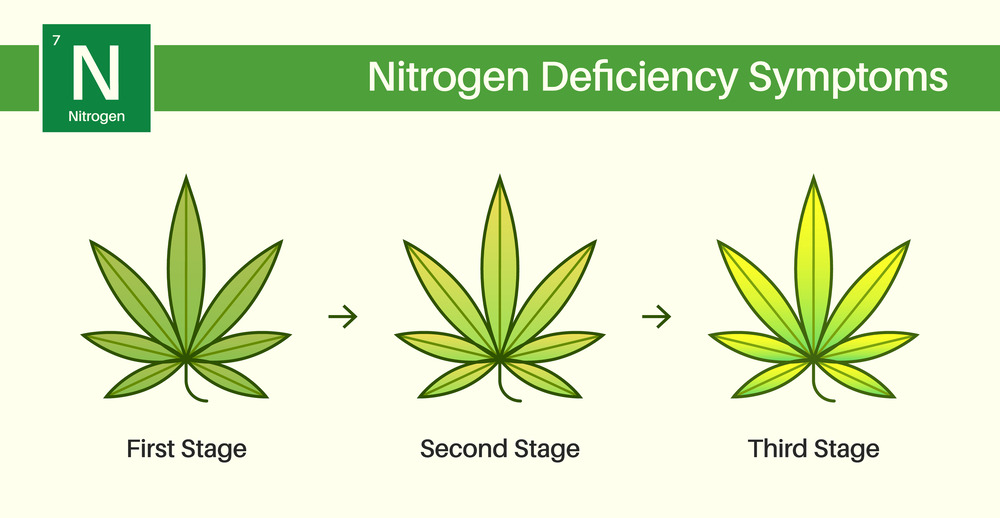
Nitrogen deficiency cannabis symptoms are extremely common, especially in flowering plants where nitrogen demand naturally decreases.
Symptoms:
- Chlorosis (yellowing) of lower fan leaves, beginning at the leaf tips and spreading inward.
- Pale green foliage across older growth.
- Stunted growth and reduced plant size.
- Weak stems and reduced vigor.
- Fan leaf stems may develop reddish or purple hues.
Nitrogen is a mobile nutrient, so the plant redirects available nitrogen toward new growth first. This means older fan leaves show symptoms before the top canopy.
Fixes:
- Flush the medium with pH-corrected water first to rule out nutrient lockout.
- Check runoff EC and PPM levels for excess salt buildup.
- In soil grows, apply nitrogen-rich amendments such as:
- Worm castings
- Fish emulsion
- Blood meal
- Bat guano
- In coco or hydro systems, reintroduce nutrients at slightly reduced strength before gradually increasing feed levels.
- Avoid overcorrecting, as excess nitrogen can cause clawing and dark green foliage.
Phosphorus deficiency: symptoms and fixes
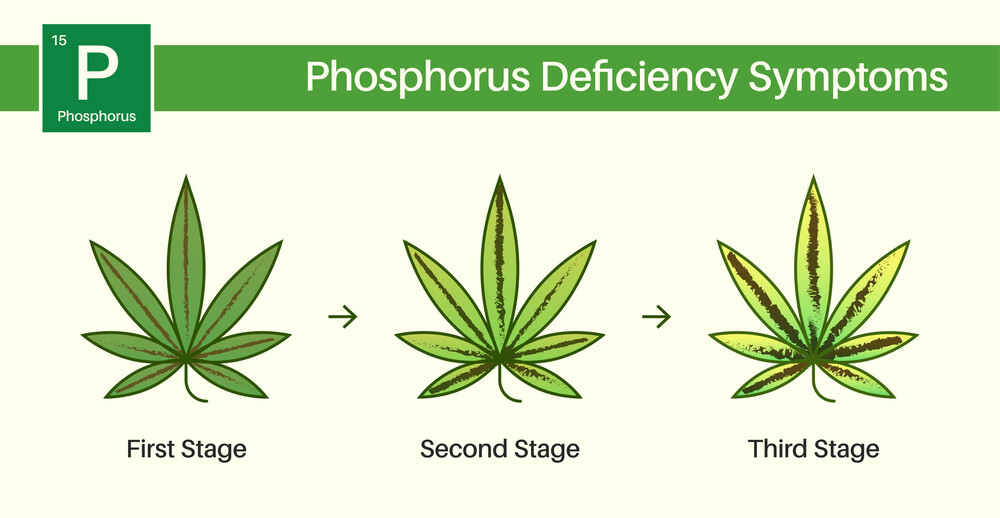
Phosphorus deficiency cannabis problems commonly appear during flowering when demand for phosphorus increases dramatically.
Symptoms:
- Lower fan leaves become dark green or slightly bluish.
- Leaf edges curl upward and inward.
- Purple stems and petioles may appear.
- Burnt leaf tips on older growth.
- Severe growth stunting during flowering.
- Reduced bud density and slower flower development.
Cold root zones often contribute to phosphorus lockout, especially in hydroponic systems.
Fixes:
- Flush and test runoff pH immediately.
- Maintain root zone temperatures between 20°C and 24°C.
- Add high-phosphorus amendments such as:
- Bone meal
- Bat guano
- Bloom boosters
- In hydro and coco, gradually restore nutrient strength after flushing.
- Avoid excessive calcium supplementation, which can interfere with phosphorus uptake.
Potassium deficiency: symptoms and fixes
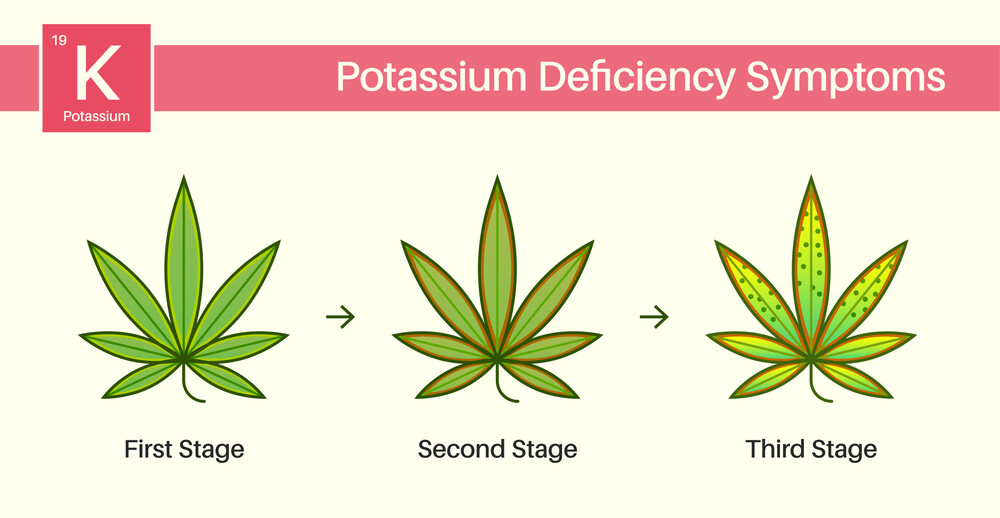
Potassium deficiency cannabis symptoms are often confused with nutrient burn because both create leaf edge damage.
Symptoms:
- Brown or burnt leaf margins.
- Crispy leaf edges and dry-looking foliage.
- Cannabis leaves curling downward in a claw-like shape.
- Yellowing around leaf tips and margins.
- Brown spotting that does not rub off.
- Weak stems and poor resistance to environmental stress.
Potassium plays a huge role in water regulation and nutrient transport, so deficiencies often affect overall plant health quickly.
Fixes:
- Flush excess salts from the root zone.
- Correct pH imbalances before increasing nutrients.
- In soil, use potassium-rich amendments such as:
- Kelp meal
- Sulfate of potash
- Wood ash
- In hydro systems, slowly increase potassium levels while monitoring EC closely.
- Maintain stable watering schedules to prevent nutrient fluctuations.
Calcium deficiency: symptoms and fixes
Calcium deficiency cannabis symptoms typically appear on newer growth first because calcium is an immobile nutrient.
Symptoms:
- Brown spots on cannabis leaves.
- Twisted or misshapen new growth.
- Yellow spotting across fan leaves.
- Weak stems and poor structural growth.
- Curling leaf edges.
- Purple stems and stalks.
Calcium deficiencies are especially common in coco grows because coco naturally binds calcium and magnesium.
Fixes:
- Flush and stabilize pH levels first.
- Add calcium supplements such as:
- Gypsum
- Oyster shell flour
- Lime
- Cal-Mag products
- Maintain proper transpiration with adequate airflow and humidity.
- Avoid overwatering, which reduces calcium transport through the plant.
Magnesium deficiency: symptoms and fixes
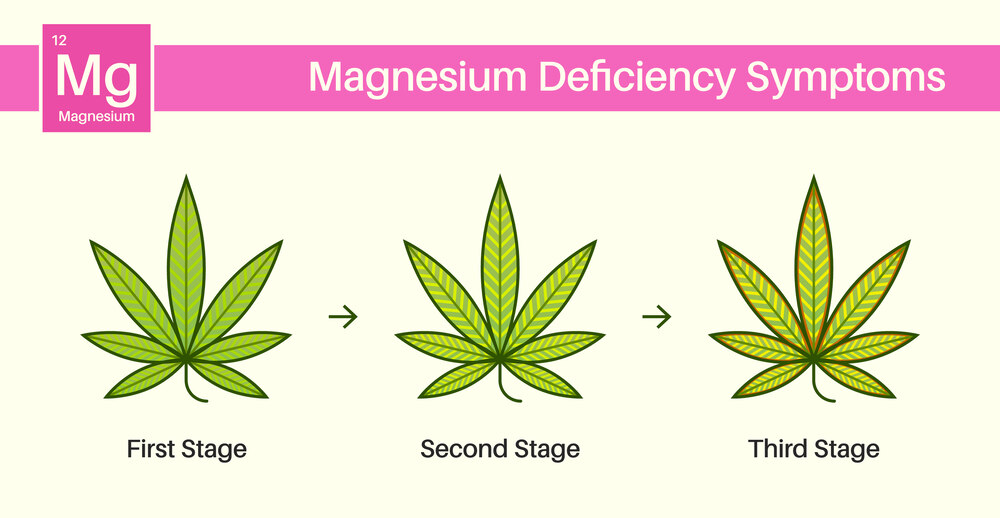
Magnesium deficiency cannabis symptoms are extremely common under LED grow lights and in coco coir grows.
Symptoms:
- Interveinal chlorosis on older fan leaves.
- Yellowing between leaf veins while veins stay green.
- Rust-colored spots on affected leaves.
- Pale or lime-green upper foliage.
- Older leaves dropping prematurely.
Because magnesium is mobile, the plant transfers it from older growth into newer growth during deficiency.
Fixes:
- Flush with pH-balanced water to eliminate nutrient lockout.
- Add magnesium supplements such as:
- Epsom salts
- Dolomite lime
- Cal-Mag supplements
- Hydro and coco growers should monitor calcium-to-magnesium ratios carefully.
- Reduce excessive potassium levels, which can compete with magnesium uptake.
Silicon Deficiency Cannabis and Weak Plant Structure
Silicon is not always considered essential, but experienced growers know it dramatically improves plant strength and stress resistance.
Symptoms:
- Weak stems and branches.
- Poor resistance to pests and disease.
- Drooping foliage under heavy flowers.
- Slower recovery from environmental stress.
- Thin cell walls and fragile growth.
Silicon becomes especially important when growing large, high-yielding cannabis cultivars under intense lighting.
Fixes:
- Supplement silica products during vegetative growth.
- Use potassium silicate carefully within proper pH ranges.
- Maintain balanced nutrient levels to support uptake.
- Avoid excessive humidity that weakens plant tissue.
Diagnosing Common Cannabis Plant Problems: Micronutrient Deficiencies
Micronutrients are needed in much smaller concentrations than macronutrients, but they still play a major role in healthy cannabis growth, nutrient uptake, terpene production, enzyme function, and overall plant metabolism. Even a minor imbalance can quickly lead to cannabis deficiency symptoms that reduce plant vigor, slow flower production, and impact final yields.
Micronutrient deficiencies are often harder to diagnose because the symptoms can resemble nutrient lockout, pH imbalance, overfeeding, or environmental stress. This is why I always recommend monitoring your pH, EC, runoff, and overall plant health before making aggressive feeding changes.
Most micronutrient deficiencies affect newer growth first because many micronutrients are immobile within the cannabis plant.
Boron Deficiency Cannabis Symptoms and Fixes
Boron deficiency cannabis symptoms are less common than calcium or magnesium problems, but they can become serious very quickly if left untreated.
Symptoms:
- Twisted, curled, or misshapen new growth.
- Brown spots throughout the leaves.
- Brittle stems and weak branch development.
- Stunted growth with smaller leaves overall.
- Poor root development and reduced vigor.
Boron plays a role in cell wall formation and nutrient transport, so deficiencies often create distorted plant growth.
Fixes:
- Flush with pH-balanced water first to eliminate nutrient lockout.
- Check runoff EC and pH for salt buildup.
- Add a water-soluble boron supplement carefully.
- Foliar spraying can help restore boron levels faster.
- Avoid overapplication because boron toxicity develops very easily in cannabis plants.
Copper Deficiency Cannabis Symptoms and Causes
Copper deficiency cannabis symptoms usually appear in stressed root zones or improperly balanced hydroponic systems.
Symptoms:
- Dark blue or dark green foliage.
- Twisted or curled new growth.
- Leaf tips becoming pale or burnt.
- Weak flower development.
- Reduced terpene and resin production.
Copper supports enzyme activity and reproductive growth, making it especially important during flowering.
Fixes:
- Flush excess nutrient salts from the medium.
- Correct pH imbalances immediately.
- Add a copper chelate supplement if necessary.
- Improve root oxygenation and airflow around the canopy.
- Avoid overwatering, which can reduce copper uptake.
Iron deficiency: symptoms and fixes
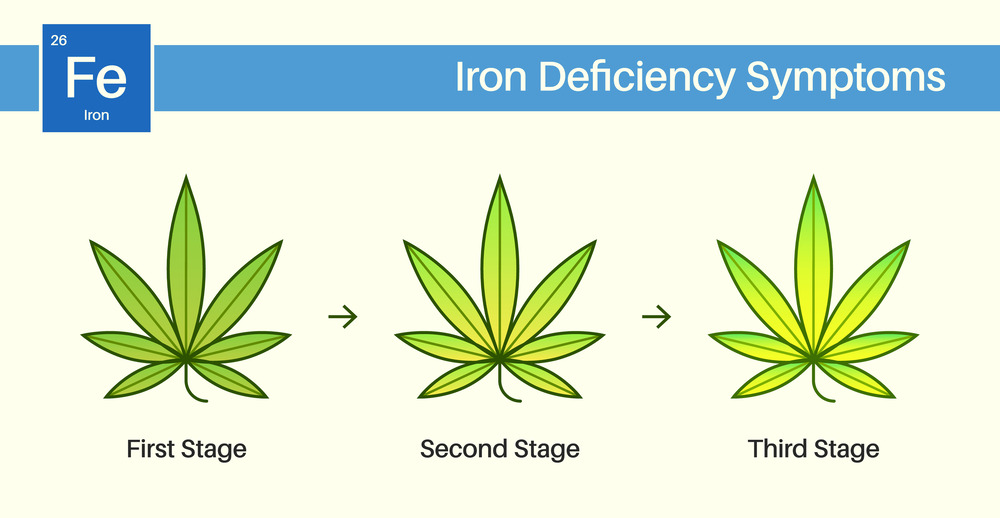
Iron deficiency cannabis symptoms are among the easiest micronutrient deficiencies to identify because they affect the newest growth first.
Symptoms:
- Interveinal chlorosis on new fan leaves.
- Bright yellow tissue with dark green veins.
- Pale or almost white leaf tips.
- Stunted and weak new growth.
- Severe cases may cause leaf death and tissue necrosis.
High root zone pH is one of the biggest causes of iron lockout in cannabis plants.
Fixes:
- Flush and stabilize pH levels first.
- Maintain hydro and coco pH below 6.5.
- Add chelated iron supplements to your nutrient solution.
- Foliar spray iron supplements for rapid correction.
- Reduce excessive phosphorus levels that may interfere with iron uptake.
Manganese deficiency: symptoms and fixes
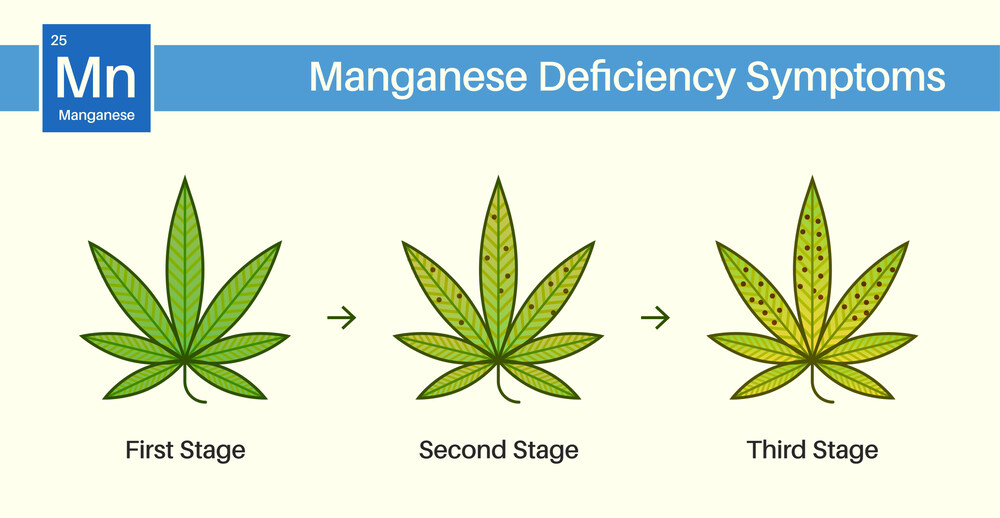
Manganese deficiency cannabis symptoms closely resemble iron deficiency, although manganese problems usually include dark spotting as symptoms progress.
Symptoms:
- Interveinal chlorosis on new growth.
- Gray or brown speckling across leaves.
- Stunted upper growth.
- Rust-colored spotting on older leaves.
- Yellowing leaves that eventually die and drop off.
Manganese supports photosynthesis and nitrogen metabolism, so deficiencies can severely impact vegetative growth.
Fixes:
- Flush the root zone with pH-adjusted water.
- Test runoff pH carefully.
- Add manganese sulfate or manganese chelate supplements.
- Avoid excessive iron supplementation, which can compete with manganese uptake.
- Maintain healthy root temperatures and oxygen levels.
Molybdenum deficiency: symptoms and fixes
Molybdenum deficiency cannabis symptoms are relatively rare, but they can still appear in cold or highly acidic growing environments.
Symptoms:
- Interveinal chlorosis on older leaves.
- Yellowing beginning near the leaf tips.
- Burnt or crispy leaf edges.
- Symptoms resembling nitrogen deficiency.
- Slow growth and weak plant vigor.
Molybdenum helps convert nitrogen into usable forms inside the plant, which is why deficiencies often mimic nitrogen problems.
Fixes:
- Check pH levels first, especially in hydro systems.
- Raise root zone temperatures if conditions are too cold.
- Flush excess nutrient salts if lockout is suspected.
- Add molybdenum supplements only when necessary.
- Avoid overfeeding micronutrients unnecessarily.
Sulfur deficiency: symptoms and fixes
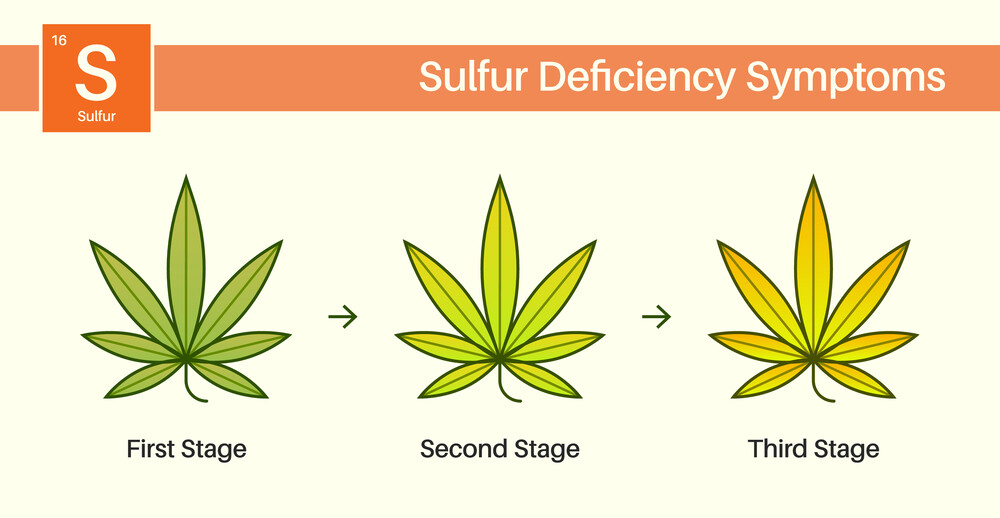
Sulfur deficiency cannabis symptoms can resemble nitrogen deficiency, although sulfur problems usually affect newer growth first.
Symptoms:
- Uniform yellowing across the plant.
- Pale upper growth.
- Thin stems and weak structure.
- Smaller leaves and reduced vigor.
- Delayed flower production.
Sulfur supports amino acid formation and terpene production, making it important during flowering.
Fixes:
- Check root zone pH immediately.
- Add sulfur-rich amendments such as:
- Epsom salts
- Gypsum
- Sulfate-based nutrients
- Improve root zone oxygenation.
- Avoid overwatering and cold root conditions.
Zinc deficiency: symptoms and fixes
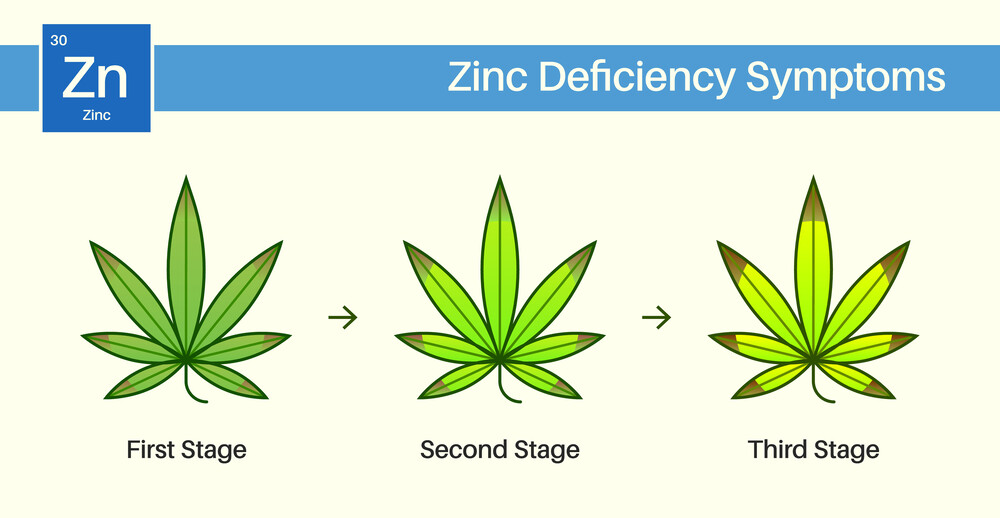
Zinc deficiency cannabis symptoms usually affect rapidly growing plants during vegetative growth and early flowering.
Symptoms:
- Yellowing between veins on younger leaves.
- Small distorted leaves and shortened internodes.
- Downward leaf curling in a claw-like shape.
- Stunted vertical growth.
- Poor bud formation during flowering.
Zinc plays a major role in hormone production and stem elongation.
Fixes:
- Monitor EC carefully to prevent salt accumulation.
- Flush and stabilize root zone pH.
- Add zinc supplements through nutrient solution or foliar spray.
- Avoid phosphorus overfeeding, which may block zinc uptake.
- Improve root health and oxygen availability.
How to keep cannabis plant healthy

Keeping cannabis plants healthy is much easier than constantly correcting nutrient deficiencies and fighting nutrient lockout. Prevention is always better than recovery, especially during flowering when stressed plants have less time to bounce back before harvest.
Healthy cannabis plants are built on consistency. Stable environmental conditions, balanced feeding schedules, proper watering practices, and a healthy root zone all work together to prevent cannabis nutrient deficiencies before they begin.
Over the years, I have learned that most cannabis nutrient problems start small. A slight pH drift, inconsistent watering, excessive EC levels, or poor airflow can slowly create deficiencies that become major problems later in the grow cycle. Paying attention to the fundamentals is what separates smooth harvests from stressful grows.
Best Feeding Practices to Avoid Marijuana Plant Deficiencies
Proper feeding practices are one of the most important parts of preventing cannabis deficiencies.
I always recommend starting nutrients at lower strengths than the manufacturer suggests, especially with younger plants. Cannabis nutrient companies often recommend aggressive feeding schedules that can easily overwhelm inexperienced growers.
A healthy feeding routine should focus on:
- Stable EC and PPM levels
- Proper nutrient ratios
- Gradual feed increases
- Monitoring runoff
- Avoiding salt buildup
Cannabis plants also require different nutrient ratios throughout their lifecycle.
During vegetative growth:
- Higher nitrogen levels support leaf and stem development.
During flowering:
- Phosphorus and potassium demands increase dramatically.
Using bloom nutrients too early or feeding excess nitrogen late into flower can create nutrient imbalances and poor bud quality.
I also recommend supplementing calcium and magnesium when growing in coco coir or under powerful LED lighting, as these setups commonly trigger Cal-Mag deficiency cannabis symptoms.
Monitoring EC, PPM, and pH Levels Correctly
One of the biggest mistakes beginner growers make is feeding blindly without measuring nutrient strength or pH.
I consider these tools mandatory:
- pH meter
- EC meter
- TDS/PPM meter
Without them, diagnosing cannabis nutrient deficiencies becomes guesswork.
Monitoring pH is especially important because cannabis plants absorb nutrients within very specific ranges.
| Growing Medium | Ideal pH Range |
| Soil | 6.0 – 7.0 |
| Coco Coir | 5.8 – 6.3 |
| Hydroponics | 5.5 – 6.5 |
I also monitor runoff regularly because runoff tells you what is happening inside the root zone.
High runoff EC usually indicates:
- Salt buildup
- Overfeeding
- Nutrient lockout risk
Low runoff EC may indicate:
- Underfeeding
- Nutrient depletion
- Poor nutrient retention
Keeping your root zone stable is one of the best ways to prevent weed plant deficiencies and nutrient lockout.
Proper Watering and Environmental Control
Watering mistakes are responsible for a huge percentage of cannabis nutrient problems.
Overwatering reduces oxygen availability around the roots, while underwatering interrupts nutrient transport and stresses the plant.
Healthy watering practices include:
- Allowing proper dry-back periods
- Watering evenly throughout the medium
- Avoiding constantly soaked roots
- Maintaining proper drainage
Environmental conditions matter just as much as nutrients.
Poor environmental control can reduce nutrient uptake even when feeding is perfect.
I always focus on:
- Stable temperatures
- Proper humidity
- Strong airflow
- Consistent VPD
- Healthy root zone temperatures
Cold roots are especially problematic because they slow phosphorus uptake and contribute to cannabis nutrient lockout.
Excessive heat can also increase transpiration and create calcium deficiency cannabis symptoms surprisingly fast.
Choosing the Right Nutrients for Cannabis Plants
Not all cannabis nutrients perform equally. Some nutrient lines are heavily concentrated and designed for experienced growers, while others are easier for beginners to manage.
I prefer nutrient systems that:
- Provide stable pH buffering
- Include micronutrients
- Offer Cal-Mag support
- Work consistently across different stages
Organic growers should focus on building healthy soil biology because microbes help break down nutrients into forms cannabis roots can absorb naturally.
Synthetic nutrient systems offer faster control and correction, but they also require closer monitoring to avoid overfeeding and nutrient lockout.
No matter which system you use, consistency matters more than constantly changing products.
Preventing Cannabis Nutrient Problems Before They Start
Preventing cannabis deficiencies is mostly about maintaining balance.
I always recommend:
- Feeding conservatively
- Monitoring runoff
- Keeping pH stable
- Avoiding overwatering
- Maintaining healthy airflow
- Checking plants daily
Daily inspections help you catch:
- Yellow leaves
- Brown spots
- Interveinal chlorosis
- Leaf curling
- Early nutrient deficiencies
The earlier you catch a problem, the easier it becomes to fix.
Healthy plants also resist pests, mold, heat stress, and environmental fluctuations much better than stressed plants.
When to Flush Cannabis Plants to Prevent Nutrient Buildup
Flushing is useful when:
- Runoff EC becomes extremely high
- Nutrient lockout develops
- Salt buildup accumulates
- Plants show multiple deficiency symptoms at once
I prefer flushing with properly pH-adjusted water while monitoring runoff EC until levels stabilize.
However, flushing should not become a routine habit unless necessary. Excessive flushing can strip nutrients from the medium and stress the root zone further.
In healthy grows, stable feeding practices usually eliminate the need for aggressive flushing altogether.
Conclusion
Cannabis deficiencies are one of the most common challenges growers face, but they also become much easier to manage once you understand how cannabis plants communicate through their leaves and growth patterns.
Learning how to identify cannabis deficiency symptoms early allows you to correct nutrient problems before they reduce yield, potency, and flower quality. Whether you are dealing with nitrogen deficiency cannabis symptoms, calcium deficiency, interveinal chlorosis, or nutrient lockout, the key is always proper diagnosis before treatment.
Cannabis nutrient deficiency FAQs
What are the first signs of nutrient deficiency in cannabis?
Early cannabis deficiency symptoms include yellow leaves, brown spots, curling leaves, pale growth, and slow plant development.
What is the most common nutrient deficiency in cannabis?
Nitrogen deficiency is the most common cannabis nutrient deficiency, especially during vegetative growth. Yellow lower leaves are usually the first sign.
What pH level prevents cannabis nutrient deficiencies?
Cannabis plants prefer:
- Soil: pH 6.0–7.0
- Coco/Hydro: pH 5.5–6.5
Incorrect pH can cause nutrient lockout and deficiency symptoms.
Can cannabis plants recover from nutrient deficiencies?
Yes, most cannabis plants recover if you fix the problem early. Healthy new growth is usually the first sign of recovery.