
Choosing the best grow lights for your autoflowers
Growing autoflowers indoors gives you full control over your environment, but choosing the right grow light is one of the most important decisions you’ll make. Lighting directly affects plant growth, bud density, resin production, and overall yield. Because autoflowers have a short life cycle, there’s little time to correct mistakes, making proper light intensity, positioning, and scheduling essential from the start.
Modern full-spectrum LED grow lights are the preferred choice for indoor growers due to their energy efficiency, strong PPFD output, and lower heat compared to older HID systems. When combined with the correct light schedule and setup, LEDs help autoflowers reach their full potential while keeping energy costs manageable.
In this guide, you’ll learn how to choose the best LED grow light for autoflowers, understand PPFD and DLI, compare lighting types, set up your grow space correctly, and avoid common mistakes that can limit plant performance and reduce yields.
Why Cannabis Grow Lights Are Essential for Indoor Growing
Growing autoflowering cannabis indoors gives you complete control over the environment, but your grow light is the single most important piece of equipment in your setup. Autoflowers have a short life cycle, typically reaching harvest in as little as 8–12 weeks, leaving very little time to recover from poor lighting, stretching, or stunted growth. Providing the correct light intensity, spectrum, and Daily Light Integral (DLI) from the moment your seeds germinate allows plants to establish strong roots, maintain compact growth, and produce dense, resin-rich flowers.
Modern full-spectrum LED grow lights are the preferred choice for indoor autoflower growers because they deliver high levels of Photosynthetically Active Radiation (PAR) while generating far less heat than older HID lighting systems. Combined with the correct environment, LED lighting helps maximise growth, improve bud quality, and keep electricity costs manageable. If you’re new to cultivation, learning how to grow autoflowers indoors starts with understanding how lighting influences every stage of development.
How Grow Lights Influence Autoflower Growth and Yields
Outdoor autoflowers receive the full spectrum of sunlight throughout their entire life cycle. Indoor growers must recreate those conditions by providing the correct light spectrum, intensity, and coverage from seedling through harvest. Unlike photoperiod cannabis, autoflowers do not wait for shorter days to begin flowering, so maintaining consistent lighting throughout the grow is essential.
High-quality LED grow lights influence every aspect of plant development, including:
- Driving photosynthesis to support healthy growth and vigorous development
- Encouraging rapid root establishment during the first two weeks after germination
- Producing short internodal spacing and stronger stems for compact, productive plants
- Supporting larger leaves that capture more usable light
- Increasing flower production, resin development, and final bud density
- Delivering consistent PPFD and DLI levels that maximise yield without causing unnecessary light stress
From our cultivation trials: One of the clearest patterns we’ve seen when testing autoflower genetics is that plants receiving adequate light during the first two to three weeks consistently develop stronger branching and larger final canopies. Because autoflowers begin flowering according to age rather than light schedule, slow early growth is rarely recovered later in the cycle.
Recommended PPFD and DLI for Autoflowers
| Growth Stage | PPFD (µmol/m²/s) | DLI (mol/m²/day) | Notes |
| Seedling | 100–300 | 10–15 | Keep light gentle to avoid stress |
| Vegetative | 300–500 | 15–25 | Promote strong structure and leaf growth |
| Flowering | 600–900 | 25–40 | Maximise bud development and resin production |
These PPFD ranges have consistently produced healthy growth across a wide range of autoflower cultivars in our own indoor trials. While some vigorous plants can tolerate higher light levels, we’ve found there’s little advantage in exceeding about 900 µmol/m²/s unless every other environmental factor—including CO₂, temperature, and nutrition is also optimized.
Because autoflowers have a fixed genetic lifespan, every day counts. Plants that receive insufficient light early in life often remain smaller throughout the grow, resulting in reduced harvests that cannot be fully recovered later.
Understanding Autoflower Light Cycles
One of the biggest differences between autoflowering and photoperiod cannabis is how flowering is triggered. Photoperiod plants require a 12-hour dark period to begin flowering, whereas autoflowers flower automatically according to age. This means there is no need to switch your timer to a 12/12 light schedule.
Most indoor growers use one of the following lighting schedules throughout the entire grow cycle:
| Light Schedule | Light Hours | Dark Hours | Best For | Pros | Cons |
| 18/6 | 18 | 6 | Beginners | Balanced growth, lower electricity use | Slightly less total light |
| 20/4 | 20 | 4 | Intermediate growers | Increased growth and yield potential | Slightly higher energy cost |
| 24/0 | 24 | 0 | Advanced setups | Maximum DLI and growth potential | Higher heat and electricity usage |
For most beginners, an 18/6 schedule provides everything an autoflower needs to produce healthy growth and heavy yields. Commercial growers or those operating highly efficient LED systems may choose 20/4 to increase light exposure while maintaining stable environmental conditions.
The Best Light Spectrum for Autoflowers
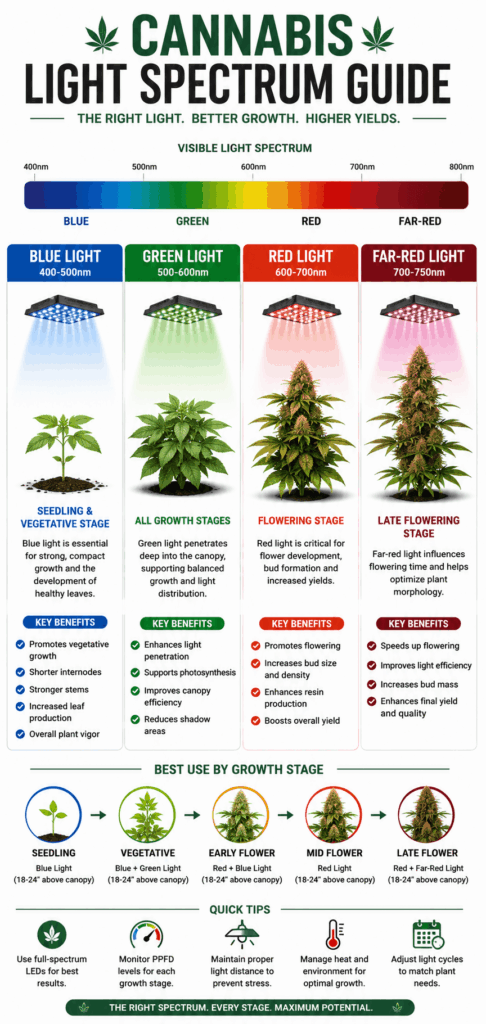
Autoflowers benefit from full-spectrum LED lighting throughout their entire life cycle, although different wavelengths influence growth in different ways.
| Spectrum Range | Wavelength (nm) | Growth Impact |
| Blue Light | 400–500 | Encourages compact growth, strong stems, and healthy foliage |
| Red Light | 600–700 | Promotes flowering, bud development, and resin production |
During the seedling and vegetative stages, blue wavelengths encourage compact growth, helping prevent excessive stretching and creating an even canopy that captures light efficiently.
As flowering progresses, red wavelengths become increasingly important for flower formation, resin production, and bud development. Full-spectrum LED fixtures provide the balanced output required for both vegetative growth and flowering without changing bulbs or fixtures.
Common Autoflower Grow Light Mistakes
Even experienced growers can lose yield through poor lighting practices. Because autoflowers develop quickly, correcting mistakes later in the grow often has little impact on the final harvest.
Avoid these common lighting mistakes:
| Mistake | Why It’s a Problem | Solution |
| Buying lights based on watts or lumens | These do not measure usable plant light | Focus on PPFD and PAR output |
| Hanging lights too close to seedlings | Causes stress and stunted growth | Start higher and gradually lower |
| Using low-quality grow lights | Poor spectrum and weak output reduce yields | Invest in full-spectrum LED fixtures |
| Increasing intensity too quickly | Leads to light stress and slowed growth | Gradually increase PPFD over time |
| Ignoring heat and airflow | High temperatures reduce plant performance | Ensure proper ventilation and cooling |
One of the most common support questions we receive from new growers involves seedlings showing signs of stress under powerful LED fixtures. In many cases the issue isn’t genetics or nutrition—it’s simply too much light too soon. Starting seedlings under reduced intensity and gradually increasing PPFD almost always produces sturdier, healthier plants.
Combining a quality full-spectrum LED grow light with the correct PPFD, DLI, temperature, and airflow gives autoflowering cannabis the best opportunity to reach its full genetic potential.
Types of Grow Lights for Autoflowers
Selecting the right grow light is one of the most important decisions you’ll make when growing autoflowers indoors. Unlike photoperiod cannabis, autoflowers have a fixed life cycle, often progressing from seed to harvest in just 8–12 weeks. That leaves very little time to recover from poor lighting, stretching, or environmental stress. Choosing a high-quality grow light from the start helps maximize growth, improve bud density, and produce larger, more resinous harvests.
Today, indoor growers have three main lighting options: LED, HID, and fluorescent. While all three technologies can grow autoflowering cannabis, modern full-spectrum LED grow lights consistently deliver the best combination of light intensity, energy efficiency, and temperature control. For most home growers, LEDs provide everything needed to take autoflowers from germination through harvest while keeping electricity costs and heat production to a minimum.
LED vs HID vs Fluorescent Grow Lights for Autoflowers
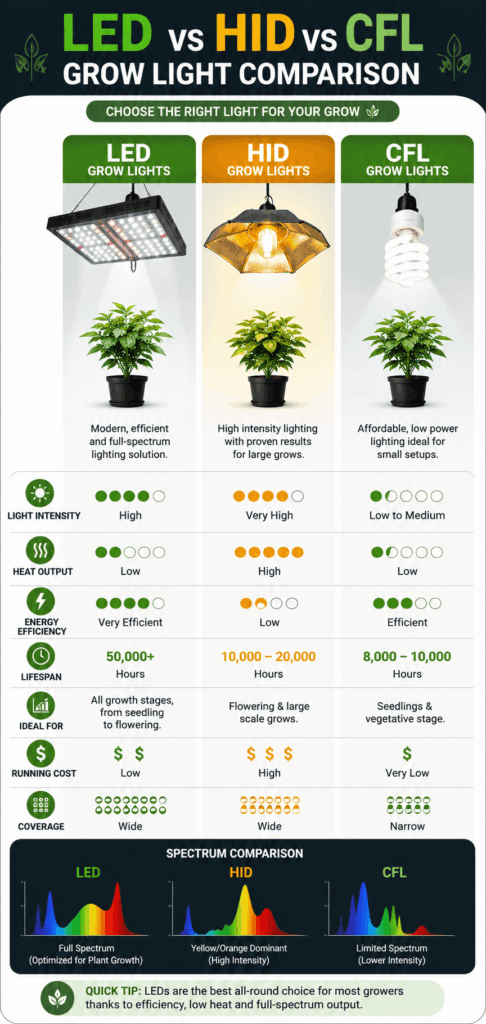
| Feature | LED | HID (HPS/MH) | Fluorescent (CFL/T5) |
| Energy Efficiency | Excellent | Moderate | Good |
| Heat Output | Low | High | Low |
| PAR & PPFD Output | Excellent | Excellent | Low |
| Yield Potential | Excellent | Excellent | Poor |
| Lifespan | 50,000+ Hours | 10,000–20,000 Hours | 8,000–20,000 Hours |
| Best Use | Entire Grow Cycle | Large Grow Rooms | Early Seedlings |
| Running Costs | Low | High | Low |
| Beginner Friendly | Excellent | Moderate | Good |
Although HID lighting can still produce excellent autoflower harvests, most growers now choose LED technology because it is easier to manage, produces less heat, and delivers a more even spread of usable light across the canopy.
Why LED Grow Lights Are Best for Autoflowers
Modern LED grow lights are designed to deliver the spectrum, PPFD, and PAR levels autoflowers require throughout every stage of growth. Unlike older lighting systems, quality LEDs provide full-spectrum light from germination through harvest, eliminating the need to change bulbs or fixtures as plants mature.
For autoflower growers, one of the biggest advantages is the ability to adjust light intensity. Seedlings require relatively gentle PPFD, while mature flowering plants benefit from significantly higher light levels. Dimmable LED fixtures make these adjustments simple, allowing growers to increase light intensity gradually without causing unnecessary stress.
Additional benefits of LED grow lights include:
- Full-spectrum lighting suitable for the entire autoflower life cycle.
- Adjustable dimming for managing PPFD and Daily Light Integral (DLI).
- Lower electricity consumption than HID systems.
- Reduced heat output for easier environmental control.
- Better canopy coverage, allowing lower bud sites to receive more usable light.
- Long operating life with very little maintenance.
Why Heat Management Matters for Autoflowers
Because autoflowers cannot extend their vegetative stage, prolonged heat stress can permanently reduce plant size and final yields. High temperatures slow photosynthesis, reduce water efficiency, and may cause plants to stretch or produce smaller flowers.
This is one of the main reasons LED grow lights are recommended for indoor autoflower cultivation. Their lower operating temperatures make it much easier to maintain stable conditions inside small grow tents, reducing the risk of heat stress while supporting consistent growth from seedling to harvest.
Are HID Grow Lights Still Worth Using?
High-pressure sodium (HPS) and metal halide (MH) fixtures were once the standard for indoor cultivation and are still capable of producing quality autoflower harvests. However, they generate considerably more heat than LEDs and typically require larger extraction systems to maintain safe growing temperatures.
Although some commercial autoflower facilities continue to use HID lighting, most new indoor growers choose modern LED fixtures because they consume less electricity, simplify temperature management, and provide more uniform canopy coverage.
Are Fluorescent Lights Suitable for Autoflowers?
CFL and T5 fluorescent fixtures emit a gentle blue-rich spectrum that can support newly germinated autoflowers during their first few days of growth. However, they lack the PAR intensity required to sustain vigorous vegetative growth or produce dense, resin-rich flowers.
Most autoflower growers switch to a full-spectrum LED as soon as seedlings become established. Attempting to complete an entire grow under fluorescent lighting usually results in slower growth, increased stretching, and significantly lower yields.
Can Household or Aquarium LED Lights Grow Autoflowers?
Household LED bulbs and aquarium lights are not designed for growing autoflowers. While they may provide enough light to keep seedlings alive temporarily, they cannot deliver the PPFD, spectrum, or canopy coverage required to produce healthy plants and heavy harvests.
If your goal is to maximize the genetic potential of your autoflowers, investing in a dedicated horticultural LED grow light is the most reliable long-term solution.
Pros and Cons of LED Grow Lights
Like any growing equipment, LED fixtures have strengths and limitations.
Advantages
- Excellent energy efficiency with lower running costs.
- Full-spectrum lighting from seedling to harvest.
- Lower heat output than HID systems.
- Dimmable models simplify PPFD and DLI management.
- Available in sizes suitable for 2×2, 3×3, 4×4, and larger grow tents.
- Long lifespan with minimal maintenance.
Disadvantages
- Higher upfront cost than fluorescent lighting.
- Lower-quality fixtures may provide uneven light distribution.
- Some budget models use noisy cooling fans.
- Incorrect hanging height or excessive PPFD can still cause light stress.
Although premium LED grow lights require a larger initial investment, their efficiency, environmental control, and ability to consistently produce high-quality autoflower harvests make them the preferred choice for both beginners and experienced indoor growers.
How to Choose the Best LED Grow Light for Autoflowers
Choosing the best LED grow light for autoflowers involves more than selecting the highest wattage. The right fixture should match your grow tent, deliver consistent PPFD across the canopy, operate efficiently, and provide a full spectrum throughout the plant’s life cycle. A well-matched light supports steady growth from germination to harvest while minimising heat, energy use and uneven development.
When comparing grow lights, focus on verified specifications rather than marketing claims. When comparing fixtures for breeding and cultivar evaluations, we pay far more attention to uniform canopy coverage than peak center PPFD. Even light distribution typically produces more consistent plant structure and flower development than fixtures with very high hotspot intensity. Reliable manufacturers provide PPFD maps, efficacy ratings (µmol/J), coverage areas and recommended hanging heights. These details help you assess whether a fixture can produce healthy, high-yielding autoflowers.
How Much Light Do Autoflowers Need?
Autoflowers require increasing light intensity as they mature. Seedlings need gentle lighting, while flowering plants benefit from higher PPFD to maximise bud production. Gradually increasing intensity helps avoid stress and supports consistent growth.
Many growers also track Daily Light Integral (DLI), which measures total daily light exposure. Combined with PPFD, DLI offers a more accurate understanding of lighting performance than wattage alone.
| Growth Stage | PPFD (µmol/m²/s) | DLI (mol/m²/day) | Typical Light Schedule |
| Seedling | 100–300 | 10–15 | 18/6 |
| Early Vegetative | 300–500 | 15–25 | 18/6 or 20/4 |
| Late Vegetative | 500–650 | 20–30 | 18/6 or 20/4 |
| Flowering | 600–900 | 30–40 | 18/6 or 20/4 |
More light does not always mean better results. Excessive PPFD can cause stress if environmental conditions are not balanced. Since autoflowers have limited recovery time, gradual increases in intensity are more effective than starting at maximum output.
What to Look for in an LED Grow Light
Not all LED grow lights perform equally. Prioritise fixtures with:
- Full-spectrum white LEDs for all growth stages
- High efficacy for efficient light output
- Even PPFD distribution across the canopy
- Built-in dimming for intensity control
- Passive or quiet cooling systems
- Clear PPFD maps and coverage data
- A size suited to your grow tent
Higher-quality components typically deliver better performance, efficiency and lifespan than budget options focused on wattage alone.
Choosing the Right Grow Light for Your Tent
Matching your light to your grow space improves coverage and efficiency. An oversized fixture run at lower power often produces more even light than a smaller unit at full output.
| Grow Tent Size | Recommended LED Power | Typical Autoflower Capacity |
| 2×2 ft | 100–200W | 1–2 Plants |
| 3×3 ft | 300–450W | 2–4 Plants |
| 4×4 ft | 480–650W | 4–6 Plants |
| 5×5 ft | 650–1000W | 6–9 Plants |
These estimates assume modern, efficient LED fixtures. Actual requirements may vary depending on canopy management and target PPFD.
Should You Oversize Your LED Grow Light?
Many growers choose a slightly larger fixture than needed. Running a more powerful LED at 60–80% output improves coverage, reduces heat and allows flexibility as plants mature. It also provides room to upgrade your grow space or grow larger autoflowers in the future.
Ultimately, the best LED grow light for autoflowers delivers even coverage, sufficient PPFD at every stage and fits your grow environment. Investing in a quality fixture helps maximise yields, improve bud quality and create a more efficient indoor grow.
Setting Up LED Grow Lights for Autoflowers
Installing your grow light correctly is just as important as choosing the right fixture. Even the best LED grow light will underperform if it is hung too high, placed too close to the canopy or run at the wrong intensity. Because autoflowers complete their life cycle in just 8–12 weeks, early lighting mistakes can permanently reduce plant size, flower production and final yields.
The goal is to provide consistent light intensity from germination through harvest while maintaining an even canopy, stable temperatures and healthy environmental conditions. Setting up your lighting properly from day one helps plants develop strong roots, compact growth and dense flowers without unnecessary stress.
How Far Should LED Grow Lights Be from Autoflowers?
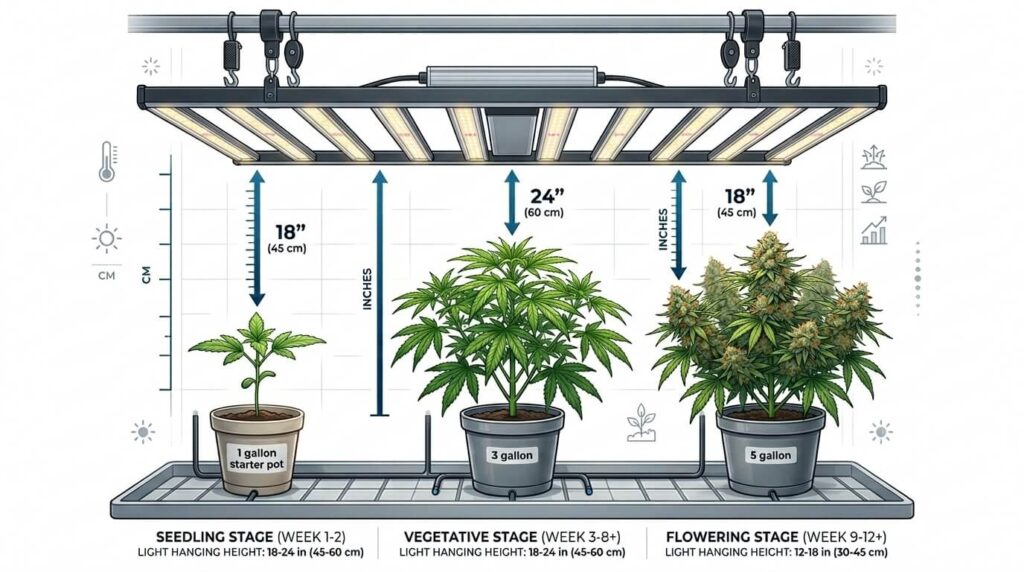
The ideal hanging height depends on your fixture’s power, design and whether it includes a dimmer. Rather than relying on a fixed distance, follow the manufacturer’s recommendations and use PPFD as your main guide.
As a general reference, modern full-spectrum LED grow lights can be positioned at the following distances:
| Growth Stage | Recommended Distance | Suggested PPFD |
| Seedling | 18–24 inches | 100–300 µmol/m²/s |
| Early Vegetative | 18–24 inches | 300–500 µmol/m²/s |
| Late Vegetative | 16–22 inches | 500–650 µmol/m²/s |
| Flowering | 14–20 inches | 600–900 µmol/m²/s |
Instead of lowering the light too quickly, gradually increase intensity by adjusting height or dimmer settings as plants mature. This promotes steady growth while reducing the risk of bleaching or light stress.
Setting the Correct Light Schedule for Autoflowers
Autoflowers do not rely on changes in light cycles to begin flowering, so there is no need to switch to a 12/12 schedule. Instead, growers typically use one consistent schedule from seed to harvest.
| Schedule | Best For | Benefits |
| 18/6 | Most growers | Balanced growth, plant health and energy efficiency |
| 20/4 | Higher yields | Increased Daily Light Integral (DLI) with manageable heat |
| 24/0 | Advanced setups | Continuous light but higher heat and electricity use |
For most growers, 18/6 offers the best balance of performance and simplicity. More experienced growers may use 20/4 to maximise light exposure while maintaining stable conditions.
Adjusting Light Intensity Throughout the Grow
Autoflowers need increasing levels of light as they develop. Seedlings are sensitive to high intensity, while flowering plants can handle much stronger PPFD to support bud production.
If your LED has a dimmer, increase intensity gradually rather than running it at full power from the start. A simple progression looks like this:
- Week 1: Low intensity for seedlings
- Weeks 2–4: Moderate intensity for vegetative growth
- Weeks 5–8: Higher intensity as flowering begins
- Late Flowering: Maintain stable output without exceeding recommended PPFD
Gradual adjustments help plants adapt and reduce stress.
Creating an Even Canopy
Autoflowers often grow at slightly different heights, which can lead to uneven light distribution. Taller plants may receive too much light while shorter ones remain shaded.
To improve canopy uniformity:
- Rotate pots regularly if your light has a stronger centre output
- Raise shorter plants to match canopy height
- Use low-stress training (LST) early to spread growth evenly
- Avoid excessive defoliation that limits light absorption
Even within the same cultivar, individual autoflowers don’t always finish at identical heights. During phenotype evaluations we regularly adjust plant height with simple risers or early LST rather than lowering the fixture for taller plants. This keeps PPFD more consistent across the entire canopy.
A level canopy ensures all plants receive similar PPFD, improving consistency and yields.
Preventing Light Burn, Stretching and Heat Stress
Lowering your light does not always increase yields. Excessive intensity can cause light stress, while lights placed too high encourage stretching as plants reach upward.
Maintaining proper hanging height, airflow and temperature is key. This is especially important in small grow tents where heat can build up quickly around the canopy.
Recognizing Light Stress and Heat Stress
Light stress and heat stress often appear together but have different causes.
| Symptom | Light Stress | Heat Stress |
| White or bleached tops | ✓ | ✗ |
| Pale yellow upper leaves | ✓ | ✗ |
| Taco-shaped leaves | ✓ | ✓ |
| Brown crispy leaf edges | ✗ | ✓ |
| Airy flower development | ✗ | ✓ |
| Stunted growth | ✓ | ✓ |
| Dry flowers | ✓ | ✓ |
We’ve also found that many growers mistake light stress for nutrient deficiencies and begin changing feeding schedules unnecessarily. Before adjusting nutrients, always check your fixture height, PPFD, and canopy temperature. Lighting is often the simpler explanation.
Heat stress typically causes upward curling leaves, brittle foliage, slow growth and airy buds. Improving airflow and lowering temperatures usually resolves the issue.
Light stress appears as bleached tops, pale leaves and discoloration directly under the fixture. Raising the light or reducing intensity will correct the problem.
By maintaining proper distance, gradually increasing PPFD and ensuring good airflow, growers can create a stable lighting environment that supports healthy autoflower growth and high-quality harvests.
Frequently Asked Questions About Autoflower Grow Lights
What is the best LED grow light for autoflowers?
The best LED grow light for autoflowers is a full-spectrum fixture that delivers even PPFD across the canopy, includes a built-in dimmer and matches the size of your grow tent. Modern LEDs are ideal because they produce less heat, use less electricity and provide the light intensity autoflowers need from germination through harvest.
What is the best light schedule for autoflowers?
Most indoor growers use either an 18/6 or 20/4 light schedule throughout the entire grow cycle. An 18/6 schedule provides an excellent balance between plant growth, electricity costs and equipment longevity, while 20/4 offers additional Daily Light Integral (DLI) that may benefit experienced growers. Unlike photoperiod cannabis, autoflowers do not require a 12/12 flowering cycle.
Can autoflowers get too much light?
Yes. Excessive PPFD or hanging your LED grow light too close to the canopy can cause light stress, even when temperatures are within the ideal range. Common symptoms include bleached leaf tips, pale upper growth, taco-shaped leaves and slowed development. Gradually increasing light intensity throughout the grow helps minimise the risk of stress.
What PPFD is best for autoflowers?
The ideal PPFD depends on the stage of growth. Seedlings generally perform best between 100–300 µmol/m²/s, vegetative plants benefit from 300–650 µmol/m²/s, and flowering autoflowers typically thrive between 600–900 µmol/m²/s when environmental conditions are properly managed.
How far should LED grow lights be from autoflowers?
The ideal distance depends on your fixture and its output. As a general guide, keep LED grow lights around 18–24 inches above seedlings and vegetative plants, reducing the distance to approximately 14–20 inches during flowering if PPFD remains within the recommended range. Always monitor plant response rather than relying on distance alone.
How many watts do I need for an autoflower grow?
The required wattage depends on your grow space rather than the number of plants. A modern 100–200W LED is usually sufficient for a 2×2 grow tent, 300–450W works well in a 3×3 tent, and 480–650W is generally recommended for a 4×4 tent. Always choose fixtures based on coverage area and PPFD performance rather than wattage alone.