
How to Grow Autoflowers Indoors: The Complete Beginner’s Guide
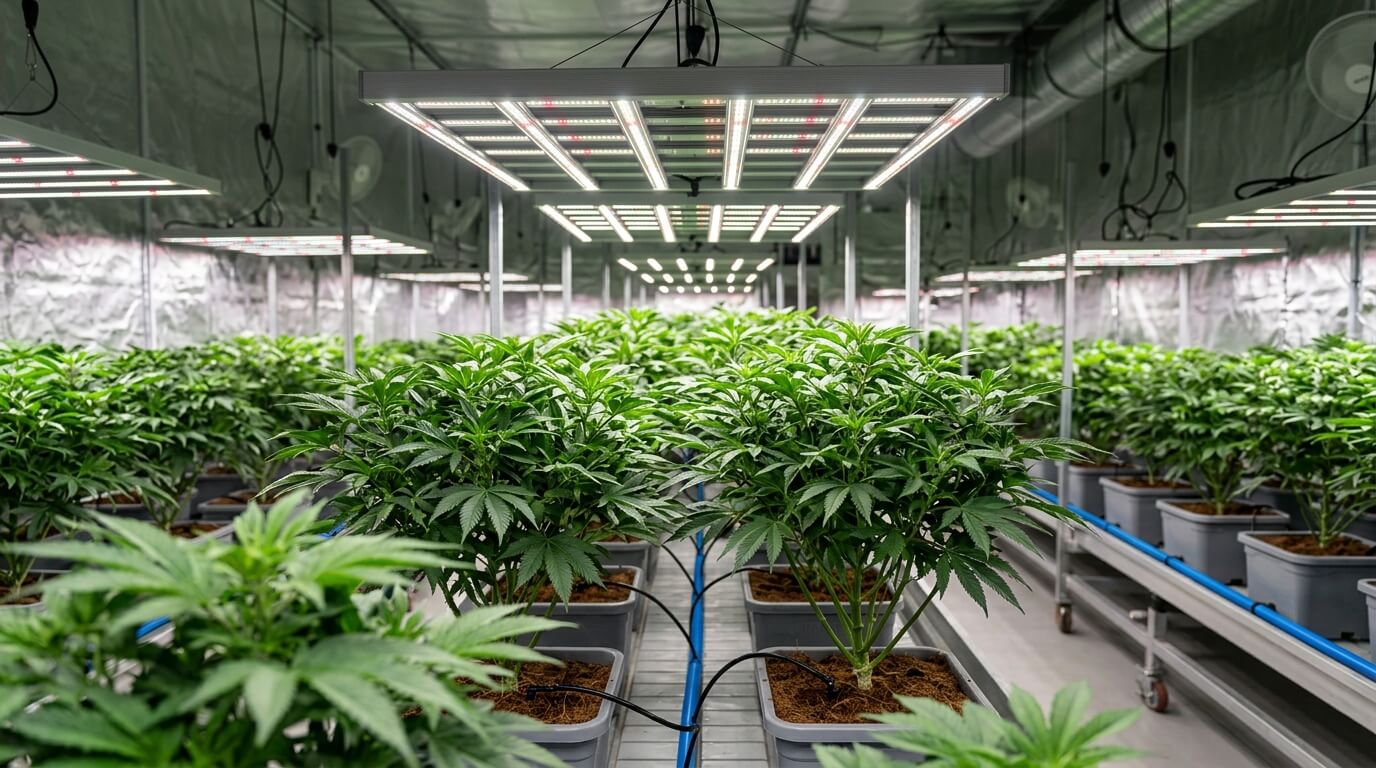
Knowing how to grow autoflowering cannabis plants indoors will ensure that you can produce superb harvests every time with little effort. Autos are much easier to grow than photoperiods due to their shorter life cycle, and are an excellent starting point for first-time or beginner-level indoor growers.
In this article, I will explain everything you need to know to grow autoflowers indoors successfully. Covering the importance of genetics, lighting, watering, the best soil and pots, optimal temperature and humidity range, common mistakes to avoid and how to increase your autoflowering yields.
Why Grow Autoflower Seeds Indoors?
Most people think of autos and presume they are only for growing outdoors in a hot climate, and stick with photoperiods using 18/6 and 12/12 lighting schedules. Below highlights the benefits and differences of growing photoperiods and autos and why you may want to think about growing autos for your next crop!
Autoflower vs Feminised Indoor Growing: What Are the Benefits and Differences?
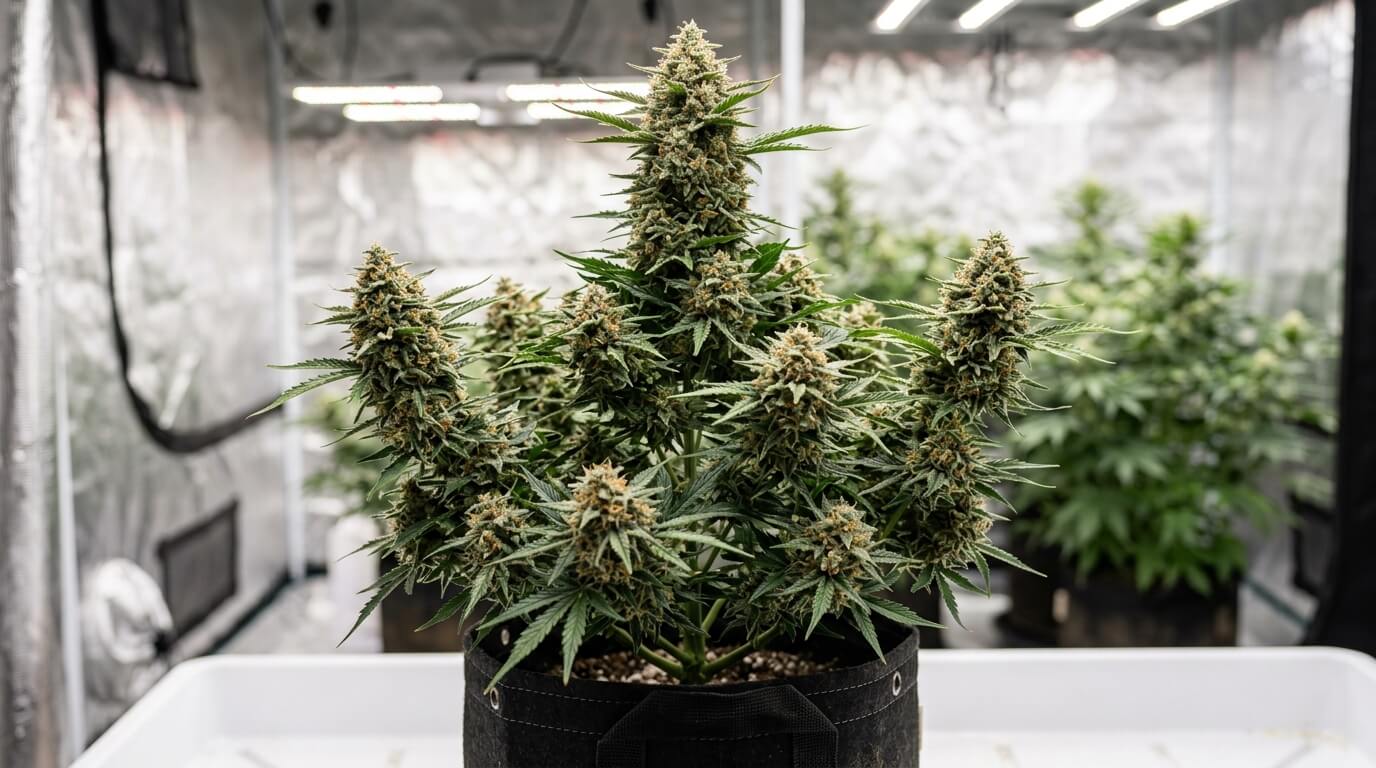
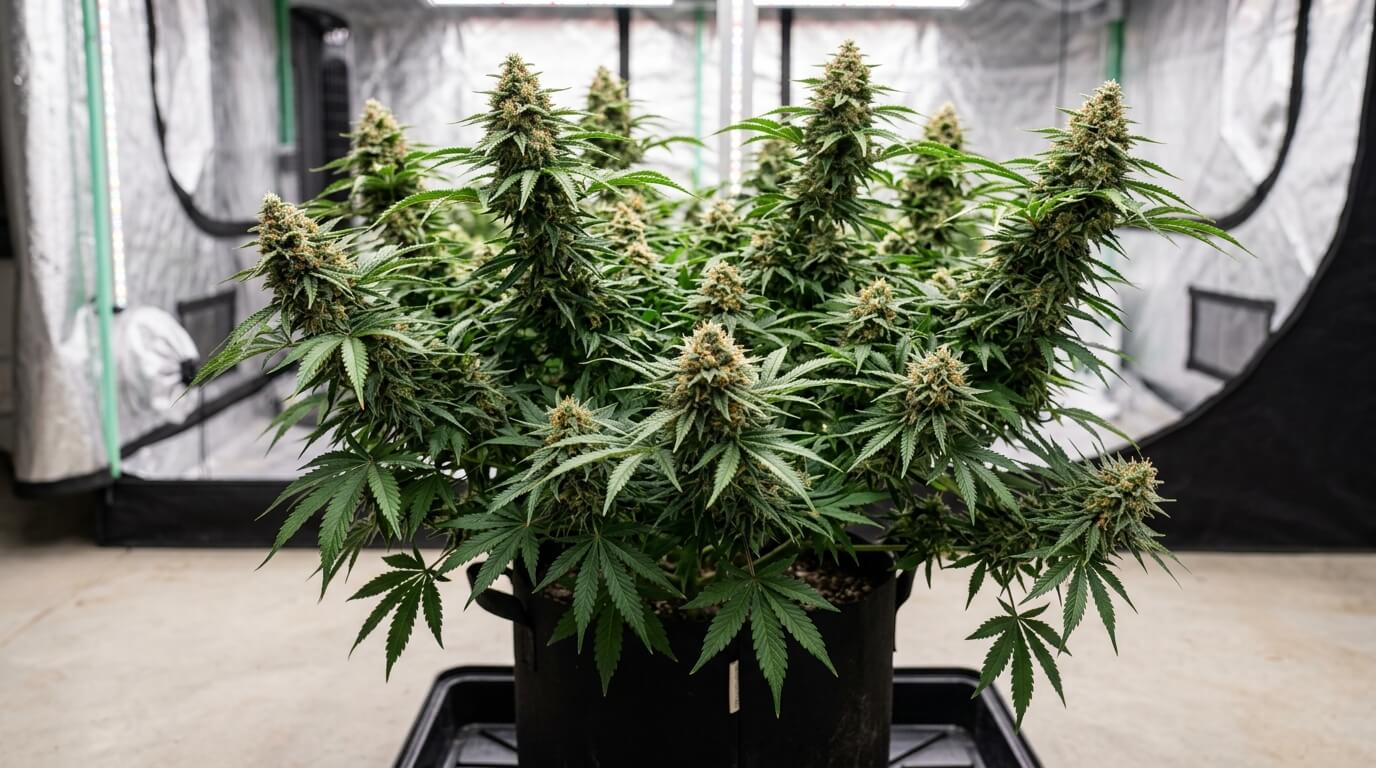
The first thing to know is that autos have a short vegetative period and will begin to flower automatically after 4 weeks from the day the seed sprouts. Photoperiods, on the other hand, are dependent on longer darkness periods to induce flower production, which is why indoor growers always follow the 18/6 and 12/12 schedule.
The only major difference you need to know is that cloning autos is not advised because the clones will begin flowering. Also, autoflowering plants do not respond well to transplanting. For this reason, we always recommend that you plant directly into a large-sized container and let the plant grow.
The table below compares the main differences between autoflowering and feminised photoperiod plants for indoor growers.
| Feature | Autoflowering Cannabis | Feminised Photoperiod Cannabis |
| Flowering trigger | Flowers automatically with age | Requires 12 hours of darkness |
| Typical seed-to-harvest time | 9-12 weeks | 14-20+ weeks |
| Light schedule | 18/6, 20/4 or 24/0 | 18/6 for veg, 12/12 for flower |
| Beginner friendly | Very beginner friendly | Better for growers with some experience |
| Cloning | Not recommended | Ideal for cloning and mother plants |
| Training time | Limited due to short veg stage | Longer training window |
| Plant size | Small to medium | Medium to large |
| Yield potential | Medium to high | Usually higher |
| Best for | Fast, simple indoor grows | Larger plants and maximum control |
The Benefits of Photoperiods
- Photoperiods can be kept in a state of vegetation indoors using 18 hours of light
- You can clone photoperiod plants and produce a mother plant
- Photoperiods allow a grower much more time to train them during the vegetative stage
- Yields are typically greater using photoperiods due to plants being taller and wider
- Outdoors, photoperiod plants planted in the spring can become massive when harvested
The Benefits of Autoflowering
Autos have a fast turnaround time, ranging between 9 and 12 weeks from seed to harvest, with some 60 day autoflowers finishing even quicker under ideal growing conditions.
- Autos are low-maintenance and easy-to-grow plants
- They are ideal for first-time growers or those with little experience
- The quality of the buds autos produce is on par with photoperiods
- Outdoors, they can be planted back-to-back during Spring until Winter
- Autos produce short-sized plants, making them discrete and stealthy
How to Grow Autoflower Seeds Indoors Successfully
So if you are already liking the idea of growing autos indoors and are looking forward to a new challenge after years of growing photoperiods, then this explains why choosing the best autoflowering seeds, the correct light and watering schedule is so important for growing autos successfully.
Choosing the Best Autoflower Seeds for Indoor Growing
Everything starts with genetics, and choosing high-quality autoflower genetics is one of the most important steps for success. For new growers, starting with proven autoflower seeds for beginners can make the entire process much easier. What do I mean by the best autoflower seeds? With so many autos on the market, it can be difficult and slightly overwhelming to check every auto strain from every breeder. I would recommend planting several different autoflowering strains together. This way, you will see which strain was your favourite and the best performer.
Light Schedule and Grow Lights for Autoflowers
Whilst autos are not dependent on the light cycle, and one reason they are so popular amongst outdoor growers, you still want to provide your autos with plenty of PAR-rich, intense light. Now there are many different grow schedules you can pick; however, the most popular and cost-effective are 18/6 or 20/4. If you’re unsure which approach to follow, our guide to the best light schedule for autoflowers explains the advantages and disadvantages of each option.
You can grow autos with 24 hours of light; many growers find the dark period benefits their plants, lowers monthly electricity bills, and makes controlling temperature and humidity easier.
As far as lighting is concerned, the more intense and PAR-rich your grow light, the better! Do not waste your time using a CFL or an HPS that is less than 600W. LED grow lights, in my opinion, are far superior at delivering optimal PAR and spectrum with significantly less heat. Selecting the best grow light for autoflower plants can have a major impact on growth rates, bud density and final yields.
The table below shows the main autoflower light schedules and when each one may be useful.
| Light Schedule | Daily Light Hours | Best For | Main Benefit | Possible Drawback |
| 18/6 | 18 hours on / 6 off | Most indoor growers | Good balance of growth and energy cost | Slightly less total light than 20/4 |
| 20/4 | 20 hours on / 4 off | Maximising growth | Excellent balance for autoflowers | Higher electricity use |
| 24/0 | 24 hours on | Experienced growers with good climate control | Maximum light exposure | More heat, stress risk and electricity cost |
How to Water and Feed Autoflower Plants Indoors
Watering your cannabis plants correctly makes a huge difference to how well the roots and foliage develop. Autos do not require much water, especially during the first 2-4 weeks. We recommend only watering your autos regardless of the growth stage when:
- The soil has become dry and dusty
- The pot has become light enough to lift off the ground
- 1-2 hours after the grow lights have turned on
- Your plants begin to wilt slightly
As far as nutrients are concerned, you do not want to overfertilise your autos, and considering that they do not require much nutrition during the seedling or vegetative period less is more.
- During weeks 1-4, use a nutrient designed for the vegetation stage
- From week 5 onwards, use a flowering feed higher in P and K
- Use half of the recommended ratio of nutrients for autos
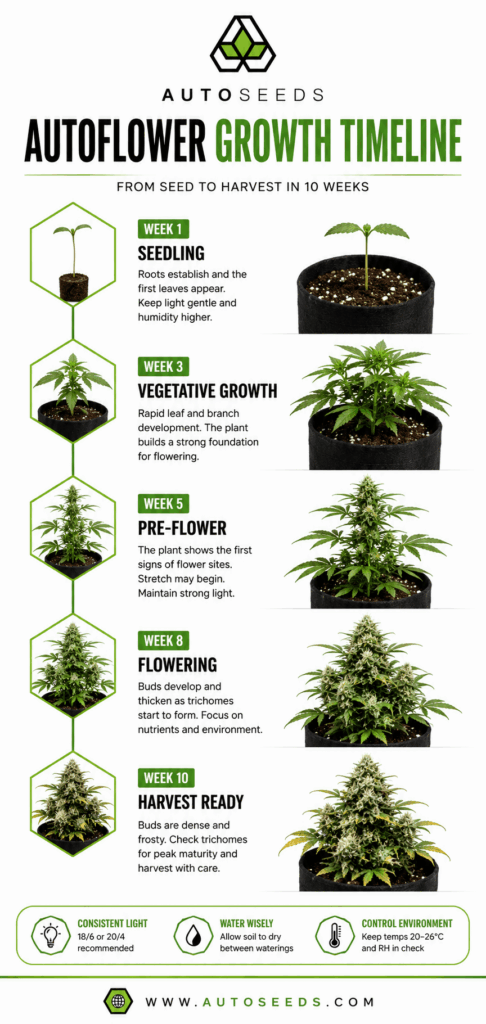
Use the table below as a simple indoor autoflower feeding guide.
| Growth Stage | Approx. Week | Feeding Advice |
| Seedling | Week 1-2 | Water only or very light root stimulant |
| Early vegetative growth | Week 2-4 | Light vegetative feed |
| Pre-flower | Week 4-5 | Gradually transition from grow feed to bloom feed |
| Flowering | Week 5 onwards | Bloom nutrients higher in phosphorus and potassium |
| Late flower / ripening | Final 1-2 weeks | Reduce nutrients or use water only, depending on your grow style |
Best Indoor Setup for Autoflower Cannabis Plants
Once you have decided which autoflowering strains are best for you, the next thing to cover is the best indoor set-up for autoflowering cannabis. This means choosing the right grow tent and ventilation, using the best soil and pots, and creating the ideal growing environment, as explained below.
Choosing the Right Grow Tent and Ventilation
The size of your grow tent will depend entirely on how many plants you want to grow, how much space you have, and if you have to abide by your state plant count laws. Autos do not grow very big, so you can produce a good yield in a small space.
Use the table below as a general guide when choosing your indoor autoflower setup.
| Grow Tent Size | Recommended Autoflower Plant Count |
| 0.8m x 0.8m x 1.5m | 4 plants |
| 1m x 1m x 2m | 4-6 plants |
| 1.2m x 1.2m x 2m | 6-9 plants |
Proper cannabis grow room ventilation is crucial for allowing plenty of fresh air to enter the grow space while removing stale, hot air.
- Exhaust fan: This is responsible for blowing air out of the top of the tent using aluminium ducting
- Carbon filter: This connects to the exhaust fan and scrubs the air clean using carbon
- Ducting: Made of aluminium, it connects the exhaust fan to the carbon filter
- Chain and hooks: Used to securely hang the equipment at the top of the grow tent
Best Soil and Pots for Autoflower Seeds Indoors
If you are a beginner grower or new to growing, we always advise growing your autoflowering or photoperiod crops in soil. The reason is that soil is a very forgiving medium for growing smooth-tasting, chemical-free flowers. The key to producing a clean and flavoursome crop is starting with top-quality soil.
- Good quality soil will have a fibrous, lightweight and spongy texture when squeezed
- Check to see how well the soil drains after watering and how frequently it dries out again
- Good quality soil should have a dark brown and black appearance with a shimmer
- Avoid using soil that has high NPK levels, such as 10-10-10, as these contain chemical inputs
- The aroma of fresh, top-quality soil will be sweet and earthy. Avoid soil with a bad aroma
- If your soil contains worms that are actively moving around, then this is a great sign of good soil
You may be thinking, what difference does the pot I grow my autos in matter? However, you would be happy to know that some pots are better for growing cannabis than others, and can even improve root development and health, as well as impact yields.
| Pot Type | Best Feature | Drawback | Best For |
| Plastic Pots | Cheap and reusable | Can become root-bound | Budget growers |
| Fabric Pots | Excellent root development | Dry out faster | Most autoflower growers |
| Air Pots | Maximum root aeration | More expensive | Advanced growers chasing bigger yields |
For most indoor autoflower growers, fabric pots are the best all-round choice. They improve airflow around the root zone, encourage air pruning, and help develop a dense network of feeder roots. A 3-5 gallon (11-19 litre) fabric pot is ideal for most autoflowering strains, although choosing the correct pot size for autoflowers will ultimately depend on the genetics and growing space available.
Plastic Pots
Plastic pots are easy to find, cheap, long-lasting and can be washed and used after every harvest. The only downside to plastic pots is that they promote root formation, leading to a root-bound structure.
Fabric Pots
Felt fabric pots are great for growing autos or photoperiods because they create a layer of air around the edges of the fabric. This layer of air allows roots to move freely towards the fabric and become pruned, resulting in more fibrous root hairs. Fabric pots are well known for allowing plants to develop a prolific and extremely fibrous root base.
Air Pots
These pots may look strange, but they do an excellent job of allowing the soil and roots to breathe and prune, just as fabric pots do. Air pots may be the most expensive of these three options, but they are superb for producing high yields in small spaces and can be washed and reused each time.
Ideal Temperature and Humidity for Indoor Autoflowers
Autos will grow for the first 4-5 weeks, before they start to flower. With such a short life cycle, making sure that you have the correct temperature and humidity levels dialled in will be crucial.
- Lights on, temperature and humidity = 24 degrees Celsius and 50-60%
- Lights off, temperature and humidity = 18-20 degrees Celsius and 50-60%
Common Mistakes When Growing Autoflowers Indoors
On one hand, growing autos can be a totally stress-free experience where everything goes great. Then again, it can be easy to make mistakes that affect plant growth and development and harm the yield and flower quality. Below is a breakdown of how overwatering and overfertilizing can affect size, development, health, and yield potential.
Overwatering Autoflower Plants
Overwatering is one mistake I think every grower has made during their time as a cannabis cultivator. It only takes a little too much water, and the next thing you know, your plants are wilting, and the soil becomes soggy, waterlogged, and dense.
The trick to avoiding overwatering is to give your plants less than you think. My golden rule is to use the 10% rule. This means that I would give, for example, a 10-litre pot 1 litre of water or a nutrient solution. I only water again when the soil is dry, and the pots feel light to the touch.
The bigger your auto becomes, the more water it will demand, so gradually increase the volume of water/nutrient solution you give them. Doing so will prevent overwatering and overfeeding.
Using Too Many Nutrients Indoors
The idea of giving your autos as much food as possible to grow into a monster is a bad idea. Cannabis plants that are overfed can become stunted, cease growth, and begin to show signs of nutrient deficiencies and toxicity. Autos are more sensitive to nutrients than photoperiods. Using half the recommended amount will benefit autos and help maintain optimal plant health and vigour.
Why Autoflowers Stay Small Indoors
There are several different reasons why your autos may end up short in height and produce a yield far lower than you were hoping for:
- Heat stress: Autos that suffer from heat stress due to hot and dry grow rooms can become small
- Low light intensity: Low light intensity can cause plants to mature between 50 and 75cm in height
- Overfertilization: Over-fertilised plants will grow much more slowly and produce lower yields
- Small pots: Using a small pot less than 2 gallons will cause short autos
How to Increase Autoflower Yield Indoors
There are ways to increase the amount of buds your autos produce, and that is through plant training, environmental optimisation and selecting high yield autoflower seeds with strong genetic potential. You have to remember that, unlike photoperiods, you do not have the luxury of long vegetation and plant training. Below explains the best training technique for maximising yields, knowing when to correctly harvest and how to dry and cure your buds properly.
Low Stress Training for Indoor Autoflowers
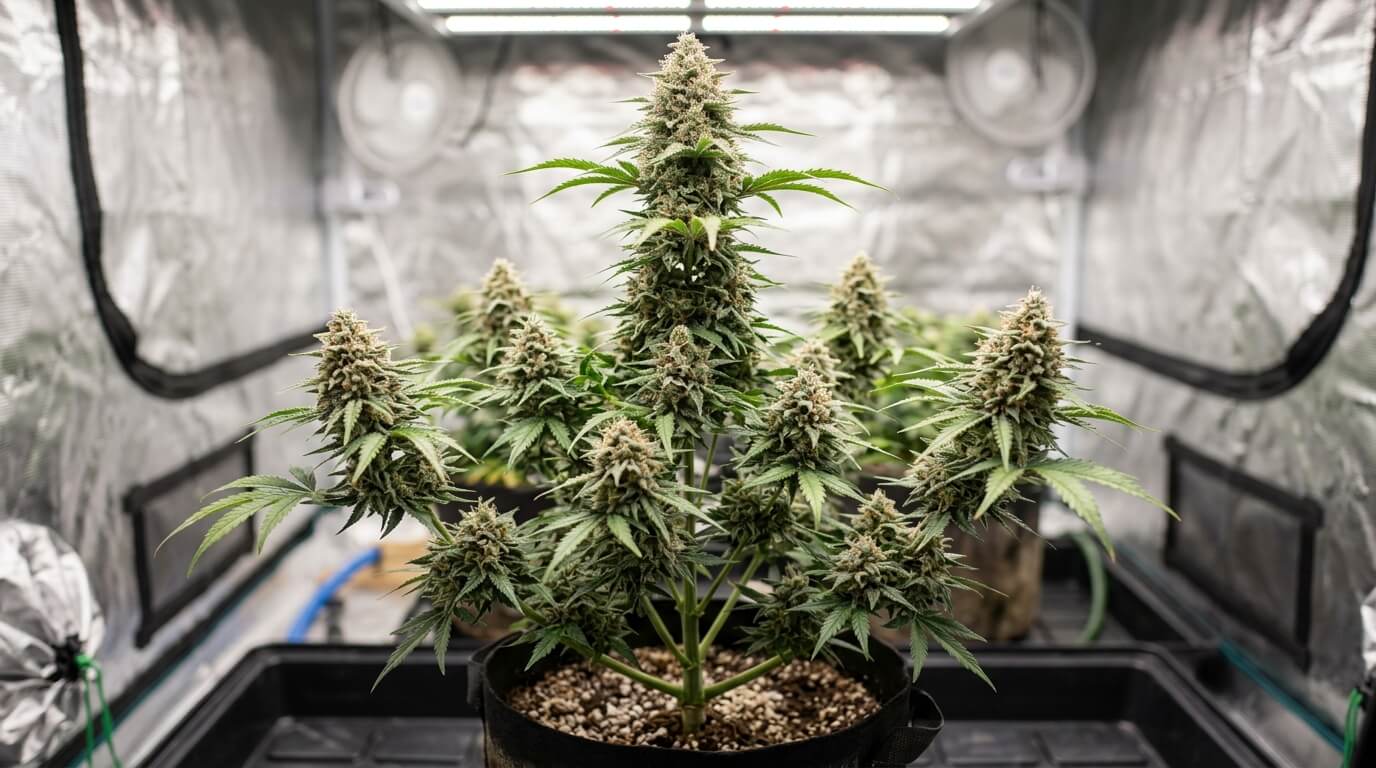
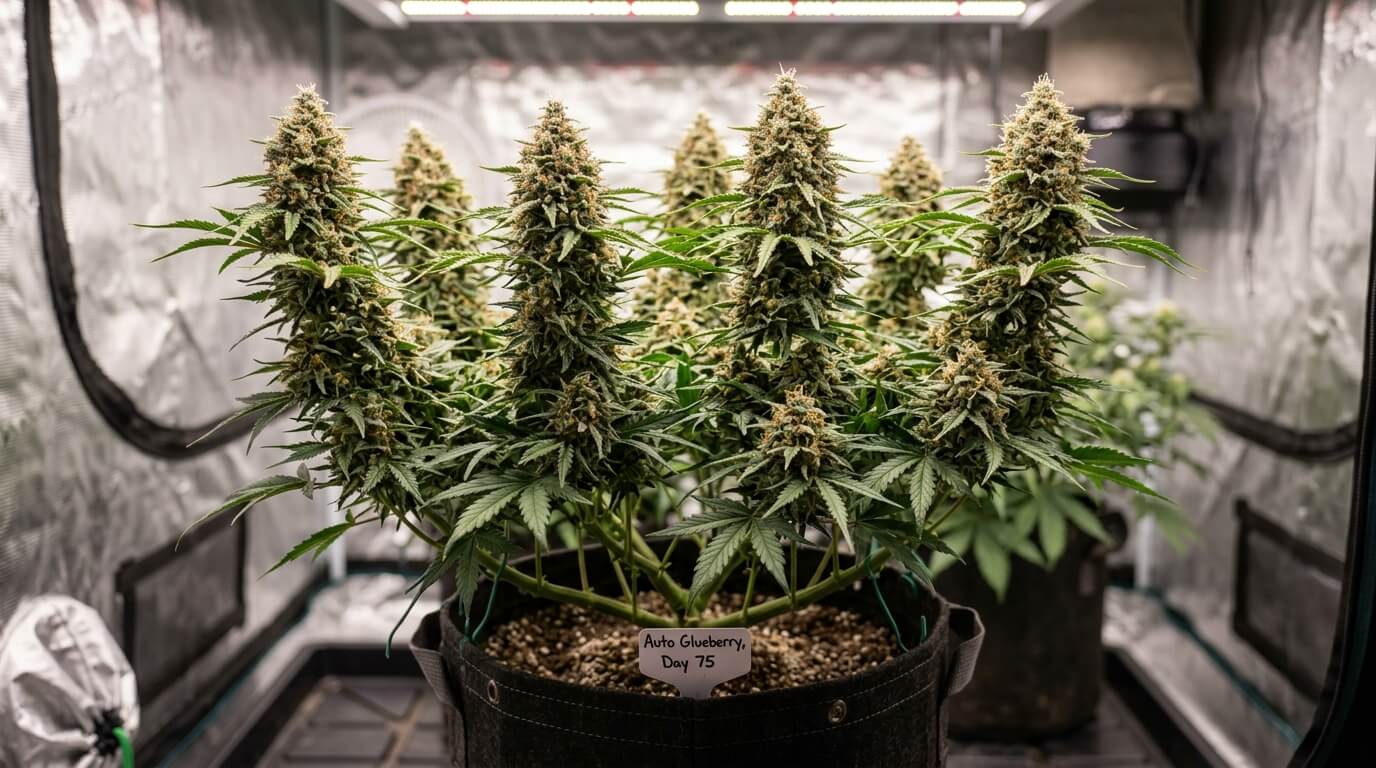
Low stress training for autoflowers is one of the safest and most effective techniques for increasing yields without slowing plant development. LST involves tying down the top of the plant horizontally, allowing the side branches to grow upwards. This technique also enhances light penetration and airflow, helping to fill out your grow space efficiently.
When to Harvest Indoor Autoflower Plants
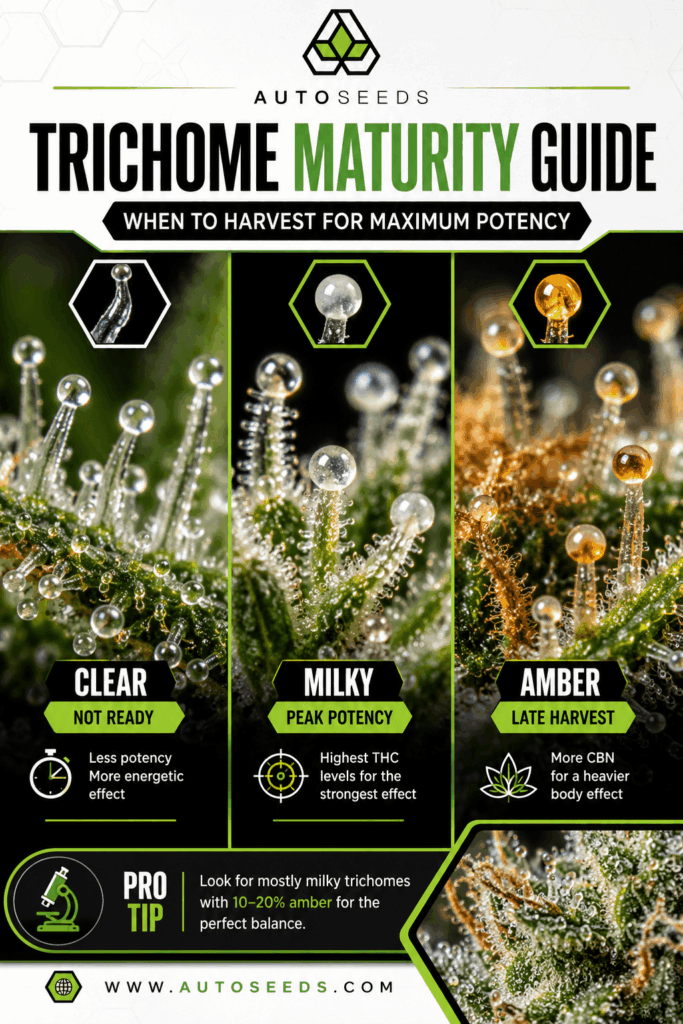
Harvesting your autos at the right time will allow you to achieve the best possible bud quality, potency and resin production, especially when growing high THC autoflower seeds.
- The trichomes under a magnification tool appear milky and amber coloured
- The buds are dense and compact when lightly squeezed
- The plant is packed with resin covering the leaves and buds
- The flowering time matches the number of weeks
- The pistils are 80-90% brown or orange coloured
Drying and Curing Autoflower Buds Properly
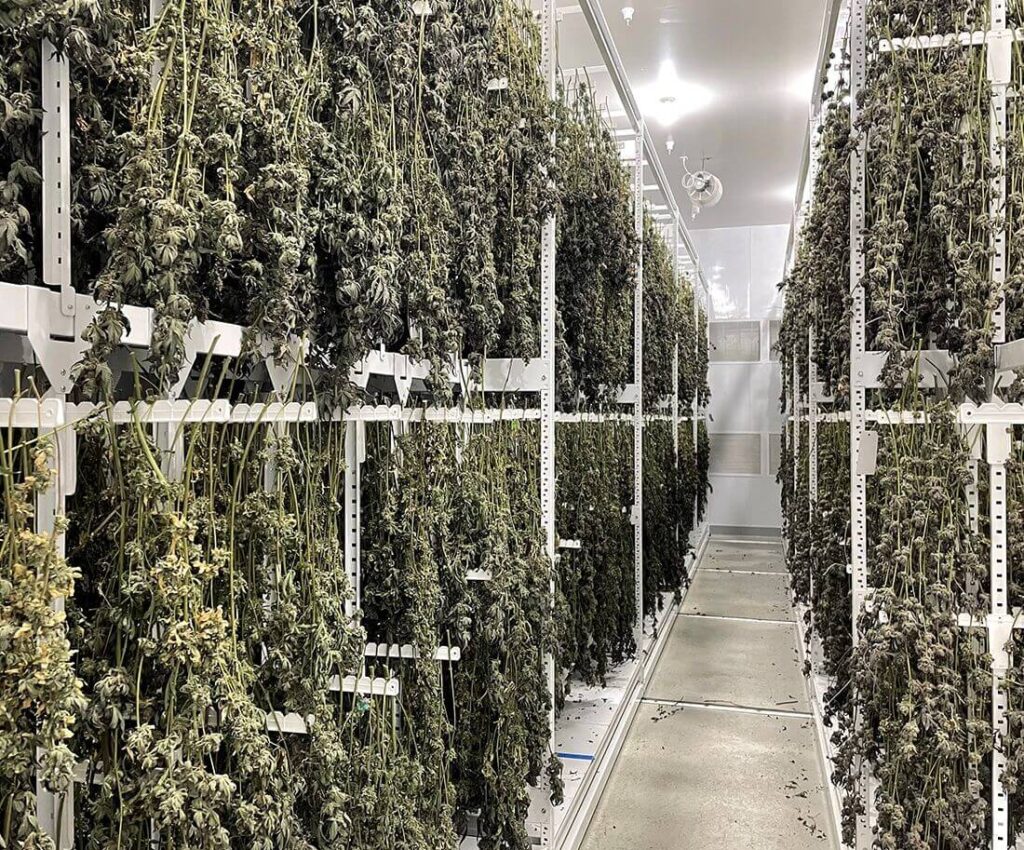
There is no point in spending months of hard work only to have your autos poorly dry out. Drying your plants properly, followed by a professional-level curing method, will produce cup-winning buds that you will love to consume.
- Cannabis buds can require 10-14 days to properly dry before being placed in jars
- The drying room temperature should be as close to 15 degrees Celsius as possible
- Maintain a humidity level inside the dry roof of 60%
- There should be good air flow inside the dry room
- Avoid blowing fans directly at hanging buds
Curing is the art of burping the jars your buds are stored inside. This involves removing the lid of the jar for 10 minutes a day. Doing so will create air exchange, improve flavour, and enhance potency. Growers can choose to cure their buds anywhere from 2 weeks to 6 months.
- Fill your curing jars or plastic tubs 75% full
- Keep them stored in a dark and cool place away from sunlight
- Avoid shaking the jars and lightly move the buds around inside
Frequently Asked Questions About Growing Autoflowers Indoors
What is the best light schedule for autoflowers indoors?
Most indoor growers use an 18/6 or 20/4 light schedule for autoflowers. While autoflowering cannabis plants can grow under 24 hours of light, providing a dark period helps reduce electricity costs, makes temperature control easier and allows the plants time to rest.
How long do autoflowers take to grow indoors?
Most autoflower strains take between 9 and 12 weeks from seed to harvest. Some fast-flowering varieties can finish in as little as 8 weeks, while larger sativa-dominant autoflowers may require up to 14 weeks.
What size pot is best for indoor autoflowers?
A 3-5 gallon (11-19 litre) pot is ideal for most autoflower strains. Since autoflowers have a short life cycle and do not respond well to transplanting, it is best to plant seeds directly into their final container.
Can you transplant autoflowers?
While it is possible to transplant autoflowers, it is generally not recommended. Any stress during the early stages of growth can reduce plant size and final yields. For the best results, sow seeds directly into the final pot.
How much can an autoflower yield indoors?
Indoor autoflower yields depend on genetics, lighting, environment and grower experience. Under optimal conditions, most autoflowers can produce between 50 and 250 grams per plant, with some high-yielding varieties producing even more.
How many autoflowers can I grow in a 1m x 1m tent?
A 1m x 1m grow tent can comfortably accommodate 4-6 autoflowering plants. The exact number depends on the strain, pot size and whether plant training techniques such as low stress training (LST) are used.
Do autoflowers need nutrients?
Yes, autoflowers benefit from nutrients, but they typically require less feeding than photoperiod plants. Many growers start with half the manufacturer’s recommended dosage and increase only if the plants show signs of needing more nutrition.
Can you top autoflowers?
Some experienced growers top autoflowers successfully, but low stress training (LST) is generally the safer option. Because autoflowers have a limited vegetative period, excessive stress can reduce growth and affect yields.
Why are my autoflowers staying small indoors?
The most common causes of small autoflowers are overwatering, overfeeding, poor genetics, low light intensity, heat stress and growing in containers that are too small. Ensuring optimal environmental conditions from the seedling stage is essential for maximising plant size and yield.
What temperature is best for indoor autoflowers?
Autoflowers perform best with daytime temperatures around 24°C and night-time temperatures between 18-20°C. Maintaining stable conditions and avoiding extreme temperature fluctuations will help support healthy growth and flower production.
Are autoflowers good for beginners?
Yes, autoflowering cannabis plants are considered one of the best choices for beginners. Their fast growth, automatic flowering cycle and low-maintenance nature make them easier to manage than traditional photoperiod strains.
Do autoflowers produce as much THC as photoperiod plants?
Modern autoflower genetics can produce THC levels comparable to many photoperiod strains. Thanks to years of breeding improvements, today’s autoflowers are capable of producing potent, high-quality buds with excellent flavour, aroma and cannabinoid content.