
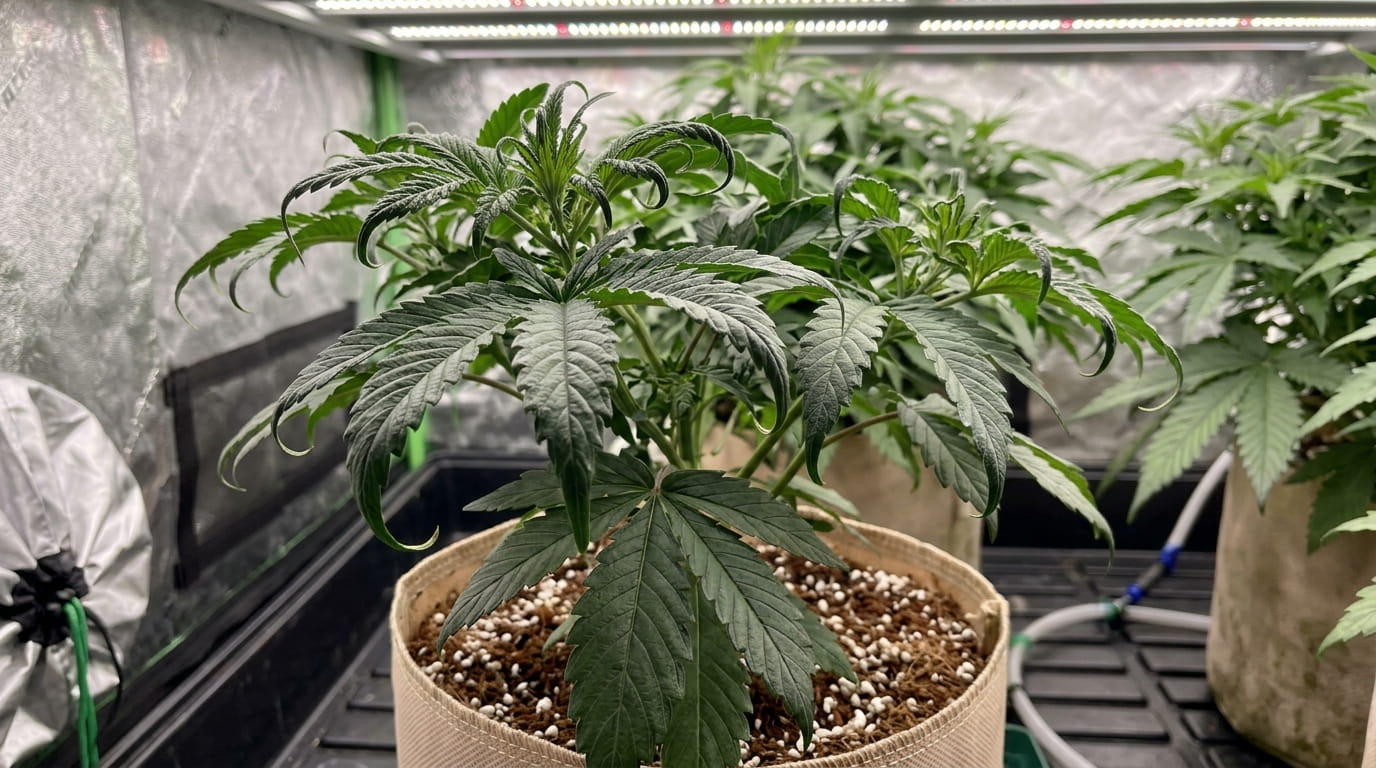
Cannabis Nutrient Toxicity in Autoflowers: Symptoms, Chart & How to Fix Nutrient Burn
Nutrient toxicity often develops gradually as excess nutrients accumulate around the roots. As concentrations rise, water uptake becomes less efficient, nutrient availability becomes unbalanced, and plant growth can slow. If left uncorrected, toxicity can negatively affect plant size, flower development, and harvest quality.
In my experience, most nutrient toxicity issues result from a combination of factors rather than a single mistake. Aggressive feeding schedules, excessive supplements, unstable pH levels, and poor root-zone management are among the most common causes.
This guide explains how to identify nutrient toxicity in autoflowers, use a cannabis nutrient toxicity chart to diagnose problems, understand nutrient-specific toxicities, and apply effective recovery and prevention strategies to support healthier growth and better yields.
Article Insights
- Autoflower cannabis nutrient toxicity is most commonly caused by overfeeding, salt buildup, and root-zone imbalances rather than a single nutrient deficiency.
- Early signs of nutrient toxicity include burnt leaf tips, dark green foliage, leaf clawing, and slowed growth, all of which can worsen quickly if feeding continues unchanged.
- A cannabis nutrient toxicity chart can help growers identify nutrient-specific issues and distinguish nutrient burn from deficiencies and nutrient lockout.
- Flushing with pH-balanced water, monitoring runoff EC, and reintroducing nutrients gradually are some of the most effective ways to recover autoflowers from nutrient toxicity.
- Preventing nutrient toxicity in autoflowers starts with conservative feeding practices, stable pH levels, regular runoff monitoring, and avoiding unnecessary supplements.
What Is Autoflower Cannabis Nutrient Toxicity and What Causes It?
Autoflower cannabis nutrient toxicity occurs when plants receive more nutrients than they can use, causing excess minerals to accumulate around the roots and within plant tissue. As nutrient levels rise, water and oxygen uptake become less efficient, leading to stress, slower growth, and nutrient lockout.
This issue is often more damaging in autoflowers than photoperiod plants because autoflowers have a fixed lifecycle. Growers starting with beginner-friendly autoflower seeds often achieve better results by using lighter feeding schedules.
What Nutrient Toxicity Means in Autoflowers
Nutrient toxicity is a form of overfertilization that develops when nutrient concentrations exceed the plant’s requirements. The resulting imbalance affects root health, water uptake, and overall growth.
In my experience growing autoflowers, nutrient toxicity is most commonly caused by feeding too heavily too early. Many autoflower cultivars perform better with gradual increases in nutrient strength rather than aggressive feeding schedules.
The earliest symptoms are often subtle.
| Early Toxicity Symptoms | What They Mean |
| Burnt leaf tips | Excess nutrient concentration |
| Dark green leaves | Nitrogen toxicity |
| Leaf clawing | Nutrient stress |
| Slow growth | Root-zone imbalance |
| Crispy leaf edges | Salt accumulation |
Identifying these signs early can prevent more serious damage later in the grow cycle.
Autoflower Nutrient Toxicity vs Nutrient Burn
Although the terms are often used interchangeably, they describe different things.
| Nutrient Toxicity | Nutrient Burn |
| Internal nutrient imbalance | Visible leaf damage |
| Root-zone stress | Burnt tips and leaf margins |
| Caused by excess nutrients | Symptom of toxicity |
| Can lead to nutrient lockout | Usually appears on leaves first |
Put simply, nutrient toxicity is the underlying condition, while nutrient burn is one of its most visible symptoms.
How Excess Nutrients Affect Autoflower Roots
Autoflower roots absorb water and nutrients through osmotic processes. When nutrient concentrations become too high, electrical conductivity (EC) levels increase in the root zone, making water uptake more difficult.
As salinity rises:
- water absorption decreases
- root growth slows
- oxygen availability drops
- nutrient transport becomes restricted
- nutrient lockout becomes more likely
This is why overfed autoflowers can sometimes appear wilted despite growing in moist soil or coco.
How Salt Buildup and pH Problems Cause Nutrient Toxicity
Salt buildup is one of the leading causes of cannabis nutrient toxicity. Every feeding leaves behind dissolved minerals, and without adequate runoff or nutrient management, those salts can accumulate around the roots.
This problem is especially common in:
- coco coir grows
- heavily fertilized containers
- hydroponic systems with high EC levels
- grows with minimal runoff
Incorrect pH can worsen the situation. When pH moves outside the optimal range, some nutrients become unavailable while others accumulate excessively, increasing the risk of nutrient toxicity and nutrient lockout.
| Growing Medium | Ideal pH Range |
| Soil | 6.0–6.8 |
| Coco Coir | 5.8–6.2 |
| Hydroponics | 5.5–6.1 |
For autoflower growers, maintaining stable pH levels and monitoring EC are two of the most effective ways to prevent cannabis nutrient toxicity and support healthy growth from seed to harvest.
Cannabis Nutrient Toxicity Chart: How to Identify Nutrient Burn in Autoflowers
Learning to identify autoflower nutrient toxicity early can prevent weeks of lost growth and reduced yields. In my experience, visual symptoms often appear before growth slows dramatically, making leaf colour, texture, and overall plant structure some of the most valuable diagnostic tools available to growers.
Because autoflowers have a fixed lifecycle, nutrient toxicity can affect final plant size and flower production much faster than many growers realise. Recognising the warning signs early allows you to correct feeding issues before long-term damage occurs.
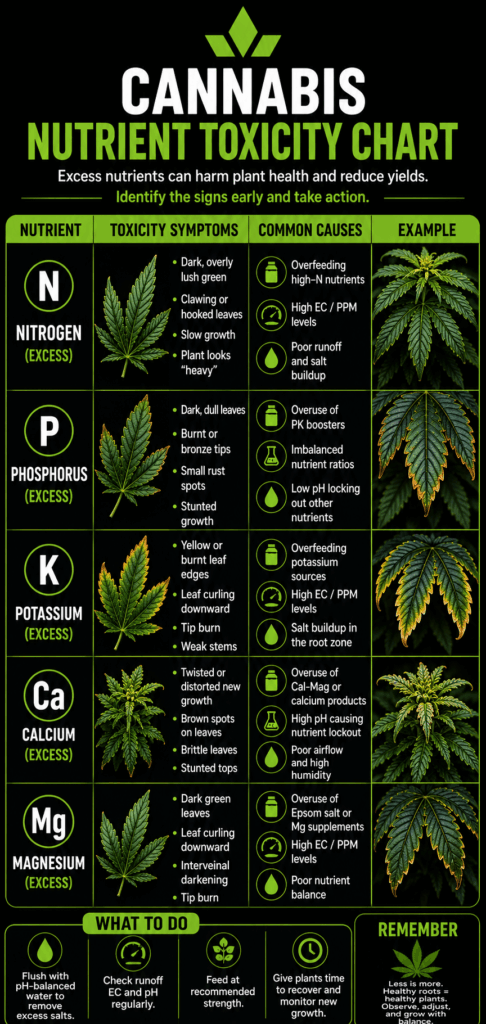
Cannabis Nutrient Toxicity Chart by Nutrient Type
Different nutrient imbalances produce different symptom patterns. While some signs can overlap, understanding how specific nutrients affect autoflowers makes diagnosis far more accurate.
Nitrogen toxicity is the most common form of cannabis nutrient toxicity in autoflowers. Excess nitrogen typically causes unusually dark green foliage, glossy leaves, thick growth, and downward clawing. This often develops when nutrient levels are increased too aggressively during early vegetative growth.
Phosphorus toxicity is less common but can occur after excessive use of bloom boosters and flowering supplements. High phosphorus levels can interfere with the uptake of important micronutrients, leading to discolouration, nutrient lockout, and reduced flower development.
Potassium toxicity usually develops when autoflowers receive excessive PK additives during flowering. Common signs include burnt leaf margins, calcium and magnesium imbalances, and declining plant vigour despite adequate feeding.
Calcium toxicity is often associated with overuse of Cal-Mag supplements. While calcium is essential for healthy growth, excessive levels can disrupt nutrient balance and contribute to distorted new growth, brittle leaves, and burnt tips.
Magnesium toxicity is relatively uncommon but can develop when multiple supplements are used simultaneously. Excess magnesium may contribute to dark foliage, leaf curling, and nutrient antagonism that affects calcium uptake.
Iron toxicity is rare in autoflower cannabis plants but can occur when root-zone pH drifts outside the ideal range. Symptoms may include bronze spotting, unusual leaf discoloration, and reduced nutrient availability.
| Nutrient | Common Toxicity Symptoms | Common Cause |
| Nitrogen | Dark green leaves, clawing, glossy foliage | Excess vegetative nutrients |
| Phosphorus | Discolouration, nutrient lockout, reduced flower development | Excess bloom boosters |
| Potassium | Burnt leaf margins, calcium and magnesium imbalance | Excess PK additives |
| Calcium | Distorted growth, brittle leaves, tip burn | Overuse of Cal-Mag |
| Magnesium | Curling leaves, dark foliage | Excess supplementation |
| Iron | Bronze spotting, leaf discolouration | Incorrect pH |
This cannabis nutrient toxicity chart provides a reliable starting point for diagnosing nutrient overload before making adjustments to your feeding schedule.
Early Signs of Nutrient Burn in Autoflowers
Nutrient burn is often the first visible sign that nutrient levels have exceeded what an autoflower can comfortably process.
The earliest warning signs typically include:
- burnt or yellow leaf tips
- glossy or unusually dark foliage
- slight leaf clawing
- crispy leaf edges
- rising runoff EC levels
At this stage, the root zone is beginning to experience excess nutrient concentration. Taking corrective action early can prevent nutrient lockout and more severe toxicity symptoms later in the grow cycle.
How Nutrient Toxicity Symptoms Appear Across Autoflower Leaves
One of the most useful diagnostic techniques is looking for symptom patterns across the entire plant rather than focusing on a single damaged leaf.
| Symptom Pattern | Likely Cause |
| Dark green clawing leaves | Nitrogen toxicity |
| Burnt leaf margins | Potassium toxicity |
| Bronze or rust-colored spotting | Micronutrient imbalance or pH-related toxicity |
| Twisted new growth | Excess calcium |
| Curling leaves with dark foliage | Magnesium toxicity |
When diagnosing nutrient toxicity cannabis growers should assess overall plant health, runoff EC, pH levels, and symptom distribution. Toxicity symptoms often appear across multiple leaves at the same time, whereas deficiencies frequently develop in more isolated patterns.
How Nutrient Toxicity Changes Throughout the Autoflower Lifecycle
Autoflowers respond differently to nutrient stress depending on their stage of development.
| Growth Stage | Common Toxicity Symptoms |
| Seedling | Burnt tips, stalled growth |
| Early Vegetative | Dark foliage, clawing, slowed development |
| Pre-Flower | Reduced stretch, nutrient lockout symptoms |
| Flowering | Burnt sugar leaves, reduced bud development |
In my experience, nutrient toxicity during the first three to four weeks of an autoflower’s life is often the most damaging. During this period, plant structure and yield potential are being established. Once growth is lost at this stage, autoflowers have limited time to recover before flowering progresses.
Cannabis Nutrient Toxicity vs Nutrient Deficiency Symptoms
Many autoflower growers mistake nutrient toxicity for nutrient deficiencies because both can affect leaf colour and overall plant vigour.
| Toxicity Symptoms | Deficiency Symptoms |
| Dark green foliage | Pale foliage |
| Burnt leaf tips | Uniform yellowing |
| Leaf clawing | Weak, thin growth |
| Crispy leaf edges | Gradual fading of leaf colour |
One of the most common mistakes I see among new growers is increasing nutrient strength when symptoms first appear. Before adding more nutrients, always check runoff EC, pH levels, and recent feeding history. In many cases, the problem is not a lack of nutrients but an excess that is preventing the plant from using them properly.
Why Specific Nutrients Become Toxic in Autoflowers
Not all cases of cannabis nutrient toxicity are caused by overfeeding alone. In autoflower cannabis plants, nutrient toxicity often develops when nutrient ratios become unbalanced, root-zone conditions deteriorate, or multiple supplements are combined without considering their cumulative effect.
One of the biggest differences between autoflowers and photoperiod plants is the margin for error. Autoflowers have a shorter lifecycle and a smaller root mass, which means nutrient imbalances can affect growth much faster.
Autoflowers vs Photoperiods: Nutrient Toxicity Risk
| Factor | Autoflowers | Photoperiods |
| Root Development Time | Shorter | Longer |
| Recovery Time | Limited | Extended |
| Tolerance to Overfeeding | Lower | Higher |
| Response to Nutrient Stress | Faster | More gradual |
| Margin for Error | Smaller | Larger |
A feeding schedule that works perfectly for a photoperiod plant can sometimes create nutrient toxicity in autoflowers within a matter of days.
Nitrogen Toxicity and Excess Vegetative Feeding
Nitrogen toxicity is the most common form of nutrient toxicity cannabis growers encounter. In many cases, the issue starts when nutrient levels are increased too aggressively during early growth.
| Nitrogen Excess Effect | Impact on Autoflowers |
| Excess foliage production | Less efficient growth |
| Reduced root development | Lower nutrient uptake efficiency |
| Imbalanced plant structure | Smaller final plant size |
| Prolonged vegetative stress | Reduced flowering performance |
In my experience, many autoflower cultivars perform best when nitrogen levels are increased gradually rather than following aggressive feeding schedules designed for larger plants.
Phosphorus Toxicity and Nutrient Antagonism
Phosphorus toxicity is most commonly associated with excessive bloom booster use during flowering.
| Excess Phosphorus Effect | Potential Consequence |
| Reduced zinc uptake | Micronutrient imbalance |
| Reduced iron availability | Lower nutrient efficiency |
| Increased salt accumulation | Root-zone stress |
| Nutrient antagonism | Nutrient lockout |
What many growers do not realise is that excessive phosphorus can create nutrient deficiencies even when nutrients are present in the growing medium.
Potassium Toxicity and Hidden Root-Zone Imbalances
Potassium is essential for flower development, but excessive levels can disrupt nutrient balance around the roots.
| Excess Potassium Effect | Result |
| Calcium competition | Reduced calcium availability |
| Magnesium competition | Reduced magnesium uptake |
| Root-zone imbalance | Lower nutrient efficiency |
| Excess EC accumulation | Increased toxicity risk |
In my experience, potassium toxicity is one of the most frequently misdiagnosed causes of nutrient lockout in autoflowers.
How Supplement Stacking Creates Cannabis Nutrient Toxicity
Many modern feeding schedules contain multiple nutrient sources.
| Common Supplement | Hidden Nutrient Contribution |
| Base nutrients | Primary NPK source |
| Cal-Mag products | Calcium and magnesium |
| Bloom boosters | Phosphorus and potassium |
| Root stimulants | Additional minerals and additives |
| Flower enhancers | Supplemental nutrients |
While each product may appear beneficial individually, combining several products often increases EC levels beyond what autoflowers require.
Why Simpler Feeding Programs Often Perform Better
| Feeding Approach | Typical Outcome |
| Multiple additives and supplements | Higher toxicity risk |
| Aggressive nutrient increases | Greater root-zone stress |
| Stable EC and pH management | More consistent growth |
| Gradual feeding adjustments | Improved nutrient uptake |
| Simple nutrient program | Lower toxicity risk |
The healthiest autoflowers I have grown were rarely the ones receiving the most products. Consistent pH management, moderate nutrient levels, and a simple feeding strategy are usually more effective than chasing growth through excessive supplementation.
How to Fix Autoflower Cannabis Nutrient Toxicity
Once cannabis nutrient toxicity develops, the goal is not simply to remove excess nutrients. Successful recovery requires restoring balance within the root zone while allowing the plant to resume normal water and nutrient uptake.
Because autoflowers have a fixed lifecycle, recovery should begin as soon as nutrient toxicity is identified. Delaying corrective action can reduce plant size, slow flower development, and limit final yields.
Step-by-Step Guide to Fixing Nutrient Toxicity in Autoflowers
| Step | Action | Purpose |
| 1 | Stop all nutrient feeding | Prevent further mineral accumulation |
| 2 | Check runoff EC and pH | Confirm root-zone imbalance |
| 3 | Flush with pH-balanced water | Remove excess salts |
| 4 | Allow the medium to drain fully | Restore oxygen around roots |
| 5 | Monitor new growth for several days | Assess recovery progress |
| 6 | Reintroduce nutrients at 25–50% strength | Avoid repeating toxicity |
| 7 | Increase feeding gradually if growth improves | Restore normal nutrient levels safely |
In my experience, one of the most common mistakes growers make is continuing to feed while waiting for symptoms to improve. Once nutrient toxicity has been identified, reducing nutrient input is usually more effective than adding corrective supplements.
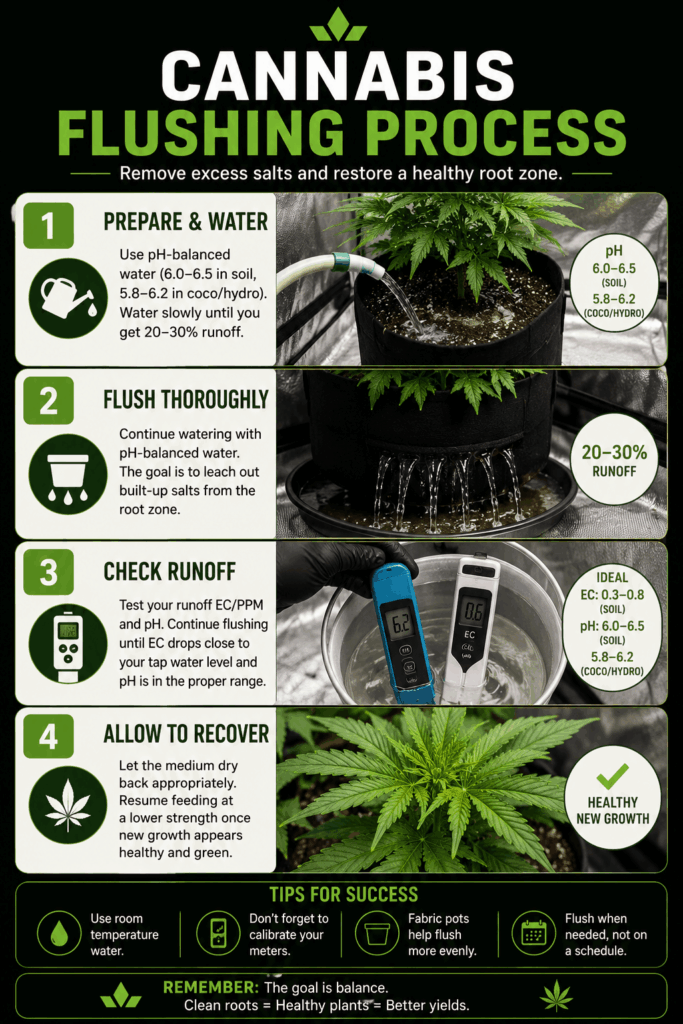
How to Flush Autoflowers Properly
Flushing is often the fastest way to reduce nutrient concentrations, although knowing when to flush autoflowers correctly is equally important.
| Flushing Step | Why It Matters |
| Use pH-balanced water | Prevent additional nutrient stress |
| Flush slowly and evenly | Improve salt removal |
| Achieve significant runoff | Remove accumulated minerals |
| Measure runoff EC | Track recovery progress |
| Allow adequate drainage | Improve root-zone oxygen levels |
For soil grows, I typically flush with enough water to generate substantial runoff while avoiding unnecessary root disturbance. Coco coir generally responds faster because excess nutrients move through the medium more easily.
Correct pH Levels for Recovery
After flushing, stabilising pH is one of the most important parts of recovery. Many apparent deficiencies that develop during cannabis nutrient toxicity are actually caused by nutrient lockout rather than a lack of nutrients.
| Growing Medium | Recovery pH Range |
| Soil | 6.2–6.5 |
| Coco Coir | 5.8–6.0 |
| Hydroponics | 5.5–5.9 |
Maintaining stable pH levels, following a proper water schedule, and monitoring EC are two of the most effective ways
Using EC Readings to Monitor Recovery
Runoff EC provides one of the clearest indicators of what is happening inside the root zone.
| Runoff EC Reading | What It Usually Indicates |
| Similar to feed EC | Balanced nutrient levels |
| Moderately elevated | Early salt accumulation |
| Significantly higher than feed EC | Overfeeding or nutrient buildup |
Rather than relying solely on leaf appearance, experienced growers often use EC readings to confirm whether recovery is progressing as expected.
Signs Your Autoflower Is Recovering
Existing leaf damage rarely disappears completely. Instead, focus on the quality of new growth.
| Recovery Sign | What It Suggests |
| Upright leaves | Reduced root stress |
| Healthy new growth | Nutrient uptake improving |
| Stable leaf color | Better nutrient balance |
| Improved flower development | Recovery progressing |
Healthy new growth is usually the most reliable sign that cannabis nutrient toxicity has been corrected. Once recovery is underway, increase nutrient strength gradually and allow the plant to dictate the pace rather than following an aggressive feeding schedule.
How Experienced Autoflower Growers Prevent Nutrient Toxicity
Preventing cannabis nutrient toxicity is far easier than correcting it once root-zone imbalances develop. In my experience, the healthiest autoflowers are rarely the ones receiving the most nutrients. Instead, they are usually grown using consistent feeding practices, stable environmental conditions, and a simple nutrient program that matches the plant’s actual requirements.
Many cases of nutrient toxicity in cannabis begin when growers focus on nutrient schedules rather than plant response. While feeding charts can provide a useful starting point, autoflowers often require lower nutrient levels than larger photoperiod cultivars.
Common Feeding Habits That Lead to Nutrient Toxicity
| Common Grower Habit | Long-Term Consequence |
| Increasing nutrients every week regardless of plant response | Excess EC accumulation |
| Using multiple overlapping supplements | Hidden nutrient overload |
| Following bottle schedules exactly | Overfeeding sensitive autoflowers |
| Ignoring runoff measurements | Undetected root-zone imbalance |
| Chasing deficiencies without testing pH or EC | Increased nutrient lockout risk |
One of the most valuable lessons I have learned from growing autoflowers is that nutrient strength should be earned through healthy growth, not increased automatically according to a schedule.
Environmental Factors That Increase Toxicity Risk
Even a balanced feeding program can create problems if environmental conditions are unstable.
| Environmental Factor | Why It Increases Toxicity Risk |
| Weak lighting | Plants use nutrients more slowly |
| Overwatering | Reduces oxygen around roots |
| High root-zone temperatures | Increases root stress |
| Poor airflow | Limits efficient transpiration |
When environmental conditions deteriorate, nutrient uptake efficiency often declines, increasing the likelihood of cannabis nutrient toxicity and nutrient lockout.
Five Rules for Preventing Autoflower Nutrient Toxicity
| Prevention Strategy | Why It Works |
| Start below recommended feed rates | Most autoflowers require less nutrition |
| Increase nutrients gradually | Reduces overfeeding risk |
| Monitor runoff EC regularly | Detects salt buildup early |
| Keep supplements to a minimum | Prevents nutrient stacking |
| Prioritise root-zone health | Supports efficient nutrient uptake |
Autoflower nutrient toxicity is usually the result of several small mistakes rather than a single feeding error. By maintaining stable pH, monitoring EC, following an appropriate autoflower nutrient schedule, and making gradual adjustments based on plant performance, growers can significantly reduce the risk of nutrient toxicity while supporting healthier growth and stronger harvests.
Frequently Asked Questions
What does nutrient toxicity look like in autoflowers?
Autoflower nutrient toxicity often begins with burnt leaf tips, unusually dark green foliage, and downward leaf clawing. As nutrient concentrations increase, growth may slow, leaves can become brittle or curled, and nutrient lockout may develop. Because autoflowers have a shorter lifecycle, these symptoms can affect plant development quickly if left uncorrected.
What causes cannabis nutrient toxicity in autoflowers?
The most common causes of cannabis nutrient toxicity are overfeeding, salt buildup in the root zone, excessive supplement use, and incorrect pH levels. Autoflowers are particularly sensitive to nutrient imbalances because they generally require lower nutrient levels than photoperiod plants.
How do I fix nutrient toxicity in autoflower cannabis plants?
The first step is to stop feeding nutrients and assess runoff EC and pH levels. If salt buildup is present, flushing with pH-balanced water can help remove excess minerals from the growing medium. After recovery begins, nutrients should be reintroduced gradually at reduced strength while monitoring new growth closely.
Can autoflowers recover from nutrient toxicity?
Yes, autoflowers can recover from nutrient toxicity if the issue is identified early. Recovery depends on the severity of the problem and the plant’s growth stage. While damaged leaves may not fully recover, healthy new growth is usually a sign that nutrient uptake has returned to normal.
How long does it take an autoflower to recover from nutrient burn?
Mild nutrient burn may begin improving within several days, while more severe cases can take one to two weeks before healthy new growth appears. Recovery time depends on the severity of the toxicity, root health, and environmental conditions.
Are autoflowers more sensitive to nutrients than photoperiod plants?
In most cases, yes. Autoflowers typically have smaller root systems, shorter growth cycles, and lower nutrient requirements. Because they have less time to recover from stress, excessive feeding often affects autoflowers more quickly than photoperiod cannabis plants.
What EC level causes nutrient toxicity in cannabis?
There is no universal EC level that causes cannabis nutrient toxicity because nutrient tolerance varies between cultivars, growing mediums, and environmental conditions. However, consistently high runoff EC readings often indicate salt accumulation and an increased risk of nutrient toxicity.
Can incorrect pH cause nutrient toxicity symptoms?
Yes. When pH moves outside the optimal range, some nutrients become less available while others accumulate excessively. This can create nutrient lockout and toxicity symptoms even when nutrient levels in the growing medium are otherwise appropriate.
Should I flush my autoflowers if I suspect nutrient toxicity?
If runoff EC readings are significantly elevated or symptoms are worsening despite continued feeding, flushing can be an effective way to remove excess salts from the root zone. However, flushing should be followed by proper pH management and a gradual return to feeding rather than immediately resuming full-strength nutrients.
How can I prevent nutrient toxicity in autoflowers?
The best way to prevent autoflower nutrient toxicity is to start with lower nutrient levels, increase feeding gradually, monitor runoff EC and pH regularly, avoid unnecessary supplements, and maintain healthy root-zone conditions. Consistent environmental conditions and conservative feeding practices are often more effective than aggressive nutrient schedules.