

Iron Deficiency in Autoflower Cannabis Plants: Signs, Causes, and How to Fix Yellowing New Leaves Fast
Iron deficiency in autoflower cannabis plants usually appears as yellowing of new leaves while the veins remain green, a symptom often caused by pH imbalance or nutrient lockout rather than a true lack of iron in the nutrient solution. Although iron is only required in trace amounts, it plays a critical role in chlorophyll production, photosynthesis, and healthy new growth throughout the entire grow cycle.
For autoflower growers, identifying iron deficiency early is especially important. Because autoflowers have a shorter life cycle than photoperiod strains, nutrient deficiencies can affect plant development, flowering performance, and final yields much more quickly. Even a brief period of nutrient stress during the vegetative stage can limit growth and reduce the plant’s overall potential.
In this guide, you’ll learn how to identify iron deficiency symptoms in autoflowers, understand the most common causes of nutrient lockout, and discover the fastest ways to restore healthy green growth. You’ll also learn how to prevent future deficiencies through proper pH management, balanced feeding practices, and healthy root-zone conditions so your autoflower cannabis plants can thrive from seedling to harvest.
Article Insights
- Iron deficiency in autoflower cannabis plants typically affects new growth first, causing yellow leaves with green veins near the top of the plant.
- Incorrect pH is the most common cause of iron deficiency in autoflowers, often leading to nutrient lockout even when sufficient iron is present in the root zone.
- Because autoflowers have a shorter life cycle than photoperiod plants, early nutrient deficiencies can reduce plant size, flowering performance, and final yields.
- Most autoflower nutrients already contain enough iron, making pH imbalance, root stress, and overwatering far more common causes than underfeeding.
- Soil-grown autoflowers generally achieve the best iron uptake around pH 6.0–6.5, while coco and hydroponic systems perform best around pH 5.5–6.2.
What Is Iron Deficiency in Autoflower Cannabis Plants and Why Does It Matter?
Iron deficiency in autoflower cannabis plants occurs when the plant cannot absorb or utilize enough iron to support healthy growth and development. Iron is a micronutrient, meaning autoflowers only require small amounts compared to primary nutrients such as nitrogen, phosphorus, and potassium. Despite being needed in trace quantities, iron plays a critical role throughout the entire autoflower life cycle.
Iron helps support chlorophyll production, enzyme activity, and energy transfer within the plant. Chlorophyll gives cannabis leaves their green colour and allows autoflowers to convert light into energy through photosynthesis. Because autoflowers have a shorter life cycle than photoperiod plants, maintaining efficient nutrient uptake throughout each stage of growth is especially important.
When iron becomes unavailable, plant performance quickly declines. Growth may slow, new leaves can become pale or yellow, and overall plant vigour may decrease. In autoflowers, prolonged nutrient stress can have a greater impact because there is less time to recover before flowering begins. If left untreated, iron deficiency can affect plant size, bud development, and final yields.
The Role of Iron in Cannabis Plant Growth and Chlorophyll Production
Iron supports several essential processes inside autoflower cannabis plants, particularly chlorophyll production and enzyme activation. Without sufficient available iron, healthy green growth becomes difficult to maintain.
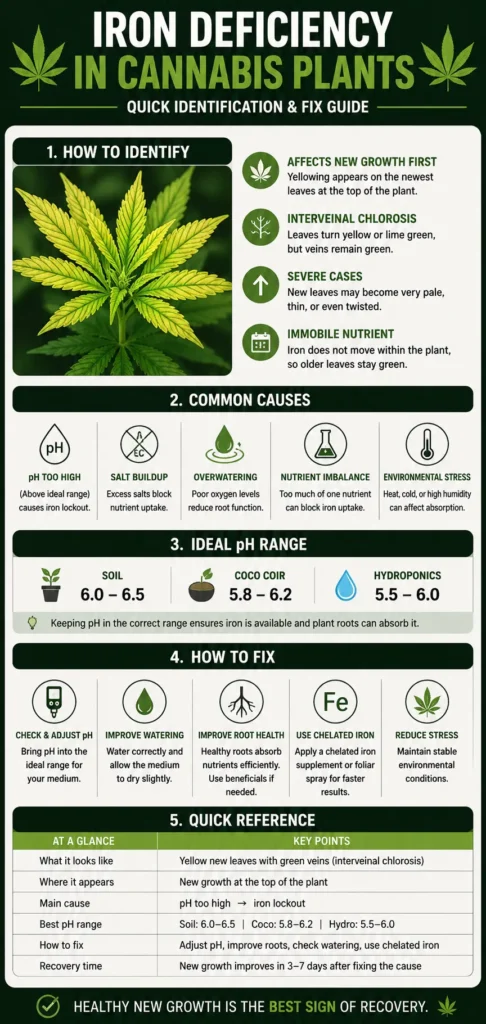
Your autoflower cannabis plant uses iron for:
- Chlorophyll synthesis
- Photosynthesis
- Enzyme activation
- Energy transfer
- New shoot development
When growing autoflowers, I pay close attention to fresh growth because nutrient deficiencies often appear in young leaves first. Healthy new growth should emerge light green before gradually darkening as it matures. If new leaves remain pale, yellow, or washed out, iron uptake may be restricted within the root zone.
Iron may be a trace nutrient, but it supports many of the systems responsible for healthy growth. Without adequate iron availability, overall plant performance can suffer significantly.
Why Iron Deficiency in Autoflowers Reduces Photosynthesis and Slows Growth
Iron deficiency reduces photosynthesis because the plant cannot produce enough chlorophyll in developing leaves. Reduced chlorophyll limits light absorption, lowers energy production, and slows overall growth.
This can lead to:
- Reduced chlorophyll production
- Slower vegetative development
- Weak new shoots
- Smaller leaves
- Reduced plant vigour
Iron is also an immobile nutrient, meaning autoflowers cannot easily relocate iron from older leaves to support new growth. This is why symptoms usually appear near the top of the plant first.
Because autoflowers have a fixed life cycle, untreated iron deficiency can reduce overall yields by limiting growth during critical vegetative and early flowering stages, particularly in high-yield autoflower strains that rely on strong early development.
What Does Iron Deficiency in Autoflower Cannabis Plants Look Like?
Iron deficiency in cannabis has a very recognizable appearance once you know what to look for. The main symptom is yellowing of new leaves while the veins stay green. This pattern is known as interveinal chlorosis.
The newest growth near the top canopy usually shows symptoms first because iron cannot move efficiently through the plant once deficiency begins.
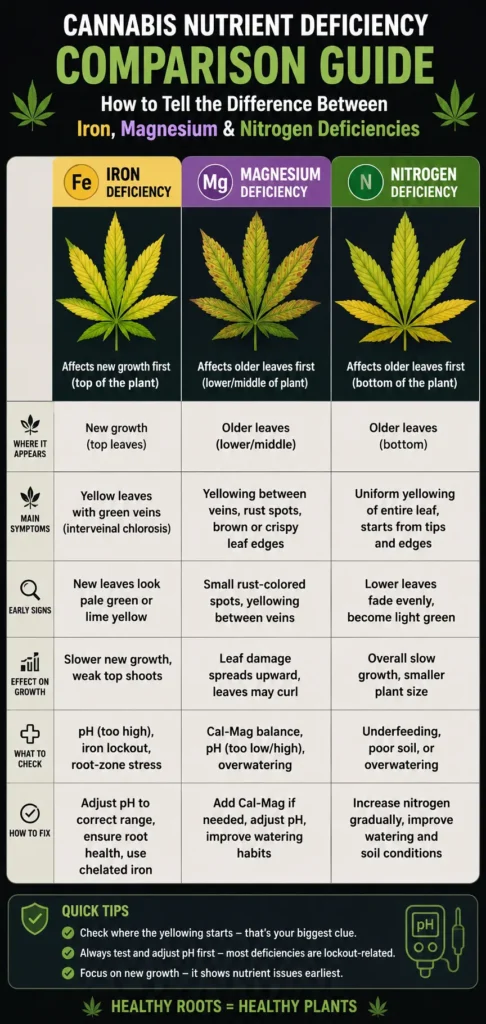
Many growers confuse iron deficiency with magnesium or nitrogen problems. The difference is mostly about location and pattern.
| Deficiency | Appears On | Main Symptom |
| Iron Deficiency | New growth | Yellow leaves with green veins |
| Magnesium Deficiency | Older leaves | Yellowing with rust spots |
| Nitrogen Deficiency | Lower leaves | Uniform yellowing |
I always recommend checking where the yellowing starts before adding nutrients. The plant’s growth pattern tells you far more than leaf color alone.
Yellowing of New Leaves and Interveinal Chlorosis Explained
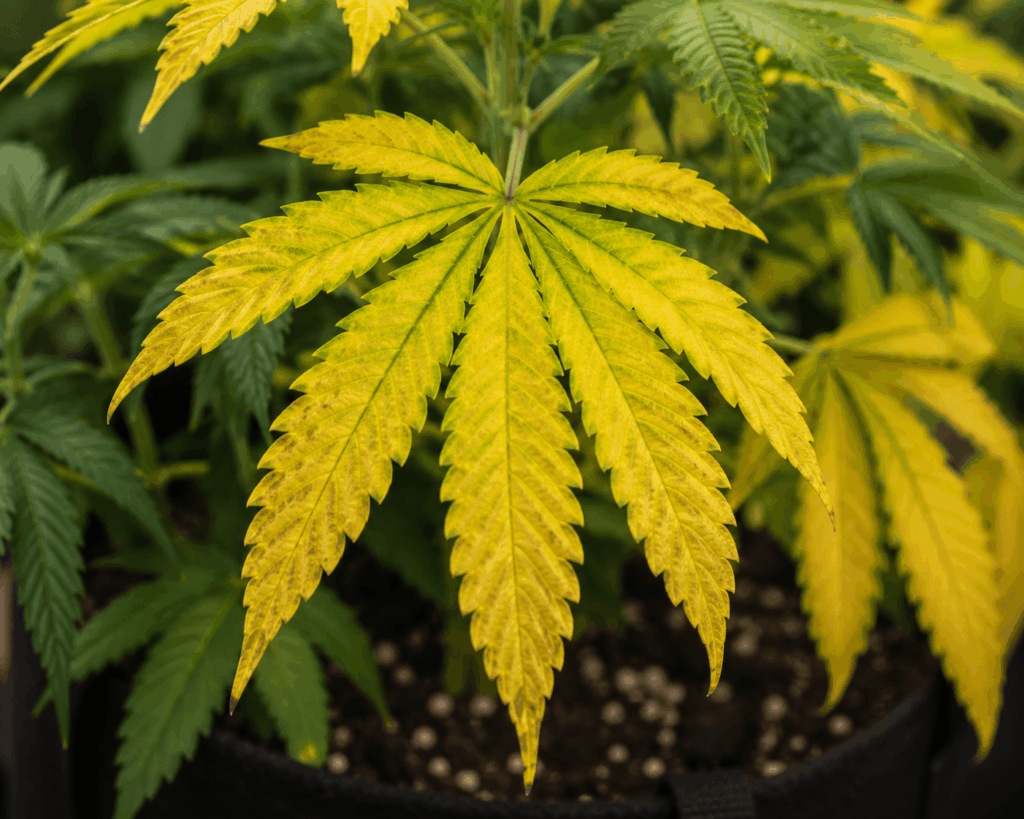
Yellowing of new leaves is the classic symptom of cannabis iron deficiency. The leaf tissue becomes pale yellow while the veins remain darker green.
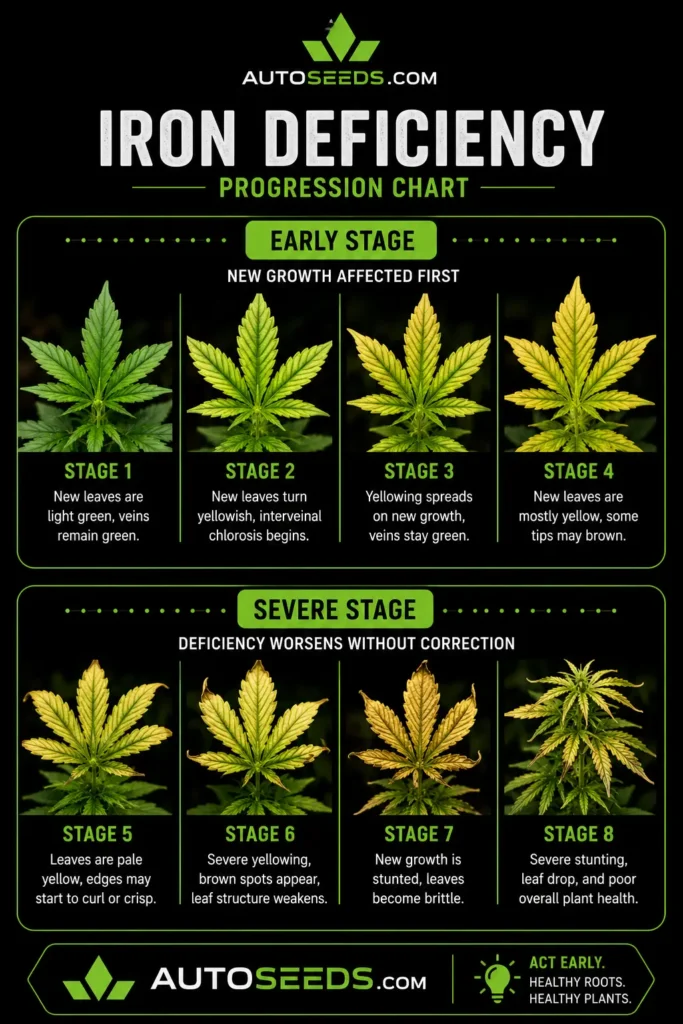
At first, the yellowing may look subtle. New leaves may appear lime green or faded compared to healthy foliage. As the deficiency progresses, the contrast between veins and leaf tissue becomes stronger.
Common symptoms include:
- Pale green new leaves
- Yellowing between veins
- Bright yellow top growth
- Bleached or white young leaves in severe cases
- Weak upper canopy growth
This pattern is extremely common in cannabis plants suffering from pH-related nutrient lockout.
Why Are My Cannabis Leaves Turning Yellow at the Top of the Plant?
If your cannabis leaves are turning yellow at the top of the plant, iron deficiency is one of the most likely causes, especially when the veins remain green.
Some cannabis strains are naturally more sensitive to nutrient fluctuations than others. If you are a newer grower, beginner-friendly autoflower seeds with stable genetics are often easier to manage when dealing with pH swings or minor feeding mistakes.
Top-leaf yellowing usually points toward issues affecting new growth, including:
- Iron deficiency
- Sulphur deficiency
- Light stress
- Nutrient lockout
- Root-zone stress
I always check pH first because most iron deficiencies are caused by incorrect root-zone conditions rather than missing nutrients.
When diagnosing the problem, ask yourself:
- Is the yellowing mainly on new leaves?
- Are the veins still green?
- Has your pH drifted recently?
- Is the root zone staying too wet?
- Did symptoms appear after increasing nutrients?
This process helps you diagnose the actual problem instead of blindly adding supplements.
How Iron Deficiency Affects Autoflower Cannabis Plants
Autoflower cannabis plants often show iron deficiency symptoms more quickly than photoperiod strains because they transition into flowering based on age rather than light schedule. Since autoflowers have a limited vegetative period, yellowing new growth can slow development during critical growth stages.
Growers should pay particular attention to new growth during weeks 2–5, especially when growing 60 day autoflowers, which have limited time to recover from nutrient deficiencies before flowering. Correcting pH issues early is especially important because autoflowers have less time to recover before flowering begins.
How to Tell the Difference Between Iron, Magnesium, and Nitrogen Deficiencies
Iron deficiency affects new growth first because iron is immobile inside cannabis plants. Magnesium and nitrogen deficiencies behave differently.
Magnesium deficiency usually appears on older leaves first and often includes rust-colored spots or crispy edges.
Nitrogen deficiency causes more even yellowing, usually beginning near the bottom of the plant. The entire leaf fades gradually instead of developing green veins with yellow tissue.
A quick diagnosis guide looks like this:
- Iron deficiency = yellow new growth with green veins
- Magnesium deficiency = older leaves with yellowing and rust spots
- Nitrogen deficiency = lower leaves fading evenly
Getting this distinction right saves time and prevents overfeeding.
If you are unsure whether your plant is suffering from iron deficiency, magnesium deficiency, or nitrogen deficiency, our autoflower deficiencies guide can help you compare symptoms and diagnose nutrient problems more accurately before adjusting your feeding schedule.
Iron Deficiency Symptoms During the Seedling, Vegetative, and Flowering Stages of Autoflowers
Iron deficiency can affect autoflower cannabis plants at any stage of growth, but the symptoms and potential impact often vary depending on whether the plant is in the seedling, vegetative, or flowering stage.
Seedling Stage
Iron deficiency is relatively uncommon in young autoflower seedlings, but it can occur if pH levels are outside the ideal range or if the growing medium is causing nutrient lockout.
Common symptoms include:
- Pale green new growth
- Slow seedling development
- Yellowing of emerging leaves
- Reduced early vigour
Because autoflowers have a limited life cycle, nutrient stress during the seedling stage can slow root development and affect growth later in the grow cycle.
Vegetative Stage
The vegetative stage is when iron deficiency is most commonly identified in autoflowers. Rapid growth increases the plant’s demand for nutrients, making pH imbalances and root-zone problems more noticeable.
Typical symptoms include:
- Yellowing of new leaves
- Green veins with yellow leaf tissue (interveinal chlorosis)
- Pale top-canopy growth
- Reduced branching
- Slower vegetative development
This stage is particularly important because autoflowers have limited time to build plant size before flowering begins. Correcting iron deficiency quickly helps maintain healthy growth and yield potential.
Flowering Stage
Iron deficiency during flowering often appears in newer growth near the top of the canopy. While the plant may continue producing flowers, prolonged deficiencies can reduce overall plant performance and bud development.
Common symptoms include:
- Bright yellow or nearly white new leaves
- Reduced plant vigour
- Weak upper growth
- Slower flower development
- Smaller bud sites in severe cases
Once flowering is underway, heavily damaged leaves rarely recover completely. The clearest sign of successful treatment is healthy green new growth appearing after pH and root-zone conditions have been corrected.
For autoflower growers, identifying iron deficiency early is critical. Nutrient stress during any stage of growth can affect final yields, but deficiencies that develop during the seedling or vegetative stage often have the greatest impact because they limit the plant’s ability to reach its full size before flowering begins.
What Causes Iron Deficiency in Autoflower Cannabis Plants?
Iron deficiency in autoflower cannabis plants is usually caused by nutrient lockout rather than a true lack of iron. Most modern cannabis and autoflower nutrient lines already contain enough iron to support healthy growth.
The problem usually starts when poor root-zone conditions prevent the plant from absorbing the iron that is already available.
The most common causes include:
- Incorrect pH
- Overwatering
- Poor drainage
- Root stress
- Salt buildup
- Excess mineral competition
- Environmental instability
I treat iron deficiency in autoflowers as a root-zone management issue first because healthy roots are the foundation of nutrient uptake. This is especially important with autoflowers because they have a shorter life cycle and less time to recover from early stress.
pH Imbalance and Nutrient Lockout in Soil, Coco, and Hydro
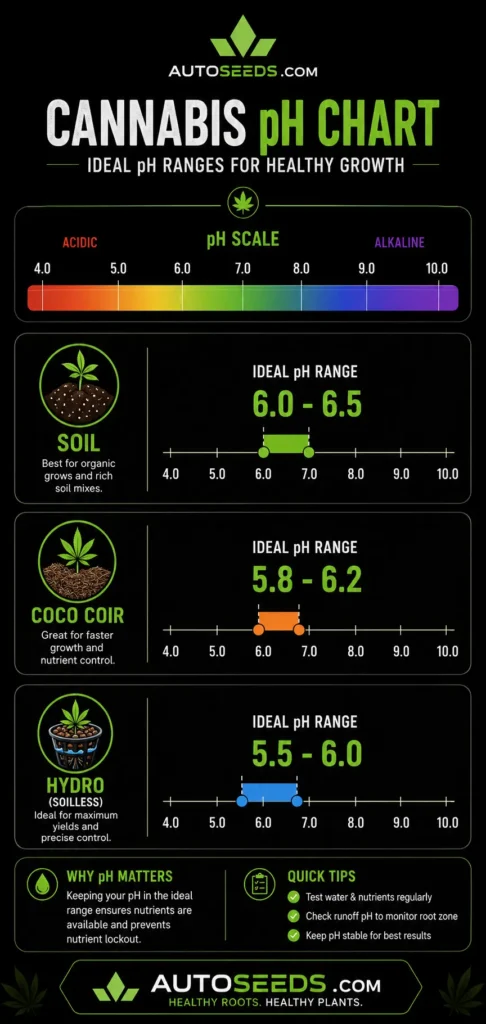
pH imbalance is the leading cause of iron deficiency in autoflower cannabis plants. When pH drifts outside the correct range, iron becomes less available to the roots, even when enough nutrients are already present in the growing medium.
Different grow mediums absorb and release nutrients differently, which is why maintaining the correct pH range is so important for stable nutrient uptake in autoflowers.
| Growing Medium | Recommended pH Range | Why It Matters |
| Soil | 6.0–6.5 | Supports balanced micronutrient uptake |
| Coco Coir | 5.8–6.2 | Helps prevent fast nutrient fluctuations |
| Hydroponics | 5.5–6.0 | Keeps iron and micronutrients available |
When pH rises too high, autoflower cannabis plants struggle to absorb iron efficiently. This is known as nutrient lockout. Many growers assume the plant needs more nutrients, when the real issue is that the roots cannot access the nutrients already present.
I always tell growers that nutrients inside the pot do not matter if the roots cannot absorb them.
Nutrient lockout can also affect multiple nutrients at the same time, which is why pH problems often create several deficiency symptoms together.
| High pH Problem | Common Result |
| Iron becomes less available | Yellow new leaves |
| Micronutrient uptake slows | Pale or weak growth |
| Root absorption weakens | Slower development |
| Nutrient salts accumulate | Increased lockout risk |
Regularly checking both input water and runoff pH helps identify root-zone problems early before deficiencies become severe. For autoflower growers, early detection is especially important because stress during the seedling, vegetative, or pre-flower stage can reduce final plant size and yield potential.
| What to Check | Why It Helps |
| Input pH | Confirms feed is within range |
| Runoff pH | Reveals root-zone imbalance |
| EC or ppm | Detects excess nutrient buildup |
| New growth colour | Shows early nutrient stress |
Stable pH levels create a healthier root environment while also improving nutrient uptake throughout the autoflower grow cycle.
Overwatering, Root Stress, and Poor Oxygen Levels
Overwatering reduces oxygen around the roots, which weakens nutrient uptake and increases stress. Autoflowers are especially vulnerable to overwatering during early growth because young plants often have smaller root systems and cannot use moisture as quickly as larger plants.
Cannabis roots need oxygen to function properly. If the medium stays constantly saturated, roots struggle to absorb nutrients efficiently.
Signs of root stress may include:
- Drooping leaves
- Slow growth
- Wet pots for long periods
- Weak new growth
- Pale upper leaves
I prefer a controlled wet-dry cycle in soil because it improves oxygen movement around the root zone while encouraging stronger root development. With autoflowers, this also helps avoid early stress that can slow growth before flowering begins.
Excess Calcium, Phosphorus, and Mineral Competition
Excess minerals can interfere with iron uptake. High levels of calcium, phosphorus, zinc, or salt buildup may block iron absorption and contribute to nutrient imbalances similar to calcium deficiency in autoflowers.
This often happens when growers overfeed autoflowers, increasing the risk of nutrient lockout and nutrient burn, because autoflowers usually have a shorter grow cycle, nutrient imbalances can appear quickly and leave less time for correction.
Common causes include:
- Excessive bloom boosters
- Heavy Cal-Mag use
- Salt buildup from synthetic nutrients
- Poor runoff management
Autoflower cannabis plants respond better to balanced feeding than aggressive feeding. Sometimes growers try to push autoflowers too hard for bigger yields and accidentally create nutrient lockout.
Environmental Stress and Poor Iron Uptake
Environmental stress can also reduce iron uptake even when nutrient levels appear correct.
Factors that contribute include:
- Cold root temperatures
- Poor airflow
- Compacted soil
- Weak transpiration
- Excessive light stress
Stable environmental conditions help autoflower roots absorb nutrients consistently. Autoflower cannabis plants prefer steady conditions over constant changes, especially during early growth and the transition into flowering.
How to Fix Iron Deficiency in Autoflower Cannabis Fast
Fixing iron deficiency in autoflower cannabis plants requires correcting the root cause while supporting recovery. Because autoflowers have a short life cycle, addressing nutrient problems quickly helps prevent lost growth and reduced yields.
The best approach combines:
- pH correction
- Improved root-zone conditions
- Balanced feeding
- Chelated iron supplementation if needed
Avoid panic-feeding. Adding more nutrients to a plant suffering from nutrient lockout often makes the problem worse.
| Recovery Step | Why It Helps |
| Correct pH levels | Restores iron availability |
| Improve root-zone oxygen | Supports nutrient uptake |
| Reduce overwatering | Prevents root stress |
| Use balanced feeding | Avoids nutrient competition |
| Apply chelated iron if needed | Provides available iron |
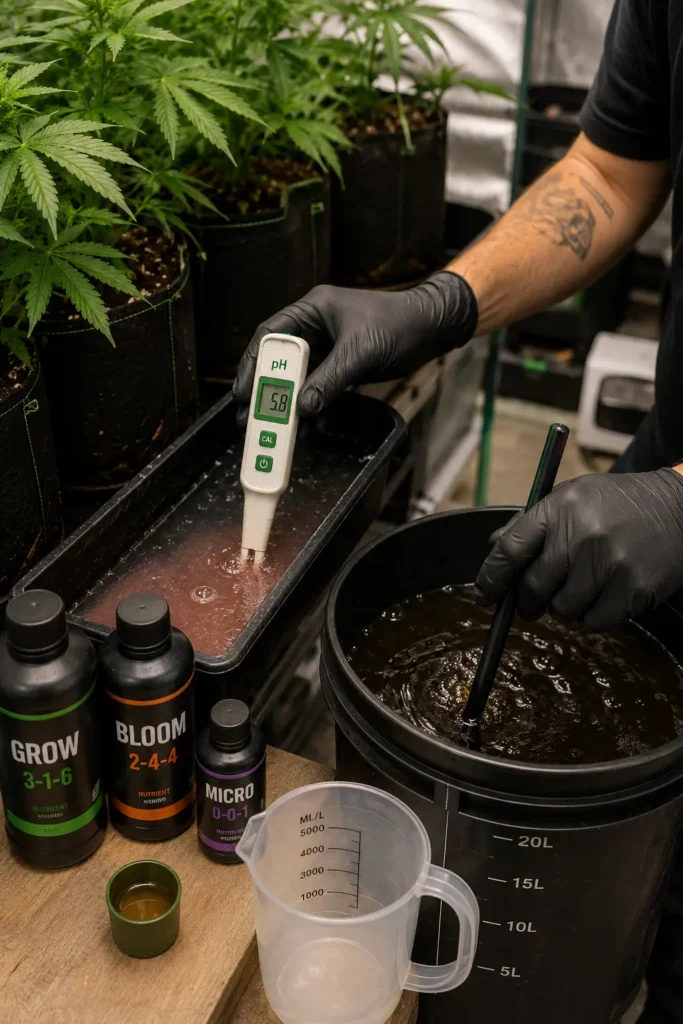
The Fastest Way to Stop Iron Deficiency in Autoflower Cannabis Plants
The fastest way to stop iron deficiency is to restore proper pH and apply chelated iron if symptoms are severe.
My usual recovery process:
- Test runoff pH
- Adjust feed pH
- Improve root-zone oxygen
- Reduce overwatering
- Apply chelated iron if needed
- Monitor new growth
Early intervention is critical for autoflowers because prolonged nutrient stress can reduce plant size and flowering performance.
Correct pH Ranges for Soil, Coco Coir, and Hydroponics
Proper pH management is the foundation of nutrient uptake.
| Growing Medium | Recommended pH Range |
| Soil | 6.0–6.5 |
| Coco Coir | 5.8–6.2 |
| Hydroponics | 5.5–6.0 |
I prefer gradual pH adjustments because sudden changes can stress roots. Monitoring both input water and runoff pH helps identify nutrient lockout before symptoms become severe.
| What to Monitor | Why It Matters |
| Input pH | Confirms feed is in range |
| Runoff pH | Reveals root-zone issues |
| EC or ppm | Detects nutrient buildup |
| New growth colour | Shows recovery progress |
How to Use Chelated Iron Supplements Properly
Chelated iron is easier for cannabis plants to absorb and can help correct deficiencies caused by pH issues or nutrient lockout.
Chelated iron can be applied through:
- Root feeding
- Foliar spraying
When using chelated iron:
- Start with mild doses
- Follow label instructions
- Spray during low-light periods
- Avoid excessive foliar spraying during flower
| Application Method | Main Benefit |
| Root Feeding | Long-term nutrient availability |
| Foliar Spray | Fast nutrient absorption |
Chelated iron works best alongside proper pH management and healthy root conditions.
Foliar Sprays vs Root Feeding for Faster Recovery
Foliar spraying provides faster results because nutrients are absorbed directly through the leaves. Root feeding is slower but offers more stable long-term recovery.
| Method | Best Used When |
| Foliar Spray | Severe symptoms or poor root uptake |
| Root Feeding | Corrected pH and healthy roots |
For autoflowers, foliar sprays can provide short-term relief, but correcting root-zone conditions remains the most important step.
How Long Does It Take Autoflower Cannabis Plants to Recover From Iron Deficiency?
Autoflower cannabis plants often begin showing improvement within several days after the underlying issue is corrected.
Monitor:
- New growth colour
- Growth rate
- Leaf development
- Overall plant vigour
| Recovery Indicator | Healthy Sign |
| New growth colour | Fresh green leaves |
| Growth rate | Consistent development |
| Plant vigour | Upright, healthy posture |
Because autoflowers have a fixed life cycle, recovery time matters. Prolonged iron deficiency can reduce plant size, slow flower development, and lower yields.
| Severity | Typical Recovery Time |
| Mild | Several days |
| Moderate | 1–2 weeks |
| Severe | Multiple weeks |
Old damaged leaves may remain yellow, but healthy green growth at the top of the plant is the clearest sign of recovery.
How Much Iron Do Autoflower Cannabis Plants Need and How Can You Prevent Deficiency?
Autoflower cannabis plants only need iron in small amounts, but they require consistent access to it throughout their short life cycle.
Most quality autoflower nutrient lines already contain enough iron. Preventing deficiency is usually about maintaining the correct root-zone conditions so autoflowers can absorb nutrients efficiently from seedling through harvest.
When growing autoflowers, I focus more on consistency than chasing perfect numbers. Healthy roots, balanced feeding, and stable pH levels help prevent most nutrient deficiencies before they affect growth or yields.
How Much Iron Autoflower Cannabis Plants Need
Autoflower cannabis plants require iron as a trace micronutrient rather than a primary feeding element. Although autoflowers use much smaller amounts of iron than nutrients such as nitrogen or potassium, iron remains essential for chlorophyll production, photosynthesis, and healthy new growth.
In most cases, iron deficiency in autoflowers is caused by nutrient lockout rather than a lack of iron in the feeding schedule. The nutrient is often present within the root zone, but pH fluctuations, root stress, or overwatering can prevent efficient uptake.
| Nutrient | Amount Needed by Cannabis | Main Role in Growth |
| Iron | Trace amounts | Supports chlorophyll and photosynthesis |
| Nitrogen | High | Drives leaf and stem growth |
| Phosphorus | Moderate to high | Supports root and flower development |
| Potassium | High | Regulates nutrient and water movement |
| Calcium | Moderate | Strengthens plant structure |
| Magnesium | Moderate | Supports chlorophyll production |
Excess iron can also contribute to nutrient imbalances within the root zone, which is why adding more nutrients is not always the best solution. Micronutrient deficiencies often occur alongside larger feeding problems, including potassium deficiency in autoflowers.
Why Most Autoflower Nutrients Already Contain Enough Iron
Most commercial autoflower nutrients already include iron as part of their micronutrient package. As a result, true iron shortages are relatively uncommon. If your autoflower plants develop yellow new growth despite using quality nutrients, nutrient lockout is usually the more likely cause.
I always recommend checking pH levels and root health before increasing nutrient strength because most iron deficiencies develop from environmental or root-zone issues rather than a lack of nutrients.
| Common Cause | How It Affects Iron Uptake |
| Incorrect pH | Blocks iron absorption at the roots |
| Salt buildup | Restricts nutrient uptake |
| Root stress | Weakens feeding efficiency |
| Excess minerals | Creates nutrient competition |
| Environmental stress | Slows root activity and transpiration |
In simple terms, your autoflower may already have access to enough iron, but poor root-zone conditions can prevent the plant from using it effectively.
Best Feeding Practices to Prevent Iron Lockout in Autoflowers
Consistent feeding practices help prevent iron lockout and reduce the risk of nutrient deficiencies throughout the autoflower grow cycle. Autoflowers perform best when nutrients, pH, watering habits, and environmental conditions remain stable from start to finish.
I prefer making gradual adjustments instead of aggressive feeding changes because autoflowers generally respond better to a steady routine than sudden corrections.
| Best Practice | Why It Helps |
| Use balanced autoflower nutrients | Prevents nutrient imbalance |
| Avoid unnecessary additives | Reduces salt buildup |
| Monitor pH regularly | Keeps nutrients available to roots |
| Water correctly for your medium | Improves oxygen and nutrient uptake |
| Avoid overfeeding | Prevents excess mineral competition |
| Manage runoff properly | Helps remove excess salts |
Small improvements in feeding routines can have a significant impact over an autoflower’s short life cycle. Monitoring new growth regularly also helps identify early signs of nutrient stress before they affect overall development.
| Grower Tip | Benefit |
| Make gradual feeding adjustments | Reduces root stress |
| Monitor fresh growth regularly | Helps catch issues early |
| Keep feeding schedules consistent | Supports stable nutrient uptake |
| Check runoff periodically | Helps detect lockout early |
Monitoring pH and Runoff to Avoid Future Problems
Monitoring pH and runoff allows autoflower growers to identify nutrient issues before symptoms spread throughout the plant. I pay close attention to new growth because the upper canopy often reveals iron uptake problems early.
Runoff readings provide a clearer picture of root-zone health and can help diagnose issues before visible deficiencies become severe.
| What to Monitor | Why It Matters |
| Input pH | Confirms nutrient solution is in range |
| Runoff pH | Reveals root-zone imbalance |
| EC or ppm | Measures nutrient concentration |
| Pot weight | Helps prevent overwatering |
| New growth colour | Shows early nutrient issues |
| Leaf posture | Indicates plant stress levels |
Healthy new growth is usually the strongest indication that an autoflower’s root zone is functioning properly. If fresh leaves remain green and vigorous, nutrient uptake is generally stable.
| Healthy Signs | Warning Signs |
| Fresh green new growth | Yellow top leaves |
| Upright leaf posture | Drooping or weak leaves |
| Stable growth rate | Slowed development |
| Consistent runoff readings | Large pH swings or salt buildup |
Beginner-Friendly Autoflower Strains That Handle Nutrient Stress Well
Some cannabis strains are naturally more sensitive to nutrient fluctuations than others. If you are a newer grower, beginner-friendly autoflower seeds with stable genetics are often easier to manage when dealing with pH swings or minor feeding mistakes.
Comparison Table
| Strain | Grow Difficulty | Nutrient Sensitivity | Best For |
| Northern Lights Auto | Easy | Low | Beginner indoor grows |
| Gorilla Cookies Auto | Moderate | Medium | High-yield growers |
| Blueberry Auto | Easy | Low | Small grow spaces |
| AK Auto | Easy | Low | Fast flowering cycles |
Conclusion
Iron deficiency in autoflower cannabis plants is one of the easiest nutrient problems to identify once you understand the symptoms. Yellowing new leaves with green veins usually indicate pH imbalance, nutrient lockout, or root-zone stress rather than a true lack of iron in your nutrient solution.
The key to fixing iron deficiency in autoflowers is correcting the growing environment first. Stable pH levels, healthy roots, proper watering practices, and balanced nutrition allow plants to absorb iron efficiently throughout their life cycle. Chelated iron supplements can help speed recovery, but they work best when the underlying cause has already been addressed.
Because autoflowers have a fixed life cycle, early diagnosis is especially important. Nutrient stress during the seedling, vegetative, or pre-flower stage can reduce plant size and limit final yields. Healthy roots, consistent growing conditions, and regular monitoring help prevent most iron deficiencies before they become serious.
When you learn to identify early warning signs and maintain a stable root-zone environment, autoflower cannabis plants become much easier to manage from seedling through harvest.
Frequently Asked Questions About Iron Deficiency in Autoflower Cannabis Plants
What causes iron deficiency in autoflower cannabis plants?
Iron deficiency in autoflower cannabis plants is most commonly caused by incorrect pH levels leading to nutrient lockout rather than a lack of iron in the nutrient solution. Overwatering, poor root health, salt buildup, and environmental stress can also reduce iron uptake.
What does iron deficiency in autoflowers look like?
The most common symptom is yellowing of new leaves while the veins remain green. This pattern, known as interveinal chlorosis, usually appears near the top of the plant because iron is an immobile nutrient.
How do I fix iron deficiency in autoflowers fast?
The fastest way to fix iron deficiency in autoflowers is to correct root-zone pH and improve oxygen availability around the roots. Chelated iron supplements and foliar sprays can help accelerate recovery when symptoms are more advanced.
What pH causes iron lockout in autoflower cannabis plants?
Iron uptake becomes restricted when pH rises above the optimal range. Most autoflower growers achieve the best iron availability around pH 6.0–6.5 in soil and pH 5.5–6.2 in coco coir or hydroponic systems.
Can iron deficiency reduce autoflower yields?
Yes. Untreated iron deficiency can reduce photosynthesis, slow vegetative growth, and weaken overall plant vigour. In autoflowers, this often results in smaller plants, reduced flower production, and lower final yields.
How can I prevent iron deficiency in autoflower cannabis plants?
You can help prevent iron deficiency by maintaining stable pH levels, avoiding overwatering, monitoring runoff regularly, and using balanced autoflower nutrients without excessive additives or salt buildup.